
 I remember reading an article about reverse culture shock, written by an American expat who had been abroad for several years. He finally returned to the States and went to the grocery store. Naturally, that's where it hit him. Things had changed. So many choices. An embarrassment of riches. He expressed a mixture of amazement and delight and vague disgust at a type of rabid consumerism that we generally take for granted.
That's what I see on my horizon. We'll be back in the States in less than two weeks, so I'm doing advance research. Looking at the websites, draft lists and dinner menus of trendy beer bars and restaurants, for example... I'm amazed. Delighted. And vaguely disgusted. So many choices. And it's all so damn precious.
One place that really piques my interest – and I think this is a fair example of the US craft-beer-and-food trend, particularly in larger cities – is the Birch & Barley restaurant in DC, and its attached ChurchKey beer bar. They have a person whose title is beer director. They have pairings. They have foie gras. On the daytime bar menu they have lists of "farmstead cheeses" and charcuterie. The taps are pouring Kölsch from Köln, Alt from Düsseldorf, biere de garde from France, and Scotch-barrel-aged beers from Scotland – and that's just to mention a few.
It's all a bit... much. It's enough to make a yank want to duck into a cheap dive and quietly suck down shakers of Sierra Nevada. Because frankly I would be content to do so.
Or I could be a good soldier, put on a brave face, and attack that Pig's Head Terrine with a becher of Uerige Sticke. You know. Just for courage.
I'm not fooling you, am I?
Tuesday, June 29, 2010
Has American Craft Beer Culture Gone Over the Top?


Monday, June 28, 2010
D.C., Missouri, Wyoming, Oregon: Tell Me Where to Go.
 Our upcoming trip to the States will be a fairly long one encompassing decent chunks of all those places. Finally liberated from intensive Spanish classes that have limited my writing time, I'll be blogging from the road. Where would you send us? If you know any of those areas, what are the must-do's?
Remember that my wife and I are beer geeks who've been abroad for about four years. There are new haunts even in the areas that we (used to) know well. And we are just as likely to hunt interesting food and atmosphere as we are memorable brews.
So if some joint or beer or plate has a special place in your heart, tell me about it. We might just track it down.
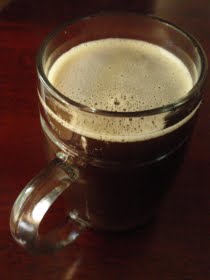
Pictured: the Oscura, a coffeeish dark brown homebrew that was probably the best beer in Costa Rica last week. This week it's a barrel of sessionable, dry-hopped pale ale that happens to be in my fridge. If we have serious competition, I'd like to know about it.
Friday, June 18, 2010
Ingredients Just Fall From Trees Around Here.
 I've been thinking about the cas fruit. It's a zesty little green jobber that falls from Costa Rican trees and starts rotting the second it hits the ground. You have to be quick. But it's worth the effort.
It doesn't travel well, so you won't find it at any of your fancy organic markets or big-city Latin groceries. Or rather, I'd be very surprised if you did. And there are few fruits like it so it's pretty difficult to describe. But essentially it's round, tart and acidic, and very refreshing when made into a soft drink. Fresco de cas (pictured) is a popular item in sodas* across the country. Even though they add sugar. They really shouldn't. In-house experiments with sour cas drinks have proven successful. You don't need a recipe. Just think of a blender full of cas with a splash of water and a squeeze of lime and you've got the idea. A shot of Guaro never hurt anyone either.
Well, it probably has hurt someone. Not me though.
Anyway, as an amatuerish homebrewer who has always found that his favorite beers are basically in line with the Reinheitsgebot, I am naturally looking at the whole world as a basket of possible ingredients. Against my better judgment. And I am thinking that cas fruit could be used in one hell of a sour beer.
Speaking of sour beers: Regarding the Lambic Summit during Philly Beer Week, check out the Mad Fermentationist for a full report.
*Sodas are little roadside and city-block pit stops for soft drinks and snacks. But instead of Coke and Doritos, the tico soft drinks are fresh fruit juices and the tico snacks are empanadas. For example. Theyre called sodas because they don't sell beer, so you'll have to take my word for it: sodas are a good thing.
Tuesday, June 8, 2010
Popular Brussels Haunt About to Open Up a Bit.
 Bier Circus, one of Brussels' top beery destinations, is making a few changes. In theory they should appease the quiet and not-so-quiet grumblings of beer geeks over the years.
According to an e-mail sent to patrons, the restaurant will close from July 1 to 22 for its annual holidays. When it re-opens, it will be a bit less like a restaurant and once again more like a Belgian brasserie. That basically means it will be open throughout the day and that you'll be able to simply have a drink in what has long been the dining-only area. Likewise you can sit at the bar and have a meal if you want. Meanwhile owner Patrick D'hane is scaling the menu down a bit — but just a bit. There will still be hot meals, including the popular meatloaf with Bink cheese sauce. Yum.
The new hours: Saturdays 6 p.m. to 11 p.m., weekdays 11 a.m. to 11 p.m., and still closed Sundays.
The upshot is that traveling beer lovers will be more likely to find the place open, and they won't be shuffled to the bar if they only want to drop some coin on a vintage bottle. Basically good news all around for local enthusiasts and thirsty pilgrims.
Sunday, June 6, 2010
Lambic Chat in Philly.
Someday I'll get to attend Philly Beer Week. Or any Beer Week would be nice really. The whole Beer Week phenomenon is something that has continued to explode in the years we've been abroad. But I can't attend. Not this year. So instead I'd like to live vicariously through any of you with the good fortune and industry to be in Philadelphia this week. And I have an assignment for you. On Wednesday evening, go to the Penn Museum and attend the tasting and discussion with Jean Van Roy of Cantillon, Armand Debelder of Drie Fonteinen, and Frank Boon of, um, Boon. Dan Shelton of the Shelton Brothers will be moderating the talk and keeping it edgy, something I think he does when he's not even trying.
Especially if you've never had the chance to chat with any of those guys, I can promise an enlightening experience.
UPDATE with more details from Kevin Brooks of Shelton Brothers: "The Lambic Summit is this coming Wednesday (June 9) at the University of Pennsylvania Museum of Archaeology & Anthropology in Philadelphia as part of Philly Beer Week. The session will take place in the Lower Egyptian Room in front of a large statue of a sphinx. It will be a converation about lambics featuring Jean Van Roy, Armand Debelder and Frank Boon, moderated by Daniel Shelton. There will be quite a bit of lambic (including some vintage stuff) from the three producers to be tasted. This link says that it costs $60, but the price is being lowered to $50."
Saturday, June 5, 2010
Now Let's Talk About That 3 Percent.
That sliver of market not owned by the monopoly's marketing departments is — for the moment — entirely comprised of imports. That doesn't include familiar faces like Heineken and Corona, handled here by the aforementioned monopoly. It would include Guinness, Leffe, Duvel and Oettinger, which are all becoming more common on supermarket shelves here. Which is not to say that they are widely popular.
Oettinger is really an odd one. I'll have to tell you about that another day.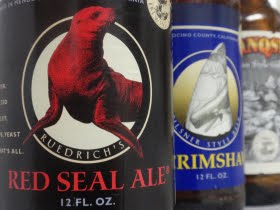 Our first big surprise was finding Sam Adams, brewer and patriot, about a month ago at an upscale supermarket here in Escazú. But that was nothing compared to the most recent discovery — a chunk of North Coast's stable, out of Fort Bragg, California. So far we've seen Scrimshaw Lager, Red Seal Ale and the Belgian-style Pranqster. I saw a shelf tag for the Acme IPA, but no bottle yet. The prices range from the equivalent of $3 to $5 per bottle. We've only found them in one place: the American-owned Fresh Market supermarket in Santa Ana.
What does it all mean? Besides the news that you can stop weeping for hop-starved gringos in paradise, it might say something about the global reach of American craft beer. And we can thank a corporate supermarket chain for daring to smuggle in the contraband.
We are not the only ones who've noticed. North Coast's shelf space was nearly decimated when we found it — and we did our best to clean out the rest — while other pricey ones like Duvel and Leffe looked untouched.
With luck the masters will get the message: Send more contraband.
Friday, June 4, 2010
What Passes for Premium Beer?
A friend of mine recently had the chance to chat with an executive from Cerveceria Costa Rica, the monopoly that runs things around here. My friend said, "So you guys must control about 85 percent of the beer market." And the executive said something like, "Ho ho ho, it's more like 97 percent. Our marketing departments are in fierce competition only with each other."
True story. And it says all you need to know about the flavor of their products. Honest question: What is a "premium beer"? Cynical answer: It is a way to package inoffensive lager at a higher price point. And that says all you need to know about Bavaria 1460.
Among the desperate few who've bothered to taste all the lagers here, this one is usually considered the best of a poor lot. It does have a gorgeous copper color. It does have an impressive label, and I've never seen it in cans (another sign that it is "premium"). There is a certain delicate malt backbone and lightly bitter bite to it... But you can say the same for any of the others, if you pay attention.
So this is what you might drink here, if you had to choose among the products of the various CCR marketing departments. But I'm painting a very sad and desperate picture. What we really want to talk about (don't we?) is that other 3 percent — which is suddenly getting a lot more interesting around here.
I'm seeing tiny wedges in the cracks, and diminutive feet in the doors, of the Costa Rican beer landscape. Which will serve as well as any other for an ongoing case study in the global reach of craft beer.
Wednesday, May 26, 2010
Experimenting With Cacao.
 What you see in the photo is the inside of a cacao fruit. To me it's a bit gross, like something from H.R. Giger. But it smells nice enough.
Here in Costa Rica you can buy this fruit in the supermarket, or local farmer's market, or pick them from the trees if you know where to look. Possibly you can find them in fancy big-city markets in the States or Europe these days, I'm not sure. I do know this: Through one of our favorite processes — fermentation — those seeds can become cocoa nibs. And those can be used to make chocolate. Or drinks that include chocolate. Including beer.
That's pretty much our project in this case. We plan to mature our own cocoa nibs to make chocolate, or steep them in a home-brewed stout — let's call it dry-nibbing.
Unfortunately it's not very clear how to conduct that fermentation process in your own home. There are plenty of sites like this one that advertise cocoa nibs — already fermented — which you can buy and use to make chocolate "from scratch." Except it's not really from scratch. A lot of the hard work was already done in the jungle.
Basically, farmers put the cacao seeds — sweet-smelling, fruity pulp and all — into wooden crates lined with banana leaves and leave them there for as long as a week. There may be some stirring involved. Meanwhile there are unseen, natural critters at work, transforming the seeds from something that tastes like potatoes (trust me on that one) into something that vaguely resembles dark, bitter chocolate.
Somehow — call it homebrewer's intuition — I think that the wooden crates and banana leaves are not exactly necessary. Unfortunately I can't seem to find a lot of information on this, and we're left with the opportunity to experiment on our own. Which is not all bad. Our first attempt resulted in sweet-smelling nibs that still tasted like potatoes. But there are more attempts to come.
Anyway: After we've done a bit more research, and toying around, look for a post titled "How to Ferment Cocoa Nibs at Home, and How Much to Drop Into Your Stout." Or something like that.
Tuesday, May 25, 2010
Of Middling Soccer and Great Thirst.
Nearly four years ago, I was in the nosebleeds in Gelsenkirchen watching the USA get shellacked by the Czech Republic, 3-0. I was shunning the Budweiser not for any high-minded principles, but because the line was too long. So much for the Germans boycotting the King of Beers as sponsor in their own homeland. Let's be honest: At a momentous event like the World Cup, you will drink whatever is handy. As long as it's handy. Not too many beers are handy here in Costa Rica. But the San Jose suburb of Escazú, home to many well-heeled foreigners, seems to have more handy than the rest of the country. In particular, the best selection we have found — such as it is — is at a gringo-run sports pub called the Time Out Tavern. There one can find Duvel and Guinness among a wide variety of international lagers. And there one can also find Sam Adams. Which naturally we appreciate like never before.
Tonight we'll be at the Time Out, watching the USA play Czech Republic for the first time since my heart and many others were broken in Germany. It's just a friendly, but it's also a World Cup tune-up. And a chance for comeuppance. And Sam Adams, brewer and patriot, will be handy. So it's not meaningless.
There is no sign saying "Time Out" in front of the pub. The painted wall flags down knowing gringos in plain English. Want to find it? Look about 300 meters uphill from the Costa Rica Country Club. That's what passes for an address in these parts.
Sunday, May 16, 2010
We're All Waiting for the Malt.
 I'm sitting here in the lobby of the Hotel Tilawa on scenic Lake Arenal.
There's a three-barrel brewing system here that needs some spit and polish, and a broom to knock out those spider webs, but otherwise it's ready to roll. The hops are in the cooler. So is the yeast. A brewer has joined the outfit and is trying to keep busy.
All they need is the malt.
At the moment there are about 5,000 pounds of the stuff sitting in Canada. It's several weeks late now. Through no fault of its own, customs officials have decided the malt's paperwork is not altogether complete. Which is not the same as explaining exactly what paperwork is required. Bureaucracy is fun. Two governments that make an art of it are Canada and Costa Rica.
Anyway, I just wanted to say hello. There's a lot more to tell about Volcano Brew, and about another upstart on the Pacific Coast. That one is waiting on the malt too. Until it shows up, there are exactly zero microbreweries in Costa Rica. Stay tuned.

 Posts
Posts


