
 It's a bit of a shit photo, but it should give you an idea of the best sort of beer selection you can hope to find in Costa Rica or Panamá, which are probably a half-step ahead of the rest of Central America. A few international lagers, with the Japanese well represented. Sam Adams. Paulaner Hefeweizen and/or Helles. Leffe and/or Duvel. Bottled Guinness "Draft" as well as the mighty Foreign Extra.* North Coast beers are possible but sort of a rare bird. Distributors are notoriously flaky too, so rarely will everything be available at one time.
Most notable would the Libertas and Segua, upper left corner, from Costa Rica's Craft Brewing Co. Drink local, right?
This particular fridge is at Los Amigos in Jaco, right on the Pacific Coast and about an hour from San José (that is, it takes an hour unless weather, landslides or construction work shut the autopista). Popular spot with tourists and expats of all stripes -- families, fishermen, surfers, gamblers and whoremongers. I call it a gringo bar. Gringo bars often have better beer selections, catering to those with the hankering and cash for something besides Imperial. They often have better food as well (that imported U.S. ribeye was a thing of beauty). Just the remedy for a Yank expat tired of lean, chewy, grass-fed Brahman beef.
Another great gringo bar, with probably the best beer list in the country: Time Out Tavern in Escazú. And another: El Estribo in Santa Anna. Sportsmens Lodge in downtown San José. Most of them are also sports bars. And there are plenty more, here and there.
Rumors: I've heard about another guerrilla brewer in Guanacaste, brewing, bottling and selling his own to locals. That's makes at least three of them that I've heard about. They appear to be popping up spontaneously, with little or no communication among them. If nano-brewing falls somewhere between home- and micro-, then I think these guys are in that nebulous space between home- and nano-. Basically: They're homebrewers who are selling it because (a) people like it, and (b) they can get away with it. People want something different, they're willing to pay for it, and the authorities surely have better things to do than come around and ask for permits. Especially from someone brewing just 10 or 15 gallons at a time.
I'm trying to learn more, but what they're doing is not technically legal. My fear is that sharing the details could send the wrong sort of attention their way and shut them down.
Still... There's definitely a story there.
*So far, no true draft Guinness has appeared in Costa Rica, to the best of my knowledge. Might be just a matter of time.
Friday, June 3, 2011
Craft Beer in Gringo Bars.


Friday, May 6, 2011
Munch. Sip. Munch. Sip. Scribble.
The great communal beer-and-cheese experience... OK, I thought about sitting this one out. I mean, come on man, I live in Central America. To vastly understate the problem, Cypress Grove Humboldt Fog is a little hard to come by. In fact the cheese situation is eerily similar to the beer situation: bland and dominated by a national quasi-monopoly.
Fine. So maybe I go with the local stuff, right? Nah. Like the lagers, the local cheeses are generally bland, artificially expensive for what they are, and nothing you'd want to seek out. So scratch the idea of a tasting of tico beers and cheeses. We can do better.
Just like there are a few imported beers available, there are a few imported cheeses. Most of the imports are widely available in the U.S. or Europe, or at least similar to products that are widely available. So what's the use in that, I thought? Actually, there's a lot of use in that. Some semi-hard, mild Dutch goat cheese, some aged Spanish Adarga de Oro, and Roquefort. Also some generic cheddar and Danish blue thrown in for fun. Paulaner Hefeweizen, North Coast Acme Pale Ale, and Guinness Foreign Extra Stout. Not only are they fairly widely available internationally, as far as non-lagers go, but they also happen to be archetypes. So we should be able extrapolate and draw out a tip or two that would be useful to anyone, anywhere a few decent beers and cheeses are available.
So that's the rationale behind the main players. My wife and I took some time tonight to mix and match. Here's what we learned--most of which we already knew, in retrospect, but the data are no less valuable for having been confirmed:
Hefeweizen is a slut. She'll hook up with any old cheese and be happy doing it. It's odd, because normally you don't even give her a second glance. You see her around and take her for granted. But take her out for a meal and she shines. She smells nice. Appetizing, even. She has a knack for bringing out the fruity acidity in certain cheeses (oops, lost the metaphor), which is a really interesting thing to notice in cheese when you can manage it. She also lacks bitterness, too much of which can frustrate the munch-sip-munch-sip experience.
Unexpected: The Paulaner Hefeweizen even got along well with the mighty Roquefort, thanks to that carbonation that cleans up after the cheese and resets the palate. Meanwhile the smooth saltiness of the cheese does a brief two-step with the sweet clove notes in the beer.
Best pairing: the Hefeweizen with the Adarga de Oro, which has an interesting toasted-crusty-bread quality beneath the milk, salt, nuts and acidity. That bready quality draws out the beer's wheat flavor. Time to remember that it all comes from grasses... Wheat, barley, milk. The Adarga, by the way, is made from a blend of cow, sheep and goat milk. Thanks, Internet!
Sad`news: The Acme Pale Ale, bought from a local upmarket grocery store, is totally oxidized. Past its prime. Such a same. Such a waste. Still goes OK with the generic cheddar, but... sad. Smells like a well-aged barley wine. Except that it isn't one.
Late pinch-hitter: some fresh, homebrewed hoppy extra pale. The citrus aroma and dry finish draws out the Spanish's cheeses fruity acidity. That Adarga is versatile with beer and doesn't put a foot wrong on its own. Hard to stop eating it. Find some if you can.
The bruisers: The blue cheeses with Guinness Foreign Extra... not for the faint of heart. The beer's serious bitterness and the cheeses' stank sets up a challenging perimeter to penetrate. Buried deep in that charred bracken somewhere, the saltiness via contrast draws out that bit of sweetness in the beer. But then the lingering bitterness covers it up again.
I was afraid of this: The Foreign Extra is a manly drink. It's challenging in the way of a cigar or glass of whiskey. It demands charred meat. It has little patience for your metrosexual cheese party. A grilled bacon cheeseburger though? Yes please. Throw the Roquefort on there too. Don't hold back.
Big winners: The Hefeweizen and the Adarga. Together they were far greater than the sum of their parts, but they were also able to lift the other players and make them better.
Conclusion: Hefweizen and anything, but especially Hefeweizen and aged Spanish cheese like Adarga de Oro or Manchego. Give it a try.
You know, I once had a thing for a Spanish exchange student. She fell for a German guy. Go figure. I wonder if they're still together?
Friday, September 24, 2010
The Top 5 Beers You Can Find in a Place Like Costa Rica, Not Counting Homebrew.
 This might be useful for those who live here or come to visit. (A lot of people come to visit.) It also might be mildly interesting to anyone who likes hypotheticals. If I were stuck there, what would I drink?
Let me know if you're surprised at what's available here. I know I have been. Keep in mind that only a very tiny sliver of the population drinks any of these beers. Most of that tiny sliver, I'd wager, corresponds to a small percentage of expats. Nearly everyone else is brand-loyal to a product of Florida Ice and Farm, a.k.a. Cerveceria Costa Rica. That means Imperial, Pilsen, Bavaria, Rock Ice, and even Heineken.
My Top 5:
5. Duvel. One of the most overrated beers in history is still pretty good. Physically gorgeous and packed with flavor. Sadly the flavor often becomes downright unpleasant halfway through the glass. Too much alcohol heat to be really drinkable, IMO. But some people go for that. Usual supermarket price: $4.50 for 33 cl.
4. Paulaner Hefeweizen. Just edges out Paulaner Munchner Hell for its surprising compatibility with local food. Think banana-and-clove aroma with fried plantains and gallo pinto with sour cream. Yum. Also works just fine in hot weather. Price: $5 for 50 cl.
3. Samuel Adams Boston Lager. American geeks who turn down their noses at this modern classic need to spend a few weeks in the tropics and then taste it again. It has plenty of character and yet is light enough for the climate. Bonus points for being below 5% abv. Price: $4.50 for 12 oz.
2. North Coast Acme Pale Ale. Only found at the Fresh Market chain, as far as I know. Previously it also carried Red Seal Ale, Scrimshaw Lager, and Pranqster Belgian Ale, but I haven't seen them there lately. Haven't seen Old Rasputin yet, unfortunately. These are the only genuine American craft beers I've seen in Costa Rica (unless you count Sam). Price $4.50 for 12 oz.
1. Guinness Foreign Extra. The most flavorful beer in the Caribbean is likewise in Costa Rica. Just drinkable enough to be dangerous at 7.5% abv. Really nice with parrillada, or anything with grill marks. As far as I'm concerned it has nothing to do with that creamy, gorgeous, bland stuff that comes from the nitro taps. Which are impossible to find here anyway. Price: $3.50 for 12 oz.
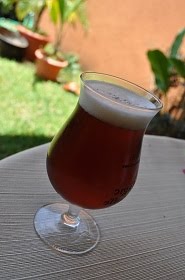
Pictured: a friend's homebrew, an extract recipe from a ready-made kit, that I'd place above any of these five.
Saturday, June 5, 2010
Now Let's Talk About That 3 Percent.
That sliver of market not owned by the monopoly's marketing departments is — for the moment — entirely comprised of imports. That doesn't include familiar faces like Heineken and Corona, handled here by the aforementioned monopoly. It would include Guinness, Leffe, Duvel and Oettinger, which are all becoming more common on supermarket shelves here. Which is not to say that they are widely popular.
Oettinger is really an odd one. I'll have to tell you about that another day.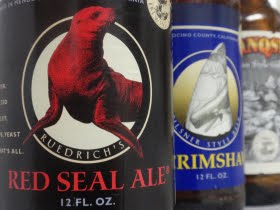 Our first big surprise was finding Sam Adams, brewer and patriot, about a month ago at an upscale supermarket here in Escazú. But that was nothing compared to the most recent discovery — a chunk of North Coast's stable, out of Fort Bragg, California. So far we've seen Scrimshaw Lager, Red Seal Ale and the Belgian-style Pranqster. I saw a shelf tag for the Acme IPA, but no bottle yet. The prices range from the equivalent of $3 to $5 per bottle. We've only found them in one place: the American-owned Fresh Market supermarket in Santa Ana.
What does it all mean? Besides the news that you can stop weeping for hop-starved gringos in paradise, it might say something about the global reach of American craft beer. And we can thank a corporate supermarket chain for daring to smuggle in the contraband.
We are not the only ones who've noticed. North Coast's shelf space was nearly decimated when we found it — and we did our best to clean out the rest — while other pricey ones like Duvel and Leffe looked untouched.
With luck the masters will get the message: Send more contraband.


 Posts
Posts


