
Yesterday I spoke for a while with Mike Stevens, CEO of Founders Brewing, for an upcoming article in Draft. While I had him on the horn, there was something else I wanted to know about: the All-Day IPA.
When I first met this beer in 2011 at the Great Taste of the Midwest, there was an iffy, experimental air about it. It was a brewers' beer, one they had been tweaking and enjoying for a few years, and I don't think they knew if it would really take off with a public making noise for Kentucky Breakfast Stouts and the like. On this blog I've banged the session-beer drum, mainly for selfish reasons (i.e., I want to see more of them). But aside from a few cranky writers there has not been much evidence of any wider session beer trend. Most of the buzz and attention has gone, and still goes, to stronger, more extreme beers or those with weird stuff in them.
 Session beers are not sexy. But maybe that's the point.
My argument has been that there appears to be money in lower-alcohol beers, if anyone cares to make it. The country's best-selling beers are light lagers that hover around 4.2%. Granted, they're devoid of character, but they do say something about what people find useful. More to the point of flavorful beer--as session beers ought to be--is the popularity of wheat beers in North America. Boulevard Wheat (4.4%) and Widmer Hefeweizen (4.7%) have paid a lot of bills. Is it because they're made with wheat? Or maybe it's the lemon!
Or maybe people are just, I don't know, fucking thirsty.
Now we're seeing more session-strength hoppy ales. Founders All-Day IPA is one of the more visible ones. So, two years later, how is it doing?
"It's killing it," Steven said. "It honestly is. ... We knew we had something great there, we knew we'd have positive results, but we didn't expect the results we're seeing."
 Partly by design, Founders goes for variety and lacks an obvious flagship. Meanwhile All-Day IPA is on its way to becoming the brewery's top seller.
Not bad for a "seasonal." For now the beer is only available from March to September. It was the brewery's second-biggest seller in the year's first quarter... and it was only available in March.
"We can't make enough of it right now. It's crazy," Stevens said. Canned 12-packs of it will arrive in July.
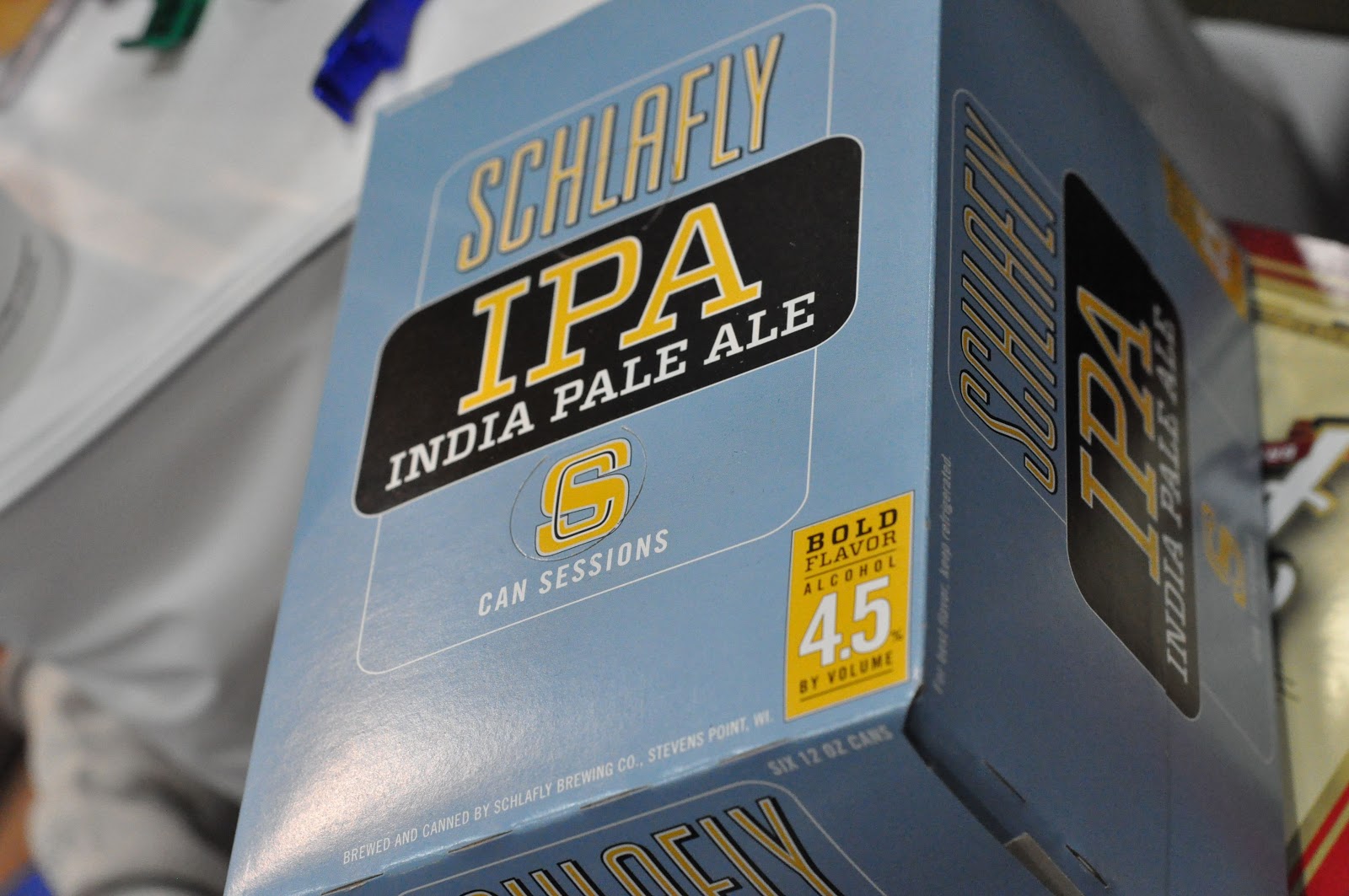
(And let's watch what happens with Schlafly's new IPA, available in cans and clocking in at 4.5%. I bet it sells very well. Without lemons.)
All this happens while Founders is in the midst of a $25 million brewery expansion. It sold 70,000 U.S. beer barrels last year and estimates 130,000 this year, as the brewery expands its distribution footprint. A session beer is part of that success.
Funny how that seems to happen when brewers sell beers that they particularly like to drink. People who work with beer tend to--shocking, I know--drink it often. There is utility in reasonable strength.
"It gets more and more difficult to do these all-day promos, so a session beer was sounding really good," Stevens said.
My crazy-insane theory: a beer that is useful for a brewer tends to be useful to other working people too... and those may be the drinkers who, aside from a few cranky writers, make the least noise.
Tuesday, April 16, 2013
'All-Day' Beers and Usefulness as a Useful Standard.


Monday, January 30, 2012
More Ruminations on Midwestern Style, Such As It Is.
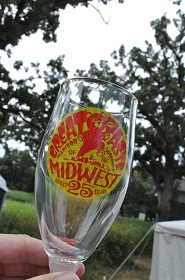
I went to the 25th annual Great Taste of the Midwest last August searching for "somewhereness" in the beers there. I'm a Midwesterner myself, originally, and I wanted to know if there was anything that sets the region's beers and brewers apart from the rest of the world.
Part of that search resulted in an article in the latest All About Beer magazine, including some fun stuff from New Glarus co-owner and brewmaster Dan Carey. The article's not on the website so look for it wherever the finest magazines are sold. Or subscribe here.
Like most kids growing up, I didn't think my hometown or even my region had any culture to speak of. But, as often happens, I moved away and looked back. Then I saw it pretty clearly.
 Tom Griffin is another Midwesterner with perspective. He lives in Madison and is a longtime member of the Madison Homebrewers and Tasters Guild, which organizes the Great Taste. But he's originally from Florida and recently has become known as the “Barrel Guy” (more on that story here). Griffin has traveled tens of thousands of miles selling used whiskey barrels to brewers, facilitating the barrel-aging phenomenon almost single-handedly. If you've tasted a barrel-aged beer from any brewery around the country, there's a pretty good chance that Griffin sold them the barrel.
For his part, Griffin says the secret to Midwestern beers may lie in the friendly, open communication among brewers. He said he's seen plenty of that same cooperative spirit on the West Coast—and noted that many of those brewers, including Firestone Walker's Matt Brynildson, are originally from the Midwest. And what about Fritz Maytag, often thanked for fathering modern craft beer when he revived Anchor in San Francisco? Yep. He's from Iowa.
“Our culture here has become beautiful,” Griffin said, “and it is infused by the way that people talk to each other.” As far as the beers, he said, “we're very much into balance. ... That sense of balance, between the malt and the hops, we have that here.” Even the hoppier Midwestern beers tend to be “more approachable, less abrasive on the tongue,” Griffin said. “Why does beer have to be challenging? It should have grace and balance.”
What story do the beers tell? To be fair, not all of what I tasted that fine Saturday at the Great Taste could described as "balanced." However, trying to go for a mix of the weird and not-so-weird, I found that the most impressive beers were indeed on the “everyday” end of the spectrum. I tasted several excellent, flavorful lagers loaded with grainy, hoppy, country character. I tasted a series of session-strength pale ales with big hop aromas but nonetheless subdued bitterness—a bitterness that nods and says “howdy” but doesn't caulk your tongue with resin.
One of my favorite examples that day: a crisp, aromatic pale ale from Dave's Brewfarm that weighed in at 3.7% alcohol. Its name: Imperial Double. So maybe there's also something to be said, as well, for the Midwestern sense of humor.
“Brewers are just lazy,” said Dave Anderson, brewer and owner of the wind-powered farmhouse brewery in Wilson, Wisc. At the Great Taste he wore a wide-brimmed straw hat and a name tag that said, “Farmer Dave.”
“It's imperial this, double that. I mean, really?”
A few days before the Great Taste, some words on the Madison Beer Review website caught my attention. Site editor Jeffrey Glazer said that “the Midwest is often dismissed as the 'red-headed stepchild' of the beer industry—good, occasionally great, but often boring.”
The dirty little secret, he said, “is that our 'boring' beer is far better, on average, than the 'boring' beer made by every brewery in the known universe.”
So I hunted Glazer down at the Great Taste and got some more out of him.
"While it might be great to have a sour beer, an IPA, whatever, we're really looking for something we can buy a 12-pack of, or the case that we can keep in the garage," he said. "We throw that in the garage, and that's what we drink.
"What we're really looking for something that we can drink every single day, because that's when we're doing to drink it."
So is there anything to this? Does Midwestern beer find its sense of style in the balanced, in the drinkable? There is plenty of anecdotal evidence, for whatever that's worth. As I mentioned in the article, the region's top craft sellers include beers like Boulevard Unfiltered Wheat, Goose Island Honker's Ale and New Glarus Spotted Cow.
Another anecdotal example, off the top of my head: Steve Crider of 2nd Shift in New Haven, Mo., is a wizard with hops and his IPAs are among the best I've smelled and tasted. But his smooth Hibiscus Wit is the one that sells like mad.
On the other hand: More than anywhere else, the West Coast has carved out a beer identity with its hop-forward IPAs—which many people I spoke to described as "unbalanced." Comparisons are inevitable; quite possibly, easterners and southerners would describe their own beers as "balanced" and "drinkable" in comparison.
In thinking about the beers I tasted that day, I can remember a few that I thought had some "sense of place" without even checking my notes. There was the Moon Man No-Coast Pale Ale from New Glarus, for its balance and its name. (On the other hand, it is difficult to avoid thoughts of terroir with the brewery that advises us to "drink indigenous.") The Founders All-Day IPA hit a similar sweet spot. There was the Hopfenstange Pils from Delafield Brewhaus, one of many grainy and well-hopped lagers at the festival. Lots of potential in that vein.
Painting with broad strokes: Clean beers, pale, in which the bitterness is restrained so that one can taste the grains, but with the hops often making a comeback in the flavor and aroma. They are, in short, the sorts of beers that I especially like to drink. Which proves absolutely nothing, except that I'm looking forward to more field testing when I go home this summer, and every time I go home.

 Posts
Posts


