
"EXPERIENCE THE WIDE VARIETY OF BELGIAN BEERS," trumpets the headline atop the beer selection on the Belgian Beer Café's website. It would be a joke, if it were funny.
Maybe you've heard the news that Belgium-based Anheuser-Busch InBev aims to open a chain of 60 or so Belgian Beer Cafés in the United States, besides 55 already open in other countries. If there is any justice in this world, this cynical attempt to profit on Belgian beer's ever-growing cachet in America will fail spectacularly.
Oh, go on and defend it if you want. Go ahead and say that bringing the Trappist ales Westmalle and Chimay to more people who may never have tasted them can't be all bad. To that I would say: OK, but did you see the other 40-odd beers on the sample list? They are a better primer than I could have written myself on the over-sweetened, over-spiced, over-boozed or otherwise just plain insipid direction of most Belgian "special beer" makers. Twist my arm and I might start naming names.
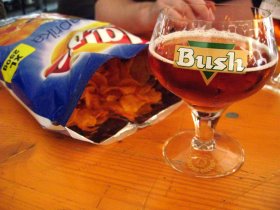 "Special beer," by the way, is Belgium's phrase for "not lager." It has nothing to do with quality and everything to do with the leftover scraps of yet another pils-loving national market. But why be content with scraps when you can sell your sweetened concoctions to much larger markets abroad, add a charming accent to your sales pitch, some stemmed glassware, and a bit of snob appeal? When we are talking about markets in North America and Asia and beyond, the scale becomes immense. He with the biggest production capacity wins, period.
When the Belgian Brewers Guild, a.k.a. the "Beer Paradise" Marketing Campaign Inc., puts on costumes every year and anoints certain people Knights of the Mashstaff, they are usually honoring folks who have helped promote "special beer" exports. In many cases, those exports are said to be the only thing keeping some of these "smaller" breweries alive. A closer look reveals a couple of things: Some of those breweries are not so small, in the Belgian scheme of things. Others should have had the plug pulled on them long ago, but for Americans curious about Belgian beers in general and often enticed by anything with high alcohol and an exotic name.
If only that beer list were just plain old mainstream. If they were just 60 Stella Artois bars I wouldn't have raised an eyebrow. But it's worse than mainstream. That beer selection features some of Belgium's sweetest cough syrups and parades them as "local beers." Essentially A-B InBev has partnered with just a few of Belgium's not-so-small breweries to ensure that the beer list provides a wide range of colors--all of this from a shameless caricature of Belgian culture and atmosphere replicated 100 times over. It's a cookie-cutter for industrial speculoos.
I suspect that most beer aficionados will see through it. It's everyone else I worry about, those hapless folks excited about trying Belgian beer for the first time, because they've heard so much about it. Will Mommy pull the trigger on a Floris Mango? Will wine-loving Dad order a Belle Vue "Gueuze" after reading something about lambic in the New York Times? No doubt much Kwak will be sold on the merits of the glassware alone.
My main fear, I suppose, is that clumsy A-B InBev is going to capitalize on Belgian beer's reputation and flush it rapidly down the toilet. You think my fear is exaggerated? If this thing really takes off, let's take the temperature in a few years and see if Belgian beer is as "cool" as it used to be.
The Belgian thing would be to laugh this off. So why do I feel like weeping?
Wednesday, September 21, 2011
Belgium's Worst. Inquire Now About Franchising!


Tuesday, September 13, 2011
Costa Rica's Craft Nets Silver in Chile.
Not bad for a brewery that's barely nine months old.
Costa Rica's Craft Brewing Company is maxing out its brewhouse and selling every drop it makes. The beer is now available in 8o-odd bars and restaurants across the country, with a waiting list of would-be clients who are ready for the brewery to add more capacity (i.e. fermenters). The early success says at least as much about the locals' thirst for something different as it does for the quality of the beers. About that quality: An international jury in Chile thought highly of it (a jury that included Matt Brynildson of Firestone Walker and beer writer Jay Brooks, among others). At the Copa Cervezas de America, CRCB just won a silver for Segua, its hoppy red ale. Congratulations are due to brewmaster C.S. Derrick and the brewery team.
The four gold medal winners: Augustijn Blonde from Belgium's Van Steenberge, the Weizenbier from Brazil's Cervejaria Bamberg, Holland's La Trappe Dubbel, and the Stout from Chile's own Cuello Negro. Augustijn also won the Best Beer award, while Cervejaria Bamberg won Best Brewery.
Besides Van Steenberge, other Belgian breweries to take home medals included Bosteels, St. Bernardus and Brunehaut. Scotland's Brew Dog won a silver for its Hardcore IPA.
Also interesting: The organizers based the beer categories on the standard BJCP guidelines, but they also added a few subcategories: Patagonian Pale, Patagonian Amber, and Patagonian Brown.
The contest's entries and awards were mainly dominated by South American breweries, although a few from elsewhere participated. The organizers billed it as "Latin America's most important beer competition," although this was a first-time event. Regardless, the award for Segua makes a sort of statement for Costa Rica and more broadly for Central America, a region that is generally forgotten amid discussions about craft beer or cerveza artesenal in Latin America.

 Posts
Posts


