
Where you might like to be this weekend, given your proverbial druthers: the Alvinne Craft Beer Festival, at Brouwerij Alvinne in Moen. For pleasure and for learning. Many of the selections on the list were carefully engineered not only to please the taste buds but also to raise eyebrows. And there is much to be said for that. On the other hand, you've also got a range of fairly reasonable cask ales coming down from the U.K. To rehydrate, or to reset the palate perhaps.
If you don't like the alphabet (and who does?), one way to organize these beers could be alcohol content. In that respect, Struise provides both bookends. At the high end, it brings along what was once a blonde ale before being concentrated by fractional freezing. Now, what is it? Barley wine? Liqueur? Who cares? It's 25 percent alcohol and called 5 Squared. If I were there, I might roll my eyes right before getting in line to taste it.
Then, on the other end of the spectrum, the Struise Single Black. That's "bob" stout of 2 percent strength, for designated drivers. In one place I saw this promoted as a "ridicule" stout. I'm not clear whether that was clunky English or a response from Struise toward those who would ask them for lower-strength beers. Either way, I'd be game to try it.
That reminds me: I posted an updated link to Paul Briggs' studious beer festival calendar a couple of weeks ago. Out of love. On Valentine's Day. You can find it here. Plan holidays accordingly.
Also, here's a bit of info from Chuck Cook on a newish and small brewery in Hoeselt, called Toetëlèr. Its flagship, of the same name of the brewery, is a Witbier flavored with elderflowers. They are doing other experiments.
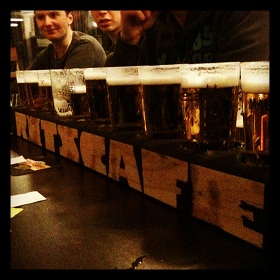 Last but not least: I've got a handful of excellent newish places in Brussels I've been meaning to tell you about. I'm going to ration them out like treats. So here is the Rits Café at Rue Antoine Dansaert 70, a five-minute walk from the Bourse. Local aficionado Steven Vermeylen has become something of a beer curator there. (He helps to organize the always fun Vilvordia Bierproeffestival, which is coming up on March 24.)
At Rits, there are a few commercial beers but featured breweries also include Cantillon, Senne and De Ryck. Vermeylen says that storage is an issue so the list is always changing, but soon he will add another list, the "master's choice, with a dozen rare Belgian and foreign beers." He calls it his "playground," and it promises further fun and education for the beverage-inclined.
*Photo by Lena Van Goethem.
Thursday, March 1, 2012
More Educational Hedonism in Belgium.


Friday, September 30, 2011
Lots More on Beer and Terroir.
Just to catch you up:
Remember that Washington Post article on "Belgium's upstart innovators"? I know, this is the third time I've brought it up. But it's where the conversation started, thanks to the quote from Wendy Littlefield of Vanberg & Dewulf.
She said that brewers like Alvinne and Struise are "really, arguably, are hurting the very culture that they claim to be arising out of."
Hang on, I thought. Now that is interesting. Not sure if I agree -- and it's worth noting that Littlefield says the quote was out of context -- but it's interesting nonetheless. So Littlefield and I struck up an email exchange on things like tradition and sense of place in light of brewers like Alvinne, Struise, Mikkeller, and others. I referred to them as part of a postmodern, transnational craft beer scene. (Insert "absolute elite" jab here.)
 Meanwhile the Pour Curator published an interview with V&D's Don Feinberg. Part of what he said: "There are a couple brewers in Belgium who are making beer for Americans. We’re interested in Belgium, we’re interested in their traditions ... There are certain flavors that are true to a type of culture, and if you don’t believe that, you’re one step away from making soda."
Are you with me so far?
Good. Because I have some more thoughtful stuff from Feinberg and Littlefield. It takes the form of an essay defending the idea of terroir in beer. Here is Wendy to introduce it:
I promised to send Joe more thoughts on the topic of what we think a good and true Belgian beer is – or is not. Don and I talked a bit – then Don left the room and wrote the essay that follows ….at the end of July – What with our with our crazy schedules and a little wrangling about whether it should appear under both our names or just his - I am only now getting around to sending it to Joe and posting it on our blog. So what constitutes terroir in the beer world?
We commend you to the writings of Stan Hieronymous ... He has given the topic a good deal of thought.
Full disclosure: We founded Brewery Ommegang –producing Belgian style beers made in America on a former hops farm. We certainly thought they had terroir – but then again….an argument can be made to the contrary. What do you think?It is clear enough in the essay that terroir for Feinberg is much broader than dirt and rocks and weather. There is a sense of identity and taste from a particular place.
A great Saison made in Denmark is beer without a home, an orphan, a delicious flavor without roots, trapped in a glass. So is an IPA made in Belgium, or an Belgian Triple made in California.So how does a brewery find its terroir?
There may be other ways to create a discernable [sic] character that sets a beer apart and above others but to me the surest way is the house character that comes only from the combination of water, climate, brewery configuration and 1 yeast strain. This character, without exception, limits the styles the brewery can produce. But, when used successfully, it also means brewery X can produce one style of beer better than other breweries. It is why so many European breweries typically specialize and brew only one style, lambic, weizen, abbey etc.For lots more discussion fodder, here is the complete essay.
The floor is yours. And if any of you blogger types decide to riff on this elsewhere, please post a link in the comments if you don't mind.
Thursday, July 28, 2011
Riffing on Beer Terroir, Scents of Place, and Belgian Upstarts.
This whole beer terroir chatter has the smell of a dog who's not going to leave my porch for a while. So I'm just going to keep feeding him. We'll see what he adds to the family.
Confluence, that's what's going on here. Lots of the people talking about the same thing and not even knowing it. It helps when you can give it a name or two and maybe even build a framework for thinking about it. A point of view. A set of questions to ask over bar chatter, or to employ when you browse the booze shop.
So: If you haven't already, go and read the Stan Hieronymous piece in the latest DRAFT, The Dirt on Terroir. Clicking on that link, by the way, does not excuse you from the good sense of plunking down a few duckets for the print magazine.
I'm not going to recap the whole article, but Stan's quote (circa 2006) from Sam Calagione of Dogfish Head is so juicy I've got to repeat it: "Je parl francais en peu, and I'm pretty sure the translated definition of terroir is 'dirt'. The wine world has wrapped this one word with mighty voodoo powers and created a cult of exclusivity around it. Breweries have terroir as well. But instead of revolving around a patch of land, ours are centered on a group of people."
Stan's kicker: "Don't call it terroir. Call it beer from a place." Now, remember that Washington Post article on "Belgium's upstart innovators"? Of course you do. It's the one with the likely-taken-out-of-context quote from Wendy Littlefield of importer Vanburg & DeWulf--the one about how brewers like Alvinne and Struise "really, arguably, are hurting the very culture that they claim to be arising out of."
Well, the Pour Curator recently had a long and interesting chat with Don Feinberg of V&D, which led to a long and interesting post. Feinberg has been deeply involved with Belgian beer for nearly 30 years, and his thoughts are enlightening. Here is part of the Curator's post, relevant to the aforementioned innovators:
When it comes to some of the new Belgian breweries, to Feinberg, the distinction is one of identity versus geography. Think of it this way: is a restaurant in Thailand necessarily a Thai restaurant? Well, maybe, in a grammatical sense, but if it serves burgers and fries, then not in the sense that most people might mean. Likewise, if a brewery in Flanders is making a great American style IPA, it may be making very good beer, but Feinberg and Littlefield would say it is not Belgian in any meaningful sense, other than strictly geographic.In my own email chat with Littlefield and Feinberg, which naturally followed that Washington Post article, Feinberg asked if I had read Jonathan Nossiter's Liquid Memory. I had not. So I bought it two days ago and have been devouring it since--mainly driven by all the obvious parallels (or near-parallels) with the craft beer world.
"There are a couple brewers in Belgium who are making beer for Americans. We’re interested in Belgium, we’re interested in their traditions," Feinberg says. "There are certain flavors that are true to a type of culture, and if you don’t believe that, you’re one step away from making soda."
(In particular it brings to mind all the petty and more or less public squabbles among brewers, critics, lovers and sellers of Belgian beer. On some days, Belgian beer looks like a snake pit in which everyone talks hell behind each other's backs in a propaganda war to impose his or her view on the open-minded and undecided... Probably I've been guilty of that myself. And I'm not even sure I regret it. By comparison, North American craft beer looks like a church camp, complete with hand-holding and Kumbaya. For the most part, everyone in the North American beer world really does get along. The trade-off is a relative lack of really strong, critical viewpoints. Is it any coincidence that importers Don Feinberg and Daniel Shelton are two of the most outspoken people on the scene? But surely that's a post for another day.)
I have referred to brewers like Struise, Alvinne, Mikkeller and Brew Dog as not so much Belgian or Danish or Scottish but part of a postmodern, transnational craft beer scene--one for which globalizing forces (such as the Internet) can take some share of the credit or blame. I think it's a fair characterization. With that in mind, here is a snippet from the Nossiter book:
Terroir has never been fixed, in taste or in perception. It has always been an evolving expression of culture. What distinguishes our era is that instantaneousness and universality of change. Before, the sense of terroir would evolve over generations, hundreds of years, allowing for the slow accretion of knowledge and experience to build into sedimentary layers, like the geological underpinnings of a given terroir itself. Today layers are stripped away overnight, and a new layer is added nearly each vintage. "Why is this dangerous?" ask those genuinely eager for progress and modernity, as well as the conscious (or self-deluding) profiteers of this new world order. Because it risks wiping out historical memory, which is our only safeguard against the devastating lies of marketing and the cynical exploitation of global markets, culture and politics.A lot to digest there. Thoughts?
I don't know whether this dog'll hunt, but at the least I'm taking him with me to the bottle shop next time. With all the options out there today, there are worse ways to narrow things down by sniffing out a sense of place.
Wednesday, July 13, 2011
Struise, Beer Cities, and Berliner Weisse.
There is a unifying theme today. That is: You are all grown-ups who can make up your own minds about these things. (But there's no reason we can't argue about them in the spirit of deliberative democracy.)
Struise and Alvinne in the Washington Post: Read the article here. A very savvy piece from Daniel Fromson.
Two questions for you. First: What do you think of Wendy Littlefield's suggestion that non-traditional brewers like Struise and Alvinne "really, arguably, are hurting the very culture that they claim to be arising out of."
Second, a bit more obscurely: De Leite and Senne are mentioned in the next paragraph as other young upstart innovators. For those relative few familiar with all four breweries: Does it make sense to include those with Alvinne and Struise?
Another Best Beer Cities List. This one from Travel + Leisure. In theory it's about the best places to drink craft beer, according to a reader poll. I'll save you having to click through all 21 pages: 1. Portland, Ore.
2. Denver
3. Seattle
4. Providence, R.I.
5. Portland, Maine
6. Savannah, Ga.
7. Boston
8. Austin
9. San Francisco
10. Nashville
11. Kansas City, Mo.
12. Minneapolis/St. Paul
13. Charleston, S.C.
14. Chicago
15. Anchorage
16. New Orleans
17. Philadelphia
18. San Diego
19. Phoenix/Scottsdale
20. Houston
Lots of notable omissions, including NYC, D.C., and St. Louis (which surely ought to rank higher these days than Kansas City). Seattle and Providence seem awfully high. What is it that makes a great beer-drinking town anyway? Where da pubs at?
To Schuss or Not to Schuss? That is the question asked by Joe Sixpack in regards to Berliner Weisse. He tells us his answer up front, as he's a "total sucker for that green syrup."
Cheers to him for confessing his sin. But remember what I said about you being able to make up your own minds? Forget it. Just say no!
Thursday, February 17, 2011
For Your Planning and/or Dreaming Purposes.
Maybe I should trademark that phrase. It often pops into my head when I tell you about stuff. Maybe because I've been doing more dreaming than planning lately.
Did you ever buy a guidebook to a really excellent place that you might never get to visit? You keep the book next to your armchair or porcelain throne, and over many months' time you absorb facts and fantasize about how it all might go down. Then, one day, you wake up and realize that you have a few vacation days and some saved duckets. And that you might actually be able to make it happen. So, for your planning and/or dreaming purposes, I present to you a few beer lists. The common threads here are Belgium and the first weekend in March. Yes, that's in two weeks. Lots of last-minute airfare deals these days.
The Alvinne Craft Beer Fest, a.k.a. the artistry formerly known as pre-ZBF, is on March 4 and 5. Bring a strong liver for strong beers. Those who get all giggly for rare ones might pee themselves, just a little. Lots of wood and hops and half-wild yeasts and sheer creativity in them there liquids.
Wake up early Saturday, March 5, for coffee, croissants and lambic at Cantillon's twice-annual Open Brewing Day. Like a moment of geeky calm between the madnesses.
Then it's off to the trusty old Zythos Beer Festival in Sint-Niklaas, happening March 5 and 6. There is no detailed beer list yet, but the list of brewers will give you an idea. Many of them bring a surprise or two.
However: My favorite has to be the planned draft list at Moeder Lambic Fontainas. Much better for those who would rather drink full glasses of drinkable beer for an extended period of time, rather than just jot notes on a series of mini-snifters. And better for lambic fans too. And an excellent reason to base oneself in Brussels for the weekend.
Hmmm. Maybe the dangerous extremophiles would stick to ACBF, while the radical sessionistas would stick to Moeder Lambic. And the other 99% of us would try to go to everything.
Wednesday, February 10, 2010
ZBF Weekend is Growing Into a Liver-Eating Belgian Beer Week Monster. And I'm Cool With That.
The over-the-top craft beer weeks that have taken over some U.S. cities — like Philly and San Francisco — have no real analogue here in Belgium. But the closest thing might be ZBF weekend, which is gradually expanding into more than half a week. Now if someone would just plan stuff for Monday, Tuesday and Wednesday — beer dinners? meet-the-brewer events? homebrew competition? — we'd be in business. (And in trouble.)
Its all built around the Zythos Beer Festival in Sint-Niklaas. More on that event later, which attracts plenty of traveling beer geeks. That makes it a good time for other places that like traveling beer geeks to organize to-dos. For now, it starts Thursday, March 4, with the Pre-ZBF Festival at Lakebosschen castle in Oostkamp, not too far from Bruges. Click on that link to find a PDF with all details in English. (Note the excellent "beeriodic system" that represents the fest's beer list.) Organized chiefly by the Alvinne picobrewery, last year's success follows with beers from Alvinne, Struise and Urthel, Dutch brewery De Molen, plus British breweries Thornbridge and Brewdog. No doubt there will be other surprises.
The Thursday Pre-ZBF event is a "whisky and beer" experience from 5 p.m. to 10 p.m. Don't bother, it's already sold out. Friday is open to the wider public, though, with or without reservation, from 10 a.m. to 8 p.m.
Also on Friday: the Night of Great Thirst, out at the excellently named Verzekering tegen de Grote Dorst (Insurance Against Great Thirst) in Eizeringen, not far west of Brussels. This is simply one of the world's best lambic cafés, and this event only happens every two years. It starts at 7 p.m., and all the major lambic makers are there... except for Cantillon. But that's OK, because...
Saturday is not just when ZBF starts. It's also Cantillon's semiannual Public Brewing Day. For those planning to hit ZBF later that day, what better way to start than coffee and croissants with the smell of cereals wafting through the air at Cantillon, bright and early?
For the rest of the weekend you've got to options: go two ZBF or drown yourself in Cantillon (and about 30 other top draft beers) at Moeder Lambic Fontainas. Or both.
Hard to go wrong, no matter which path you take.
Thursday, June 4, 2009
Warming Your Extremities with Calvados Barrel Oak-Aged [insert noun here].
There is a lot of anticipation in the air at Thirsty Pilgrim HQ these days. Even the hound dog can sense it. Not only is Around Brussels in 80 Beers about to become officially available, for real—mailing may start this weekend—but Mrs. Pilgrim is theoretically about a month away from delivering Thirsty Jr. to the world. For reasons related to that second fact I stayed home and missed out on the Weekend of Spontaneous Fermentation. From all reports the event was another hit. I'll once again hope to partake next year. So instead I stayed close to home and had a sort of mini-beer festival of my own. The hound had been noticing the slow accumulation of random "special" beers in the cellar. You know the sort. The ones where it usually doesn't feel right to open it on your own... You need some sort of occasion. Or at least a pretext. Or, in this case, a private festival.
Instead of tweak you with a vaguely pornographic list of bottles opened, I'll just tell you what I liked best: Alvinne Melchior Calvados Barrel Oak Aged. It's a funny name, I think, vaguely pornographic on its own and apparently missing some hyphens, or perhaps an extra noun at the end. It's a name that stretches its way around a label, trying to convince you of how special it is. I was skeptical, not usually being the extreme type and having tasted several "off" bottles of Alvinne beer in the past.
But in the end I was wowed.
Original flavor Melchior, if you get the chance to try it, is an amber-colored, zesty, bittersweet barley wine. It's a fine beer but not a world-beater. This one spent some time in casks once used for apple brandy, then spent some time in my cellar, then in my snifter—with an aroma like earthy mandarine-orange liqueur—then on my tongue—creamy roundness of tart, bitter and faintly sweet—and finally destined to warm my belly with its 11.5% or so strength.
And the world was beaten on Sunday. Whether you knew it or not.
Speaking of uber-complex barrel-aged Belgian ales made for sipping: Mad brewer Kris Herteleer reports that his 2008 batch of De Dolle Oerbier Special Reserva is due for bottling this weekend. It will need a week of bottle fermentation before availability. Get it while you can. Original flavor Oerbier, vinous and bitter, is already one of the country's most unusual dark ales before it spends some time in Bordeaux casks. Something so insane shouldn't be so immediately likeable.
Oof, all this talk of extreme beer. Makes me thirsty for a Biolégère or something. Or maybe just some water.
Monday, July 28, 2008
Speculatin' on a Hoppy Hypothesis.
I'm not a "hophead" per se. I'm not very interested in uber-double-imperial-IPAs or the latest hoppy monsters unleashed by extreme American breweries. But I did hone my palate on American craft beer. And I do pine for Belgian ales with more hop character--especially if they can also be refreshing.
Here's some welcome news then: Hoppy Belgian beers are on the rise. Anyway, they are according to all of my sloppy anecdotal evidence. Witness the interest in products like Chouffe Houblon, made strictly for the U.S.A. but guzzled down like mad in Brussels whenever Delirium Café opens a keg. The locals also appeared to be loving the stuff on tap at the brewery's resto in the Ardennes. And it was popular enough that Moortgat rushed out its expensive and clumsy Duvel Tripel Hop to grocery stores before the holidays last year.
The small Senne brew firm exports its bitter and quaffable ales, but meanwhile its working overtime to meet growing demand in the local market. Estivale from La Rulles is also a popular choice. Géants recently hopped up its Saison Voison to nice effect.
And the last Zythos festival, a popular event to launch new products, offered a wave of hop-focused beers: Anker's Gouden Carolus Hopsinjoor, Alvinne Extra Restyled, Lupulus from Les 3 Fourqets (run by the Achouffe co-founders, incidentally), Slaapmutske Dry-Hopped Lager (made at Proef), and Cuvée De Ranke, a hoppy blonde blended with lambic. That's just off the top of my head. The next year will no doubt bring more.
Here's what I'd really like to know: Is this only because of the American export market, on which most of the small breweries depend? Or is it possible that Belgian drinkers also long for stuff that's not just sweet and strong and also isn't the same-old lager?
Guess it doesn't matter much. Long as it finds its way into our bellies. Meanwhile, feel free to blame Belgian brewers for their part in the global hops shortage.

 Posts
Posts


