Monday, December 17, 2018
What's Up with All Those Belgian Christmas Beers, Anyway?
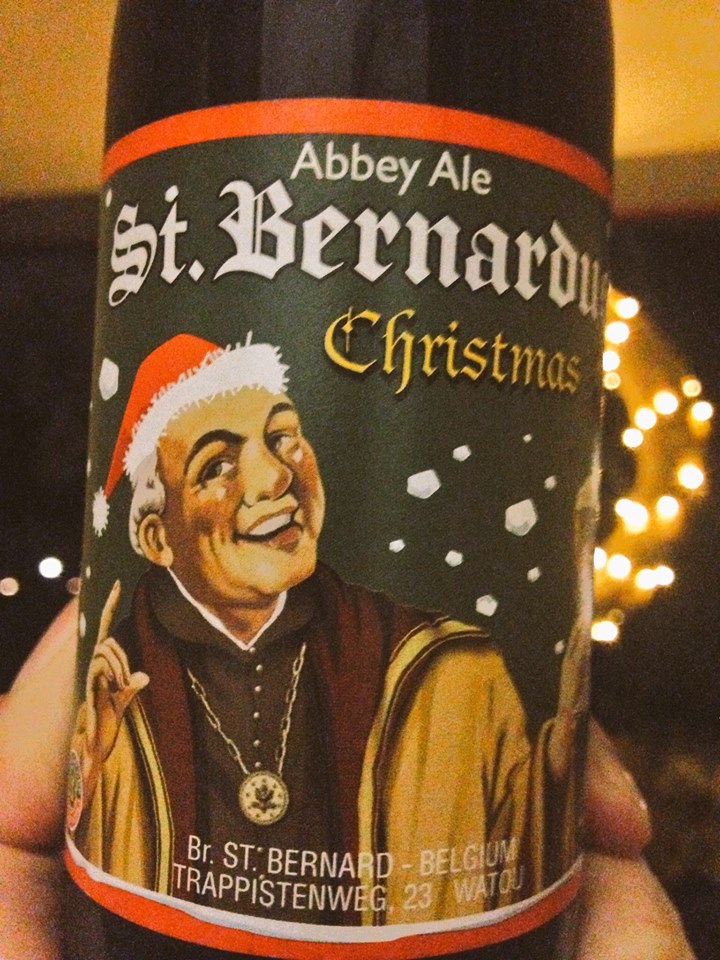
The Kerstbierfestival is in Essen, at Belgium's North Pole (near the Dutch border). The organizers go to great lengths to source every Belgian Christmas beer they can. Their first was in 1994, when they were able to find 38 of them. At that time there were about 110 breweries in the country.
What we can draw from this? For one, we can see that the number of special Christmas brews has expanded right alongside the number of small, independent breweries. That makes sense. It also makes sense (to me, anyway) that the existence of the festival in Essen has had something to do with it. Brewers know the event and want their beer to be a part of it.
So those are a couple of the possible answers to the question of why Christmas beers have become such a big thing in Belgium. Here are some other explanations I've heard or read at various times:
The faux-historical one: In the legendary old days the Belgian farmer-brewers would have had surplus grain after the harvest, so they would brew stronger ales to enjoy for the winter holidays. It's somewhat plausible and makes a nice story. I haven't found any evidence of it.
Palm started it: In 1947 it released Palm Dobbel, a somewhat stronger version of Palm delivered to clients as a thank you, and also to celebrate the brewery's bicentennial (based on a now dubious date shrouded in mist; in 1747 it would have been the De Hoorn farm brewery, which is older than that). Off the top of my head I can't think of any present-day Belgian holiday beers older than this one. That doesn't make it the first.
No, Artois started it: The story goes that Artois in Leuven introduced Stella as a Christmas beer named, sort of, for the Star of Bethlehem. However our friend Evan Rail has had a look at the brewing records. Trouble is, the brewery had fermentation problems with its earlier batches and didn't release the beer commercially until August 1927. From then on it was year-round. Thus I feel reasonably confident in declaring the Stella Christmas story to be nonsense. (Interestingly, the AB InBev site says it released Stella as "une bière de Noël, respectant en cela une coutume de l'époque," or "volgens de toenmalige traditie." That is, according to the custom of the time. So, maybe holiday beers really were a thing back then. Or, maybe we should be careful not to trust anything found on marketing websites, and this one in particular.)
Blame the British: Senne brewmaster Yvan De Baets -- whose Zinnebir Xmas is one of the best -- once told me his theory that the Belgians got the idea from the British, especially after World War I. This was a time when the Belgians were trying out pale ales and stouts too, so why not Christmas ales? (But as with other consumables, the Belgians have a special way of adding their own panache.) This is a rather plausible theory that also matches up somewhat with the timing of the Palm and Stella stories. If it was a "custom of the time," maybe this is why.
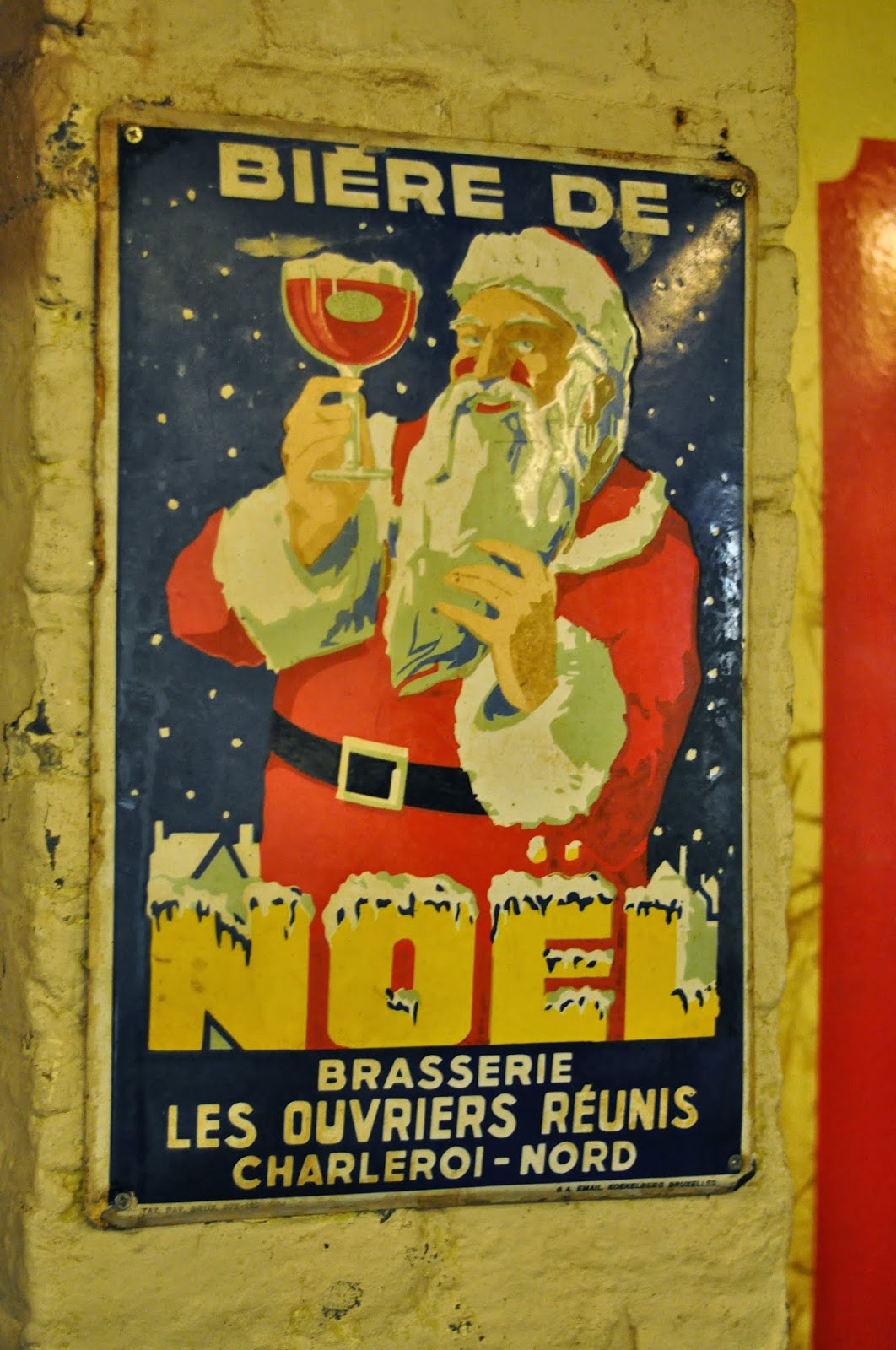
The capitalistic one: It's the money, stupid. You don't need to go to the Kerstbierfestival or fancy bottle shops to find Belgian Christmas beers. You can go to nearly any supermarket in Belgium and find endcap displays full of them. Or you can visit many corner cafés to find table tents and posters advertising brands like Palm Dobbel, Bush Noël, or Tongerlo Christmas, to name a few of the more common ones. They're nominally only available this one time of year, so many customers go for it. Not many brewers want to miss out on that.
More thoughts from De Baets: "As a brewer I can tell you what gets us moving, sometimes at least: We see clients, pubs, making an emphasis on Christmas beers at the end of the year and all the customers having their interest focused on them. So, what do we do? Well, we simply make one also. It maintains a interest in our products, it's as basic as that."
The truth may be some combination of all these things (er, minus the Stella bit): old traditions, good marketing sense, and a whole bunch of smaller breweries well versed in cranking out variety and oddities -- what's one more, to them? Why not join the fun?
Wednesday, September 27, 2017
The Long Road to a Fine (Belgian) Pils.
Once upon a time I remember telling myself: Hey, a blog post doesn't have to be about anything important. It only has to be daily. You can throw any old nonsense up there. It will be fine. Just keep it going.
Fine, fine. So I see my last blog post was in January 2016. No biggie, only eight months, wait... [blows dust off of calendar] Shit. Twenty months ago. In that time my wife and I had seven children, they all grew up and moved out of the house, I earned two additional useless college degrees to bring the total collection to 17, I grew rich on royalties, pissed it all away on donuts and cognac, grew three beards, and even read a book. Dog is still here though. Old damn dog, pees on the rug more than he used to, back in January 2016. Time is trippy, that feels like only 19 months ago. But no, says here it was 20.
I have about a million things about Belgium to share. Notebooks full of stuff, hundreds upon hundreds of photos. I aim to do something useful and (spectacles, testicles, wallet and watch) profitable with them. Oh, and half a million things about Germany, especially Berlin (where I live) and Franconia (where I hope to retire). And too many odds and ends about other places I have managed to go, thanks to a tolerant spouse and the magic of discount airfares. I aim to regurgitate some of it here in the sort of beautifully unrefined form that takes, I hope, very little time each morning. Lots of not-very-well-thought-out jokes too, inevitably.
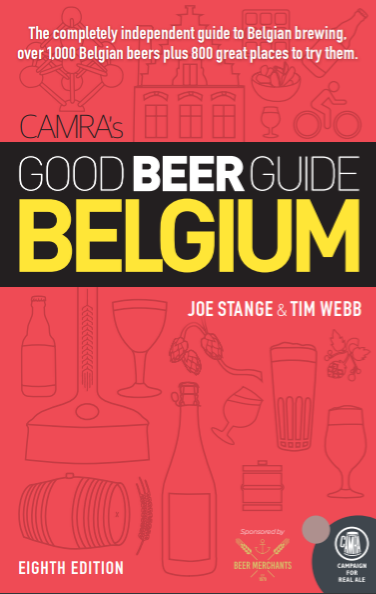
Well, here is a moment I wanted to share. It happened, as so many fine moments do, on a Wednesday. Five weeks ago to be precise, though it feels like only four and a half. This was toward the end of a long-ish day in the middle of a long-ish week of visiting as many Belgian cafés as possible. This was all, as you might have guessed, for the next edition of the Good Beer Guide Belgium. We are about a month away from deadline on that. Look for fresh copies of it in spring 2018, if nothing goes awry. It's the best book on Belgian beer that I know, and also the most useful guidebook I know, but I admit I'm biased.
No really, it's awfully fucking good. Anyway.
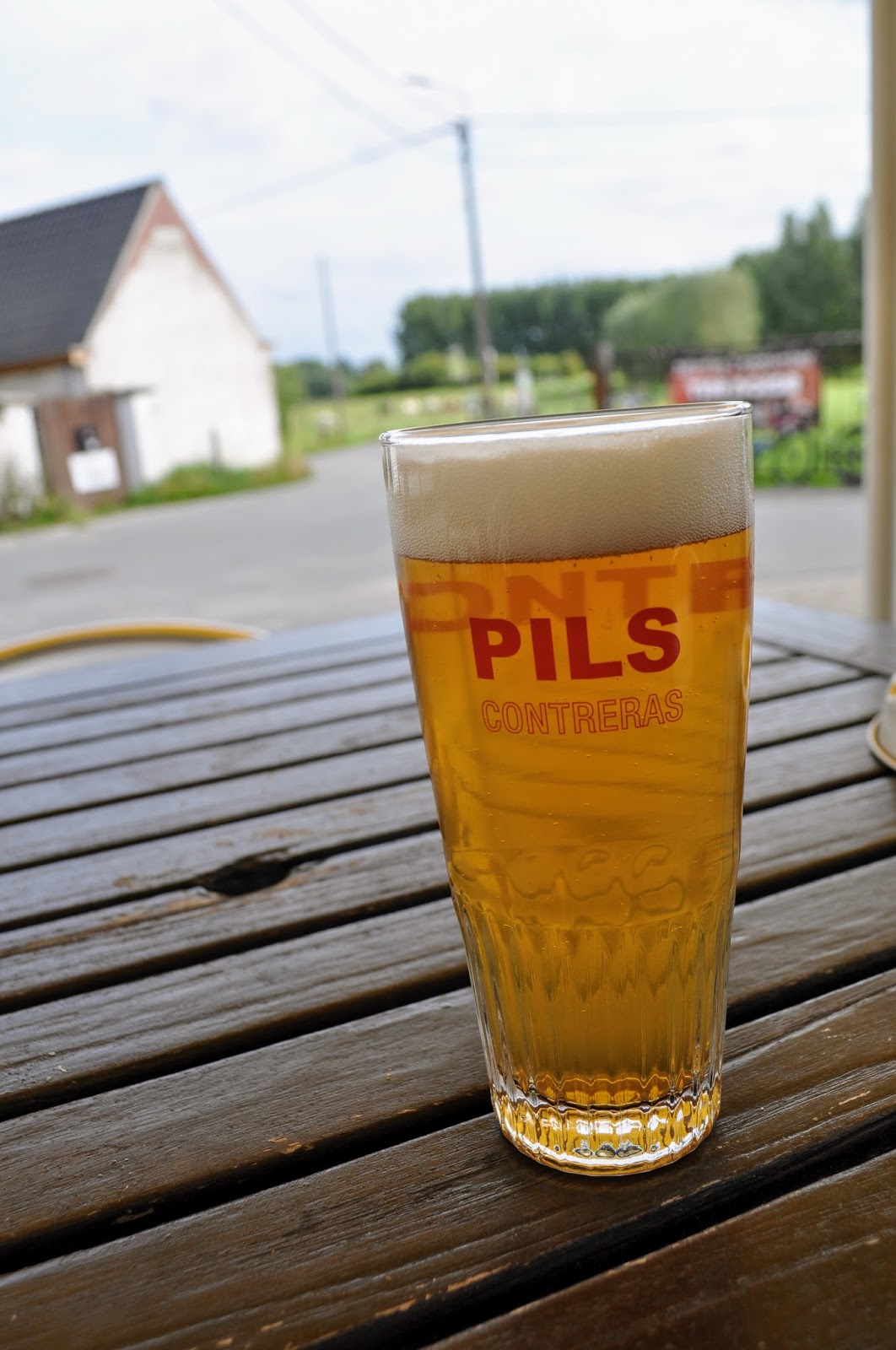
This café is called the Rotse, and it's the lovely sort of simple country pub at which Belgium seems to excel. This one is not loaded down with tacky beery bric-a-brac -- though I enjoy that -- but instead is neatly appointed like Grandma's house out in the country: white walls, antique wooden furnishings, a few select pictures hung. It has all the beers from Contreras of Gavere, so we call it an "unofficial brewery tap." I like these. I'm not sure why anyone would want to visit a brewery when they could visit an atmospheric local café where all the beers are enjoyed in their proper setting -- the local culture from which they sprouted. But then, I've toured hundreds of breweries and I get bored with them. They are all a bit different and yet they're all the same. I don't seem to get bored with visiting cafés/bars/pubs. You can learn a lot in either sort of place.
So here I am out on the front terrace, on the small crossroads. This is where a poshy-quasi-suburban area near Gavere finishes leaking out into cow pastures and bike paths near the Scheldt. A few of the punters drive here, as I did, but several more arrive on bike or foot. I'm the only foreigner (I think) and the staff are not friendly -- this aloofness is so normal in rural Flemish cafés, and in Berlin for that matter, that it doesn't bother me anymore -- so it's mostly old fellers drinking and laughing and chatting, all in Flemish. There are cows across the road, and their smells and that of the warm grasses remind me of, well, my own Grandma's house. Not sure what your Grandma smells like.
Too bad the contents are so often disappointing.
Man, Belgian pils. I could write an eloquent defense of it as a cultural practice, as local tradition. I think every beer tourist ought to try it, to participate in it. But to look at the stuff objectively, as beer, and compare it with the world's better lagers, well... It's empty stuff.
But then, I'd argue that Belgian pils isn't meant to be characterful. Not everything has to be.
This one is though. I'd had Contra Pils before and found it to be a bit more bitter than most, if nothing special. This glass of it, poured fresh from the tap, is not only more bitter than I remember but also with plenty of hop flavor -- herbal, earthy and edged with citrus, like they had some extra Saaz and said "fuck it" and just dumped it all in the kettle at flame-out. It's not IPA-ish, mind you, it doesn't punch you in the face with aroma or bitterness, but it does offer plenty of flavor to that light-bodied, thin-cracker-malt frame. And so we have one of those rare nexus of personality and drinkability that makes a beer worth hunting.
I can't say for sure if Contra Pils has recently improved, if the beer was always like that but my palate returned to Earth in the decade or so since I last tried it, or if just tasted especially good that day because, as I said, I'd earned it. But given the success and quality of the Valeir range in recent years -- on the watch of Frederik de Vrieze, who took over in 2005 -- it would not surprise me to learn that they added some zip to the Pils. (Well shit, now I'd better ask.) It's a remarkable brewery, really, and I know that without even seeing the kit. Next year it will be two centuries old but the range is fresh, not especially hindered by unnecessarily conservative traditions or cynical recipe. Belgium's other long-established family brewers could learn some things from Contreras.
So, there's some nonsense for you. Let's do this again "tomorrow." See you in 2019!