Showing posts with label De Cam. Show all posts

Monday, April 29, 2013

Mysterious Belgian Bar Snacks, Part III: Choesels.

It's been a quick five years or so since I posted a couple of entries in a hypothetical series called Mysterious Belgian Bar Snacks. Then this choesels thing came up. A long-delayed sequel, like the Color of Money and Wall Street II: Gecko's Revenge, or whatever that one was called.

A disclaimer, in the tradition of long-delayed sequels that are inconsistent with their predecessors: Choesels are not really a bar snack. I mean, they could be, but like many weird old peasant foods they're more easily found in upmarket restaurants that pay attention to local traditions. On the other hand, they would traditionally be accompanied by beer--lambic, most likely, because this is an ancient Brussels thing.

So, choesels! What are they?

I asked that very question some years ago at Restobières. And the waiter told me they were bull's balls. Well, how do you say no to that? Especially in the presence of friends and/or loved ones who (a) know you will eat pretty much anything and (b) heard the question and answer.

So, the other day: I'm scribbling something about Brussels food and come across choesels again. And I remember: bull's balls. Then my journalistic skepticism--a ponderous burden for anyone trying to make money by selling words--kicks in. And I think, really? Bull's balls? For real? Because journalistic skepticism sounds like that sometimes. So I spend more time than I should have googling around and learning that sometimes they could be pancreas or other bits and ends of the cow.

Not satisfied, I write to Chef Alain Fayt of Restobíères, known as one of the few chefs and restaurants still serving this local treat. And some days later I get a really fascinating answer, with historical context. Specific years and everything. He either knows the subject cold or spent some time researching; either way, I really appreciate it. Then I fix the spelling and typos just for you:

In fact, the choesels were the meal of poor people. It is an old custom. It was a mixture of different parts (breast of veal, oxtail, heifer sweetbreads, calf testes and pancreas) of beef. In fact, Gaston Clément (1879-1973) a famous Belgian chef ([royal] chef of the Belgian crown) published a recipe of the choesels in his book (1954) within included pancreas and testes. In 1899 and 1903, Jean de Gouy wrote in the 9th ed. of his book, La cuisine et la patisserie bourgeoise, that choesel is pancreas. Miss Lucas, a famous Brussels chef, has never used pancreas in the recipe of her Choesels. My opinion of this issue is that Choesels is a traditional meal and everybody can realize them with [their] personal touch. Personally, I do not put pancreas in my recipe, but [just] testes of veal.

I hope that it is now clearer for you.
A recent frustration: I had lunch at Restobières last summer without taking a single photo that was worth a damn. So instead you get an image of his cookbook, La Cuisine à la Bière, which is hugely entertaining if your French is up to it. Choesels are in there. Rocky mountain oysters, Belgian style, and Fayt typically does it with lambic from De Cam. You can buy the cookbook at his restaurant.

Thursday, February 16, 2012

How a Couple of Really Interesting Beers Are Made.

L'Enfant Terrible and bottled Oude Faro from De Cam are the subjects of our discussion today. A couple of new, hard-to-find, sourish Belgian beers made in funny ways.

The first one, from the still excellently named Dochter Van de Korenaar--I told you how fun that beer is. But I had no idea how it was made, besides the label's vague clue that it is a "gueuze-style ale brewed with wild yeast." Based on taste, my guess was an ale blended with Girardin or other lambic and allowed to mature. As usual, when it comes to me guessing about these things, I was wrong.

Here is the whole explanation, from Ronald Mengerik of the brewery in Baarle-Hertog:

L'Enfant Terrible is an odd beer. The basic beer is Bravoure, my smoked beer. After about two to three weeks fermentation as Bravoure the beer is transferred to oak wine barrels, where the beer is infected with lactic bacteria and Brettanomyces (both are local). Then, in four to six months the beer undergoes a lactic fermentation followed by a wild fermentation.

Smokey esters are changed into fruity esters by the Brettanomyces, which is a mystic and wonderful process. Then the beer is bottled by hand, and gets a refermentation of about two months.

Until now the production was very limited. I'm trying to upscale the
production. The demand is very much increased after winning a silver medal on the
'European Beer Star' this year.
About the smoky esters that go into a cocoon and emerge as beautiful butterfly fruity esters... pretty weird, right? I can vouch for it, as far as not noticing smoke. Oaky, yes. Smoky, not so much. But I've had the Bravoure a couple of times and, while fairly subtle, it is definitely smoky. So much of that smoke just disappeared in a puff of, er, fruit.

I don't want to give you the wrong idea about L'Enfant Terrible. It had a rough edge and could use some refinement... The oak might have been a bit much, and there was some alcoholic heat. But it was a very tasty beer and damned interesting and I would buy another bottle given the chance.

Next: Bottled De Cam Oude Faro, about which there have been whispers, scant photographic evidence, and a small number of reviews.

I itched my scratchy head when I heard about this one. De Cam is a traditional little blendery. Bottled faro implies non-traditional corner-cutting nonsense. It implies pasteurization and/or artificial sweetening, basically. The background: Faro denotes aged lambic with candy sugar added. In hundreds of Brussels and Pajottenland cafés around the turn of the century (no, the other century), that often meant lambic from the cask and sugar from the little bowl at your table, stirred up with a spoon. But when you try to bottle that, the wild critters chomp on the sugars and churn out enough gas to make exploding bottle bombs. Hence the trickery.

I'll say it plainly: If the only faro you've had has been from bottles, then you still haven't had faro. For the real thing you'll need to book a trip to Brussels. And you should.

Digression over. I contacted De Cam blender Karel Goddeau. At first he was reluctant to let me write about it, as "we are only starting to experiment with it." I told him the cat's out of the bag and that it might be useful for lambic geeks to know that this one's a work in progress. So he relented.

Here's what Mr. Goddeau is up to: adding candy sugar to "very old lambic" and waiting to see what the wild critters do with it. In other words, they are fermenting the sugar and leaving behind a bit of extra flavor. He said the bottled beer should be nearly flat, "almost not foaming."

In his words: "I try to get it in the bottle the same as on draft on beer festivals, but I need to convince more then 99 other micro organisms to share my opinion."

Is there a common thread here? Maybe. Remember these two beers when someone says unthinkingly that Belgian brewers do not innovate. They do. But they do it at a different pace and within a different framework than anyone else. At times, it might as well be another dimension.

Wednesday, March 16, 2011

Geuze, Geuze, and Non-Smoking News.

It only happens every other year. But that's twice as often as the World Cup or the Olympics, so let's count our blessings. The Toer de Geuze--Pajottenland's original lambic festival on wheels--is set for Sunday, May 1.

If you don't know: Nine lambic makers--Boon, De Cam, De Troch, Drie Fonteinen, Hanssens, Lindemans, Mort Subite, Oud Beersel and Timmermans--open their doors. They offer tours, beer and nibbles while buses carry happy people from one brewery or blendery to another.

Each bus takes a different route, so choose carefully. For lambic enthusiasts, an ideal route mixes a couple of old favorites with those you'd like to know better. For everyone else, it really doesn't matter. A bus will carry you around the countryside to visit five places offering the most unusual beers on Earth. What else do you need to know?

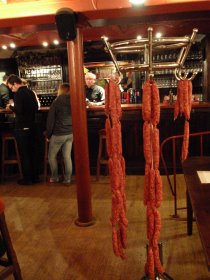
And if you go, like I did two years ago, you might just be lucky enough to see sausages on a coat rack. Or Armand Debelder in a bow tie.

Speaking of Mr. Debelder, I have a bit more info about that limited series of Drie Fonteinen blends, set to launch in May. Indeed the blends are comprised entirely of different lambics brewed at Drie Fonteinen before the thermostat disaster and the decision to stop brewing. Again, the goal of these special blends is to raise extra money to re-start brewing there. So it all fits.

Finally: Good news for Belgians and foreigners who like to smell and taste their beverages. Starting July 1 all Belgian bars and cafés must be non-smoking, says the constitutional court. Since the start of 2010 the ban had been limited to cafés that serve food, but even then "food" was loosely defined since pre-packaged foods like nuts and chips were allowed.

Now the only exception appears to be for separate smoking rooms with special ventilators... Is it hard to imagine one-room bars installing these vents? Or maybe Delirium will install these vents in all its rooms. Oh, hell. Another loophole through which we could drive a waffle truck.

Thursday, March 3, 2011

Drie Fonteinen to Brew Again? And Other News.

You might think there is a limit to my ability to get Belgian beer scoops from Central American soil. You'd be exactly right. My friend Chuck Cook is exploiting that limit ruthlessly. But he's just doing what he always does: packing lots of info-gathering and photo-snapping into another brief jaunt through Beer Paradise.* Also look way down below for tips on ZBF weekend.

Today Cook reports that Drie Fonteinen master blender Armand Debelder is "likely" to start brewing his own lambic again. As I reported last January, Debelder decided to stop brewing his own lambic and re-focus on blending his famous geuzes. "I'm not brewing anymore. That's definite," he said. This was partly because of the expense, and partly because of his age. He is approaching 60 and brewing meant long, exerting work days. However, Cook reports that Debelder has hired an assistant, which appears to be the neat answer to that problem.

Also, geuze blenders use different lambics to achieve their final product, and Debelder had an exacting recipe for his house-made portion. The idea was to have Frank Boon duplicate the recipe especially for Drie Fonteinen, but that was never going to be an ideal solution.

Cook also reports that a lambic-oriented visitor's center will open in Pajottenland in mid-May. Cook says it will be 3 km from Beersel.

Now here I've really failed you, because it's right here in my notebook from last January: "2011 - Oude Geuze Visitors Center. In Alsemberg. For HORAL members. Four languages: Dutch, French, English, German. Some help from Flemish government." Just another one of those things that got lost in the move. Sorry about that.

After the bit about the Flemish government, my notes say that Debelder whistled and said, "They've got lots of money for that!" The part about HORAL members suggests that the center will showcase mainly Pajottenland brewers: Boon, De Cam, De Troch, Drie Fonteinen, Girardin, Hanssens, Lindemans, Oud Beersel and Timmermans. Note that Cantillon is not an HORAL member.

The center potentially will be an exciting place for beer travelers to visit. No doubt there will be lambics to taste and probably cheese for nibbling. Time will tell if it's a worthy substitute for a visit to Cantillon, an earthenware mug of kriekenlambic while admiring the finches at De Cam, or a Pajottenland salmon and vintage geuze at Drie Fonteinen's restaurant.

ZBF weekend: Lots of you are in Belgium for lots of activities. Be well to each other and spread those festival tokens around. Look here for my post on various happenings. Be aware that transit strikes will slow things down, but apparently not cripple them. Belgian railways are running normally. Brussels-area metro, trams and buses will be about two-thirds normal. The De Lijn buses might have issues.

But for all the main events, I think all you'd need is a train ticket and a good pair of shoes. Happy drinking, pilgrims.

*Yes, it stings a little. No worries. I'll treat the wound right away with homebrew and sunshine.

Friday, May 29, 2009

Swirl, Sniff, Sip, Repeat. Or Just Drink It.

What the hell is wrong with me? It's Friday already and I've failed to mention that one of the year's best fests is tomorrow and Sunday. My friends, this is the Weekend of Spontaneous Fermentation in Buggenhout. That site has all the practical information I could possibly hope to share with you about how to get there and so on. In three languages, no less.

So let's cut through the bullshit and skip right to the beer, shall we?

Draught lambics from 12 breweries and blenderies. Another 11 kriekenlambics (yar, that be the stuff with cherries). How about raspberry lambics from Cantillon and Hanssens, plus—seriously?—a black currant lambic, also from Hanssens.

Drooling yet? We haven't even mentioned the bottled stuff yet, with virtually every offering from each traditional lambic brewery. The really special stuff includes the Drie Fonteinen Schaerbeekse Kriek (local cherries) and Hommage (cherries and raspberries), or the Cantillon Zwanze (rhubarb), 50N-4E (gueuze aged in Cognac barrels) and Lou Pepe series. Plus a few crazy vintages, like the Eyelenbosch Gueuze from 1988.

The geekery commences at 3 p.m. both days.

Monday, April 27, 2009

Lambic on Wheels and Wurst on a Coat Rack.

It's hard to choose my favorite thing about the Tour de Geuze yesterday.

Maybe it was all the great lambics. Maybe it was drinking the new Geuze Mega-Blend or the Timmermans Oude Gueuze. Maybe it was Armand Debelder in a bow tie. Maybe it was sausages on a coat rack. Maybe it was wisely bypassing the guided tours once we realized they were both long-winded and mostly in Dutch, and heading straight to the beer instead. Maybe it was that moment in the afternoon when you realize you're on your third brewery and you've still got two more to go. It certainly wasn't that moment in the evening when you realize your time at the last one is nearly up. Maybe it was nursing a daylong buzz and watching the Pajottenland villages roll by the bus window.

Or maybe it was just meeting so many other people who shared our passion for truly great beer.

No. I'm going with the sausages.

Wednesday, January 28, 2009

Tour de Gueuze and Other News to Insure You Against Great Thirst.

Still swamped. A nice problem to have. Meanwhile I have some lambic news for you.

First off, the Tour de Gueuze is set for Sunday, April 26. What sounds like a drunken bicycle race is in fact, theoretically at least, much safer. Instead of a bike you ride a bus around to a handful of lambic brewers and blenders in the Pajottenland region outside Brussels. This event only happens every other year. At this point six nine lambic makers plan to open their doors: Boon, De Cam, De Troch, Drie Fonteinen, Hanssens, Lindemans, Mort Subite, Oud Beersel and Timmermans. I'll share more details as they become available.

Also noteworthy: the café known as In de Verzekering tegen de Grote Dorst – the Insurance Against Great Thirst – will be open that day from 10 a.m. to 6 p.m., four and a half hours longer than its usual opening time. This is so Tour-goers in the area can make their pilgrimage to perhaps the world's top lambic café. Across from the Eizeringen village church, this is a special little place that normally open only for Sunday mornings and funerals (don't do anything drastic... just go on a Sunday).

And: The Grote Dorst has added another event to your lambic calendar: The Day of the Kriek on June 6. The spotlight will be on Belgium's famous spontaneously fermented beer steeped in cherries. Krieks from nine breweries will be there, not all of them very traditional, but you'll be able to assemble a tasting of four choice samples. Sounds like a nice event for newcomers as well as enthusiasts.

Finally, I'd be remiss if I didn't mention the Weekend of Spontaneous Fermentation on May 30 and 31 in Buggenhout. Probably the best lambic fest of the year. We're talking sheer quantity and quality here. Take the Woman's advice and bring your own blankets if you plan to crash in the horstel (part horse-riding school, part hostel). Believe me, I'll never hear the end of it.

Oh. And there's another Cantillon Public Brewing on March 7, same day that ZBF kicks off.

And I think that's really enough, don't you?

Sunday, January 18, 2009

Sunday Night Football and Old Lambic. Lots of It.

Upstairs in my neighbor's fridge is a 10-liter jug of Girardin old lambic. It is flat, softly tart, lemony, cidery and wonderful. They told us we only had a week or so to drink it before it really goes downhill. We're doing our damnedest. With the NFL playoffs tonight, it's salty snacks and sour beer for us.

The jug is part of our bounty from a productive beer expedition yesterday. Girardin was our first stop. I knew the brewery in Sint-Ulriks-Kapelle was not generally open to visitors. It's famously secretive and doesn't do tours. But I'd heard it was possible to buy lambic there, if you showed up at the right time. I cynically expected this to be some narrow window of time Saturday afternoon, or every third Tuesday after the dog howls at a full moon. Turns out it's open for sales every day except Sundays and holidays. Easy.

The brewery is an old farmhouse, square-shaped with an open courtyard in the middle. From the road as you approach you see two large, gleaming coppers through plate-glass windows on one side. That's about as transparent as this brewery gets. The rest is mist and rumor.

Picking up a jug is like the Pajottenland version of getting a growler from your local brewpub. For the record, a 10-liter plastic jug of Girardin lambic – young or old – will run you €15.80 (plus €10 deposit for the jug itself, but that doesn't count). Do the math on that and you're looking at €1.58 per liter, or less than 53 cents per glass of beer. Just pennies really, for something handmade by real artists and matured in oak for up to three years.

It's a steal. It's bargain-basement beauty. It's exactly the sort of discovery that makes you secretly hope that lambic never again catches on with the general Belgian populace. They'd only drive up the prices! Why cost-conscious Belgian lads aren't all picking up jugs of this nectar on Saturdays, when they have their buds over to watch Jupiler League, I have no idea.

Oh wait, yes I do. It's because they're drinking Jupiler.

I have many more thoughts on Girardin, but I'll save them for future posts or barroom chats. I'm going to steal some more from my neighbor right now. For handy reference, the shopping hours at Girardin are Monday through Friday 8.00-12.00 and 13.00 to 18.00; Saturday 8.00-12.00 and 13.00 to 15.00; closed Sundays and holidays. The address is Lindenbergstraat 10, 1700 Sint-Ulriks-Kapelle.

Ten liters is a lot, by the way. We could use some help. Come on over.

Thursday, September 25, 2008

Digging into Brussels' Nooks and Crannies.

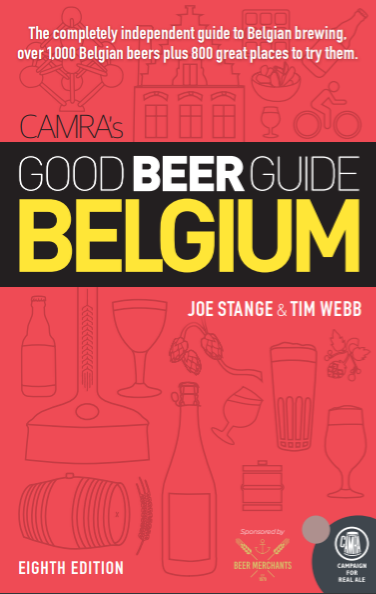
I mentioned once before that I'm working on a book. Collaborating, more accurately, on a guide to the best places in Brussels to drink good beer. A lot of strenuous research, as you can imagine. No fun at all.

Anyway, our editor suggested that I not give the book away for free on this blog. Sage advice, I think. So, how do you feel about five months or so of cruel teasing?

Try to guess this one if you want, if you've done some café-hopping in Brussels. I might or might not tell you if you're right. And taking a cue from Stan Heironymus, you might or might not get a prize. Also: There's no point looking at places on Ratebeer or Beer Advocate for clues. We're digging deeper and plan to reveal several "new" places to the non-Bruxellois world.

For example: This is on the edge of town, far from tourist civilization. Very quiet. It's also really and truly smoke-free, a rarity in Belgium. The list includes gueuze and kriek from every serious lambic brewer, including 3 Fonteinen, Cantillon, De Cam and Hanssens, served lovingly in big, bulbous burgundy glasses. The management keeps years of tasting notes and beer-related news clippings in a file behind the bar. It also sells older and lesser-selling bottles from the cellar once per year, at rock-bottom prices, to local connoisseurs.

So, where is it?

Tell you next spring.

Friday, January 11, 2008

Little Birdie Want a Sip of Beer?

When a top-notch craft brewery is at the center of civic life, you know you’re in a good town. That’s the setup in Gooik, about a half-hour west of Brussels.

OK, nerd, if you want to get technical: De Cam isn’t a brewery. It’s a blender, and what it blends are lambics. De Cam’s own lambics happen to be some of the most funkiest, most tartest beers in the world—in a good way. On Wednesday we went to sample the goods at the source.

Next to other lambic makers, De Cam is just a baby. When it started putting out beers in 1997, there hadn’t been a new blender in Belgium for four decades. Yet in terms of quality, De Cam holds its own with the country’s best. All its beers get high marks from lambic lovers. The tart and juicy Oude Kriek is a particular favorite of mine. (Aw yeah, wash some old goat cheese down with that, can I get a “smakelijk”?)

Yet De Cam is more than a beer maker—it’s the ultimate hub of local culture. It’s a community center that hosts clubs and events. It’s also a museum devoted to old musical instruments and folk art. (In Belgium, there are museums for everything. Including one dedicated solely to beer trucks.)

But still, this is Pajottenland. And here there is arguably no folk art more important than the brewing and blending of spontaneously fermented beer. The flavor of traditional lambic is arguably the flavor of this region. And Pajottenland, if you don’t know, tastes intensely sour and fruity. Incidentally, it also smells like a barn decorated with old gym socks.

That’s right, sonny, take a deep whiff. That there is the odor of craftsmanship.

Looking for our next beery life experience, our destination was the café. Because that’s the place where you drink.

Like so many other great Belgian beer cafes, the De Cam Volkscafe is largely populated by older gents. You’re free to imagine a bunch of geezers sipping the authentic, sour stuff from crockery mugs if you like. Ah, it’s a romantic notion. Unfortunately it ignores the well-known law against old Belgian men drinking interesting beer. By royal decree (as far as I can tell) all Flemish and Walloon gents beyond a certain age are required to drink Jupiler or Maes, Belgium’s answer to Bud and Miller. Sad but true.

So that’s the scene: Plenty of wood and breweriana and old guys sipping lager for lunch. It’s a pleasant scene, though, one made pleasanter by the tweets and tweedles of singing finches, whose cages sit in the middle of the room. Finch-singing competitions, if you don’t know, are a serious sport in Belgium—especially among the aforementioned geezer constituency. Those old bird men are cutthroat. We’re talking bloodsport here.

Damn it! Weren’t we about to drink some beer? On the menu—written in a local dialect that we suspect nobody actually speaks—there's a list of more than 30 different bottles beers, with plenty of quality. But that’s not why we’re here. Available on cask are De Cam’s own lambic and kriekenlambic, plus the Oude Gueuze in bottles. Except that they’re not all available. Not for us, anyway.

It turns out that the man himself—blendmeister Karel Goddeau—who plies his trade all of 40 feet from where we sit, hasn’t delivered beer to the café in more than a month. Out for the holidays, apparently. All they’ve got left is the kriekenlambic, which suits us just fine. They get respect for serving it in those old-school, stoneware type mugs—a bit cold at first, but once it warms the tart fruit really comes out and punches you in the face.

It’s delicious, and the acidity gets my belly roiling for food. Now.

So we hike up the road to a well-regarded spot called the Groene Poort. Behind the green door is not Marilyn Chambers, but a nice enough lady working all by her lonesome. We’re the only customers. Despite a chalkboard placard promising eel in green sauce and other treats, we’re told the only options are spaghetti or sandwiches. With stomachs demanding something to dissolve immediately, we’re in no condition to argue. All worries vanish as we wash the pasta down with some Girardin gueuze. Black label. The good stuff.

About De Cam: Show up on Sunday afternoon if you want a tour. That’s my plan for next time. Hopefully the café will be lucky enough to re-stock its beers by then. And maybe I’ll be lucky enough to munch on something long and snakey and covered in green sauce.

Yum.