Showing posts with label Restobières. Show all posts

Monday, April 29, 2013

Mysterious Belgian Bar Snacks, Part III: Choesels.

It's been a quick five years or so since I posted a couple of entries in a hypothetical series called Mysterious Belgian Bar Snacks. Then this choesels thing came up. A long-delayed sequel, like the Color of Money and Wall Street II: Gecko's Revenge, or whatever that one was called.

A disclaimer, in the tradition of long-delayed sequels that are inconsistent with their predecessors: Choesels are not really a bar snack. I mean, they could be, but like many weird old peasant foods they're more easily found in upmarket restaurants that pay attention to local traditions. On the other hand, they would traditionally be accompanied by beer--lambic, most likely, because this is an ancient Brussels thing.

So, choesels! What are they?

I asked that very question some years ago at Restobières. And the waiter told me they were bull's balls. Well, how do you say no to that? Especially in the presence of friends and/or loved ones who (a) know you will eat pretty much anything and (b) heard the question and answer.

So, the other day: I'm scribbling something about Brussels food and come across choesels again. And I remember: bull's balls. Then my journalistic skepticism--a ponderous burden for anyone trying to make money by selling words--kicks in. And I think, really? Bull's balls? For real? Because journalistic skepticism sounds like that sometimes. So I spend more time than I should have googling around and learning that sometimes they could be pancreas or other bits and ends of the cow.

Not satisfied, I write to Chef Alain Fayt of Restobíères, known as one of the few chefs and restaurants still serving this local treat. And some days later I get a really fascinating answer, with historical context. Specific years and everything. He either knows the subject cold or spent some time researching; either way, I really appreciate it. Then I fix the spelling and typos just for you:

In fact, the choesels were the meal of poor people. It is an old custom. It was a mixture of different parts (breast of veal, oxtail, heifer sweetbreads, calf testes and pancreas) of beef. In fact, Gaston Clément (1879-1973) a famous Belgian chef ([royal] chef of the Belgian crown) published a recipe of the choesels in his book (1954) within included pancreas and testes. In 1899 and 1903, Jean de Gouy wrote in the 9th ed. of his book, La cuisine et la patisserie bourgeoise, that choesel is pancreas. Miss Lucas, a famous Brussels chef, has never used pancreas in the recipe of her Choesels. My opinion of this issue is that Choesels is a traditional meal and everybody can realize them with [their] personal touch. Personally, I do not put pancreas in my recipe, but [just] testes of veal.

I hope that it is now clearer for you.
A recent frustration: I had lunch at Restobières last summer without taking a single photo that was worth a damn. So instead you get an image of his cookbook, La Cuisine à la Bière, which is hugely entertaining if your French is up to it. Choesels are in there. Rocky mountain oysters, Belgian style, and Fayt typically does it with lambic from De Cam. You can buy the cookbook at his restaurant.

Friday, April 13, 2012

Take This Post With You to Brussels.

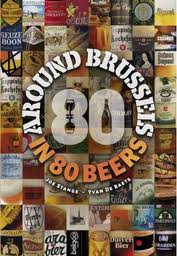
Here is another brief supplement to Around Brussels in 80 Beers. An update of sorts. There have been a couple of others, but never mind them. This is a new one.

I do this because I know you've been wanting to order several of the 500-or-so remaining copies from their stacks in Cambridge, England, so that you can then give them to loved ones for the summer travel season. Now you can print out this post, fold it neatly, tuck inside the pages, and then your friends will know how much they mean to you.

Anyway: This one began as a simple post to tell you that the café Kafka on Rue des Poissonniers has closed. (Then things got out of hand.) This article suggests that Kafka was a popular place but not quite popular enough to pay its rent. The management had other troubles, yet the peanut gallery is quick to blame the smoking ban. That's just politics and gossip to us. The point is that a good watering hole -- with loads of character, Zinnebir on draught, and real lambics in bottles -- has shut. Bummer.

Places do that sometimes. Shut, I mean. But others open or else become interesting. I have a working theory about Belgium's brown cafés in the smoking ban era: Some survive by widening their beer selections. I would not call it a full-on trend, and like I say it's a working theory. But there are examples.

Check out the Cambridge on Rue de Malines 37, a useful beery sanctuary at the far end of the bustling Rue Neuve shopping gauntlet. A clean and well-lit brown café is still a brown café if it has gambling machines and potato chips. I counted 94 beers on the list including Senne, de Ranke, Cazeau, and a few other surprises.

If you like your brown cafés really brown, then you might like the Coq at Rue Auguste Orts 14, very near the Bourse. A few years ago it was mainly InBev beers. Now there is Zinnebir, Saison Dupont and Oud Beersel to go with the long benches, ample wood paneling and mahogany rafters. When I was there in December the beer of the month was Avec Les Bons Voeux. To give you an idea.

Near Nüetnigenough, Poechenellekelder, Moeder Lambic Fontainas and at least half a dozen other good places to drink, the Lombard at Rue du Lombard 1 is an odd mix of early 1900s class and beery kitsch. Despite tourist prices and a chandelier with pink Delirium elephants, it gets a place on the circuit for 130 bottles and the sheer utility of simple brasserie food.

One welcome trend is a wider availability of Saison Dupont, which once was rare in Brussels but now appears in places that might otherwise lack something of interest. An example is Bebo, Avenue de Stalingrad 2, with 20 beers heavy on InBev, but also with the aforementioned saison, Moinette, La Chouffe and a few Trappists. There is an elaborate awning with a wide sidewalk for stretching out the legs on warm days. Just the place for an aperitif ale before the big splurge next door at Comme Chez Soi.

Another example is Cool Bun at Rue Berckmans 34 in Saint-Gilles, a gourmet burger joint where you can wash down the gorgonzola-bacon with any of Dupont's organic range.

The Ste-Catherine fish district used to be mostly devoid of decent beer, instead preferring white wine or Champagne with its mussels. That may be changing. There are positive reports on Merlo at Quai aux Briques 80, with friendly atmosphere and beers from Senne and Oud Beersel, among others. Closer to the church at Quai aux Briques 16, the Huitrière and its Vistro tavern have the steep dining prices typical for this neighborhood but also Boon Geuze, Taras Boulba, Saison Dupont in bottles and Redor Pils on draft.

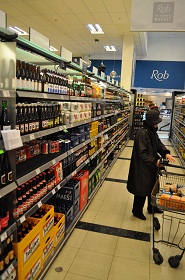
On the edge of town, the Rob gourmet supermarket in Woluwe-Saint-Lambert has more than 120 beers with better taste than the local chains. To go with hefty wine and cheese selections Rob has beers from Cantillon, Dupont, Senne, Tubize and more.

Two giants that were not yet open when the book came out: the world-class Moeder Lambic Fontainas on Place Fontainas and the Brasserie de la Senne in Molenbeek. Sadly the latter is not open to drop-in visitors, but large groups can make arrangements in advance. Then there is the aptly named Little Delirium at Rue Marché au Fromage 7, also know as Pita Street or Pita Alley. It's got 30 taps. There is much to be said for combining late-night kebob with a couple glasses of Rulles Estivale.

Greenwich has reportedly re-opened after some rehab work and a change of owners. It was never known for the beer but rather the incredible début-de-siècle atmosphere and popularity among chess players. No word on the beer list yet, but fingers are crossed. A halfway-serious bottle selection would instantly make it one of the city's best places to drink. It's that pretty.

The classy and quiet Belladone did close for a while in spring 2011 but appears to be open again.

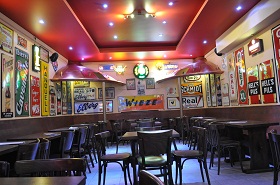
The excellent Restobiéres expanded into a space on the other side of Rue des Renards and left the old one open as a beer bar at what I presume more flexible drinking hours. Owner-chef Alayn Fayt also wrote a beer cuisine cookbook, and buying one is high on my to-do list.

Closed: Chapeau d'As, StekerlapatteStella Solaris, Ultieme Hallucinatie. No longer beery: Hotel Galia, Imprimerie, Laristo.

The Sleep Well hostel and its bar are shut for now, until it rebuilds after a recent fire.

The Warm Water on Rue des Renards has changed owners, ditched the lambic, and become Zabo. New ownership promises to serve a few local beers and might even be doing so by now.

I've got a longer list of places that may or may not be worth investigating, depending on how you value your time. If anyone out there is feeling intrepid and thirsty, drop me a line.

Additional reports welcome. Insults are welcome too, as long as they accompany useful tips.

Wednesday, October 6, 2010

Like Brussels Itself, Always a Work In Progress.

As Tim Webb compiles the Good Beer Guide Belgium, he receives a lot of tips from a loose network friends and allies who live in the country or visit there often. They do it only to help him make a better guide, and they deserve a lot of thanks not just from Tim but from all of us who rely on the book.

Our network for Around Brussels in 80 Beers is not so extensive... The first edition (and hopefully there will be a second, someday) is based mainly on a lot of research and legwork on the part of Yvan and myself. However there are a few people who have begun sending advice, updates and feedback from time to time. A serious omission from the book is a little paragraph, somewhere, explaining that we really, really like that sort of person. One of them is Mr. Simon Croome, who takes the Eurostar down from England now and then and makes excellent use of our little guide. May he be a good example to the rest of you.

Feel free to send any personal experiences, reviews, updates, suggestions or profanity to joe dot thirstypilgrim at gmail dot com. Photos are also welcome, and with permission I might post one or two to the blog. Also I will get back to you personally with thanks, and somewhere from within a very-soon-to-be-bustling warehouse brewery in Molenbeek, Yvan thanks you too.

Here is some of what Simon says, which is especially interesting to me because he and Jackie left the well-worn city-center pathways. Also I have to mention that, to their great credit, they were oblivious to the fact that the Brussels Beer Weekend was happening before they visited. Instead they came mainly for the festival at Moeder Lambic. Let's join him on their pub crawl, shall we?

Vieux Spitigen Duivel, in the southern reaches of Uccle: "It got mixed reviews from some of the other people we mentioned it to -- they felt it had gone down hill with the change of owners. Decent enough beer selection (I had an Omer for example) and we could quite happily have stayed for another beer if it wasn't already so late..."

Matin, up the hill from Chez Moeder Lambic in Saint-Gilles: "What a difference. I bet a lot of typical beer geeks would hate this place but for us it was a nice change. Great decor and loud latino music but still with Zinnebeer and Taras Boulba to drink. And amongst all the hubbub one old, flat-capped Belgian sitting at the bar oblivious to the noise..."

Moeder Lambic St-Gilles: "Finally on to the main event of the night - our first visit to the old Moeder Lambic. Quite a contrast from Fontainas but still the same great atmosphere and beers. We tried several of the festival taps -- the 2010 Fou F'oune was outstanding, really fresh and full of fruit..."

Brasseurs de la Grand Place: "Missed breakfast at the hotel so we popped in ... for brunch. Good value food surprisingly, shame the same can't be said of the beer -- fairly pedestrian but expensive."

Delices et Caprices: "a marked improvement. Pierre is an excellent host and the ability to try any of the beers straight off the shelf is dangerous. Pierre got me to try a Jessenhofke Tripel to see if I could guess the mystery ingredient, I failed as it's a quite subtle addition but still found it an excellent beer."

Schaerbeek Beer Museum: "Odd kind of place and not really my sort of museum, too much stuff with little explanation given; however it was free entry and the 75s of their 'house' beer were only 4.20 euros so we sampled one in the cafe and picked one up for the tickers back home."

Moeder Lambic Fontainas: "We finished off the festival taps that we hadn't got yesterday and then Jean mentioned his special bottle selection. I take it you know the story behind Cantillon Pinot D'Aunis, I can confirm it's an exceptional beer almost like a rose version of St Lamvinus. Not allowed to take this beer away you had to drink it in one of the four establishments involved. We also had the Wadesda 1 from Senne, and there was a Rulles 10th Anniversary beer, both of which we picked up a bottle of."

Restobieres: "Luckily it was still open and we were allowed to order. Very good food, even something as simple as sausage and stoemp had great depth, I'm glad we got to visit after passing its door so many times. We lingered for a while over a bottle of Bon Voeux before going down the hill to..."

Brocante: "which we were very surprised to find closing up at only five in the afternoon. Was that Brussels' way of saying we'd had too much already? Oh well, back to Midi and the train home."

Many thanks to Simon and Jackie and anyone else who has sent similar tips or will do so in the future.

Saturday, October 3, 2009

Another Heavy-Handed Hedonistic Post.

Stop and smell the roses. We've been told that since we were kids, if not by our parents then at least by popular culture. A simple message: Stop, pay attention, enjoy life. A lot of people forget to do it. Or so I've heard. My theory: That's the real secret behind food-and-drink pairing. More broadly it may also be a driving force behind craft beer, great wine, the foodie movement, and so on and so forth. Nothing revolutionary here: People seek greater flavor because they want greater joy in their lives.

But about pairing—with beer and food, for example—there is no real magic there. I wouldn't even call it science. There are a few matches where identifiable flavors in a food either harmonize or complement those in a beer. And there is a much wider range of foods and beers that both taste great while not stepping on any toes, let's say. But the real trick, and it's almost sleight of hand, is getting someone to pay attention to what they're tasting. It's fun to really taste something good, to tap into what is literally your sensual side. Somehow it's even more fun when you know that someone—a brewer or a chef, for example—has used a lot of passion and knowledge to make it better for you. There is special communication there, even if there is money involved. And there usually is.

Stop and smell the roses. Some people pay good money to be reminded of it—how about $350 for this meal in New York (with a hat tip to Andy Crouch). But you can do it far more cheaply at home, or in your favorite local corner restaurant. Unless you're the sort that always needs to be told what to do.

The shot here was from a birthday dinner at Restobiéres a while back. A robust Hercule Stout with roast piglet. Neither stepped on any toes. It was joyous. And considerably less than $350.