
So I've been in America for some weeks and, to be honest, not much has changed here lately -- not on the beer front, anyway. Oh, there are more and more breweries and more and more beer specialist bars with more and more taps, and there are more and more regular bars and restaurants with growing lists populated by small and regional brewers. But the products are basically the same: resinously bitter and/or highly alcoholic. When not overly bitter they tend to be overly spiced, as with the caricatures of Belgian ale that seem to be flourishing.
So much for the sweeping generalizations. There are some highly drinkable options out there, beers full of flavor and finesse. But it takes some hunting. It falls to us to share tips on what and where to hunt. Anyway, there ought to be more.
A few we've found along the road:
A true "session" took place last night at Meridian Pint in D.C., where five of its taps have been pouring beers of 4.5% or 4.6% strength. It wasn't a special event or anything like that; it just appears to be a priority for the landlord. A highlight for me was the Caledonia from Williamsburg Alewerks, a orange-amber "session IPA" full of herbal, floral hop flavor. Afterward I walked home in a straight line, more or less.
 Back in St. Louis, the Civil Life (pictured) is filling dimpled mugs full of stuff that most geeks would find boring. Good. Let the regular drinkers and seasoned pros mingle without the whale-hunters. The Rye Pale and Brown were the popular girls, but I fell for the wallflower Bitter, dry and golden, full of floral Goldings with just a touch of fruity Centennial.
Also in St. Louis, Perennial is making some oddities but seduced me with its simpler saisons. The Hommel Bier has compelling character, matching American hops with what I think is the Dupont yeast strain. In my hometown of Springfield, Missouri, I found the Saison de Lis on draft in Patton Alley and couldn't seem to stop asking them to refill the glass. Its chamomile is understated and adds depth. If you didn't know it was there, you wouldn't know it was there.
Now for breweries with numbers in their names. On the acidic end: 4 Hands put out a Berliner Weisse named Prussia that wields a refreshing lactic tartness. It's difficult to put down and weighs in at a whopping 3.5% abv. And at 2nd Shift in New Haven I tasted a barrel-aged half-wild ale named Katy, a "Brett beer" for lack of better title. Pale, lightly tart, lightly tannic, heavily addictive at 5% strength. A future star, I think.
The hunt continues. I look forward to a day when the exceptions can no longer be called that.
Thursday, July 12, 2012
Hunting for Finesse: The Exceptions Are Still the Exceptions.


Friday, January 27, 2012
Just a Year Old, More Props for Urban Chestnut.
Yesterday was the first birthday of Urban Chestnut in St. Louis. I drank a half-dozen or so of their beers last summer, a couple of them repeatedly. What I now tell people who say they're visiting St. Louis: Go to Urban Chestnut and drink the Zwickel.
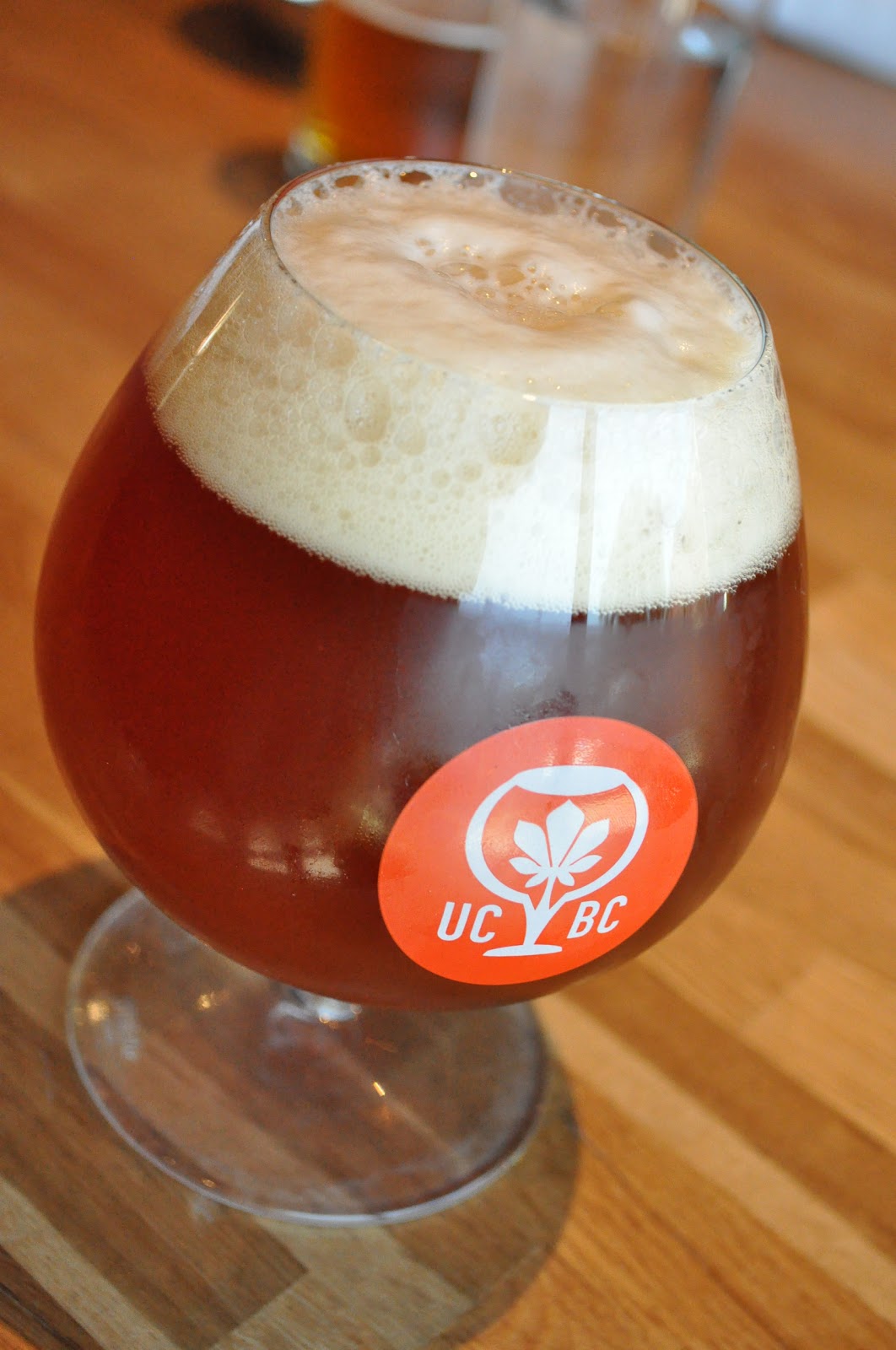 Coincidentally, we must assume, yesterday was also the day that Ratebeer announced its annual Best awards, based on individual scores by, effectively, thousands of active raters around the world. Say what you will about their biases, but these are folks who have tasted a lot of beers from a lot of places. We can criticize the herd and its findings -- and they make a nice big target, don't they? -- but these awards are nothing if not democratic and educational.
No. 5 on the list of top new breweries in the world: Urban Chestnut. And easily making the Top 50 Best Brewpubs in the world: Urban Chestnut.
This says good things about the brewery, obviously, but also about Ratebeer. Urban Chestnut is succeeding there without the beers that stereotypically succeed there: no barrel-aged imperial stouts, yet, made from coffee passed through the intestines of Indonesian weasels (although who knows what the future holds?). Its top-rated beer is Hopfen, a heavy-on-the-Hallertauer "Bavarian IPA" that weighs in around 6% strength. The Winged Nut chestnut ale (pictured) gets high marks, but so does the hoppy Half Crown session ale (4%).
More stuff from the area: I wrote the bit in the latest Draft magazine about how St. Louis is one of the spots "Where to Drink Next." It'll likely show up on the website one of these days soon, but really shouldn't you go and subscribe? Also mentioned, besides Urban Chestnut (and I would've liked to include more): Iron Barley, Civil Life, Schlafly, the Bridge and 4 Hands. I had nothing to do with this, but across from the article is a full-page Urban Chestnut ad that says, "We're proud to be part of the St. Louis craft brewing community."
For more on that community, see my post on The Spirit of St. Louis and my article in the New York Times. Not bad for a couple of weeks "work" last summer.
Finally, a pleasant surprise: Beer Advocate has an article in its latest issue about Augusta Brewing, about 40 minutes drive southwest of St. Louis. I might have mentioned before, I pay taxes and vote in Franklin County, where Augusta is setting up its new brewhouse in the old Droege's grocery store. The store was there in Washington, Mo., since 1896, having moved from a nearby spot in 1867. I shopped there a few times, with my wife and her family. Looking forward to drinking there too.
Monday, October 31, 2011
The Spirit of St. Louis.
Here is my piece on new St. Louis breweries for the Travel section of the New York Times. And here is the quote so nice I have to write it twice:
So is there a limit to the number of craft brewers that locals are willing to support?
“Seriously? It’s beer,” answered Dylan Mosley, the head brewer for the Civil Life Brewing Company in south St. Louis. “You know how many people drink beer? If I opened a hamburger joint, nobody’s going to be, like, ’Hey, you know how many hamburger joints there are?’ They’d be like, ’Sweet! Another hamburger joint!’ ”For me, this is one of those quotes that put things in Perspective -- as in, the Craft Beer Perspective, which is this: Only about 5 percent of all beer drunk in the U.S. is made by a craft brewery. St. Louis is no different in that regard. Consider that the Saint Louis Brewery, better known as Schlafly, makes about 2 percent of what's drunk locally, and that another 2 percent or so is craft beer made outside the St. Louis area. That means this wave of micros is really making their living off of 1 or maybe 2 percent... and there is probably room for more. (Hip-hop head nod to Evan Benn of the Post-Dispatch for helping me to get a handle on the numbers.)
Over Zwickel beers one night at Urban Chestnut, still a few weeks before his new brewery opened, Civil Life owner Jake Hafner followed the Mosley hamburger-joint quote with this:
But it's a little counter-intuitive than what normally happens in industries. … In our case, there's four new places, but the pie is so big right now. And we just need a small piece of it... We just need a little fraction of it and all of us are fine. And so collectively, we're so much stronger together, like, us working together and getting the word out about craft beer...It's a familiar story in America's craft beer segment -- folks who compete nonetheless helping each other out -- and St. Louis is only one of many places where that story has played out. The numbers, or rather the smallness of them, help explain the phenomenon.
But are there cultural factors as well, which might vary in degree from city to city?
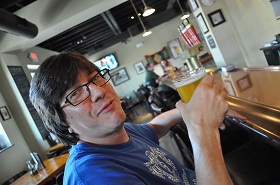 Joe Esser (pictured) is the assistant brewer and cellar manager at Six Row. He's from New Jersey but went to graduate school at Washington University in St. Louis about 20 years ago. He got his master's in literature, so naturally he soon found himself brewing in New Jersey. He returned to St. Louis in October 2010 and started at Six Row, right when the local beer scene was getting ready to pop.
Esser noted the city's underground music and art community, which he's experienced both times he's lived here. It enjoys a spirit of cooperation, he said. “There was always a welcoming, warm scene for that. And it's like that for craft beer too. I mean, the craft beer scene worldwide is sort of like an artist's colony. … And St. Louis right now is kind of like a microcosm of that. We feed our own.”
He continued: “I think that's why craft beer right now is blossoming. … There's something about this town. It's a small big city or a big small city. There's a small hometown vibe that you don't find in a lot of other cities. There's that chemistry and that warmth.”
Meanwhile all the micros remain “ïn the shadow of the behemoth,” he said. They're competing with each other, of course, “but happily we don't look at it that way.”

 Posts
Posts


