Showing posts with label 3 Fourqets. Show all posts

Tuesday, October 10, 2017

Beer Awards: Poke at Them.

There are more beer firms than we can fit into the next edition of Good Beer Guide Belgium. By "beer firms," I mean those marketing offices that sell brands but are not breweries -- though some of them are happy for us, the consumers, to assume that they do have one. They are happy for us to assume all sorts of things.

That's a hobby-horse issue for me and I could go on at length. Today I'd rather home in on beer awards.

One of those many Belgian beer firms is Tripick. Their office address is Boncelles, just southwest of Liège. I'd never heard of them -- they are new, and there are hundreds of these little firms -- until someone mentioned they were "the" "Belgium Winner" in the World Beer Awards. You can go to the website and see. They post the golden logo on the front page. Scroll down to the news section and you'll see the headline, "Tripick elected as best Belgian beer." If you look closer or read the article you'll learn that they won the "categories Lager and Strong."

(Disclosure: This year I was one of the WBA judges at a first-round session in Germany, and a few years ago I was one of the judges for the final round in London.)

Let's clear up a few things. Tripick won only one category --  Lager: Strong -- and only for Belgium. (See the country winners here. They are legion.) There were 1,900 entries from 36 countries in the 2017 World Beer Awards. There are 71 style categories in the WBA, and it's possible for any brand from any country to enter any of those categories.

How many Belgian entries do you suppose there were for the Strong Lager category? I asked. They said it was confidential. My guess: very few. Maybe only two -- Tripick Blonde and Tripel -- since there were no medals given at all, and no other awards given in that category for Belgium.

A couple of things must be said: If you are looking for great beers to try, you could do much worse than peruse the list of WBA's international winners, here. A beer doesn't get that far without technical quality, a winning personality, and some luck.

Also: I've never encountered a Tripick beer in the wild, so I've never tried it. They might be amazing, I can't say. It has existed for less than a year.

But there are things I can say. The brand sells two beers, Blonde (6%) and Tripel (8%). Both are top-fermented -- not lagers, so why did they enter that category? -- and bottle-conditioned. The levels of bitterness sound right up my alley, probably more balanced than the usual, sweet-ish tripels and blonds. There are a few technical specs on the website, plus all sorts of promo materials you could download, if you were into that, but nowhere on the website does it say where the beer is actually brewed. Sadly this is standard operating procedure for many of Belgium's beer firms.
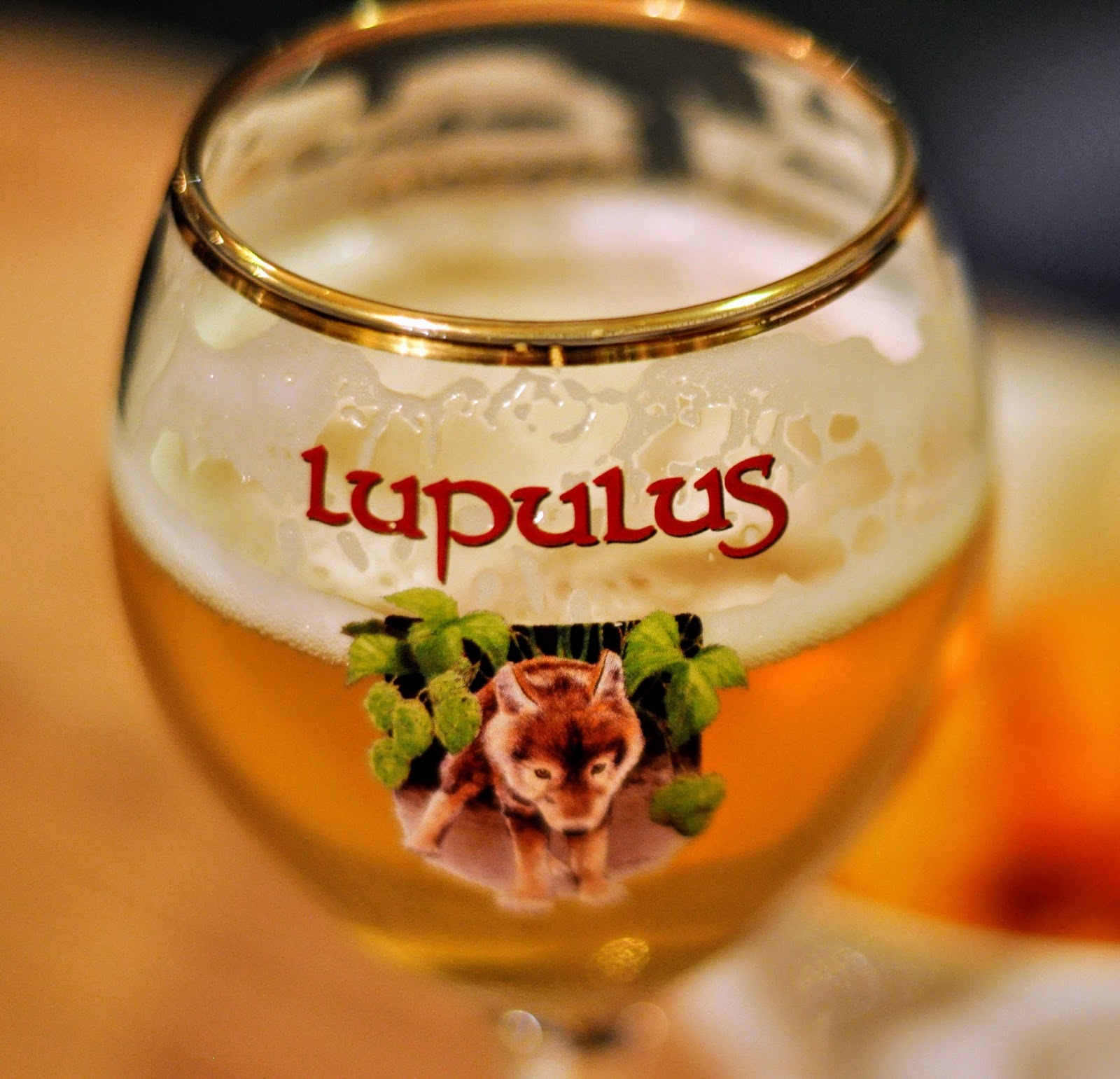
Ratebeer lists Tripick as a "client brewer," with the beers made at 3 Fourquets (which recently changed names to Lupulus to match its beers). Using the contact form on the Tripick website, I wrote them about a week ago to ask. I haven't heard back yet, but I'll update this if I hear back.

(Another disclosure: I have admin privileges at Ratebeer, so I can help to keep the Belgian stuff accurate. But generally the two Belgian admins they have are so on top of things that there is not much for me to do.)

Lupulus, led by Achouffe co-founder Pierre Gobron and his sons, is in my view one of the best breweries in Belgium. It has gradually improved its spicily-hopped, technically excellent beers over the years, and they were already good when they debuted a decade ago. If I were hiring them to brew the brand I was selling, I would boast about it. Lupulus is not likely to let a bad beer escape its gates. If they are brewing Tripick, that says much more to me about the beer than the "award."

About beer awards: The cynical view holds that they are really for brewers and marketing folks, not for consumers.

That's not a view I want to hold. Given the immense variety of beer we have these days -- much of it overpriced, much of it mediocre, some of it poorly made -- taking a look at reputable beer awards can be a useful way to cut through the bullshit and identify beers that in all likelihood are worth trying.

But does anybody do it that way?

I like to think about an imaginary shopper in the beer aisle, checking the labels to see if there is a gold or silver of this or that award competition stuck on there. If the prize is there, and only if the prize is there, the shopper will buy it, because that's how he or she knows it's a really good beer.

Why do I like to think about this shopper? Because it makes me laugh. It's absurd. Nobody does that.

I mean, it's plausible that someone iffy on whether to buy a beer sees that award on the label or website, and that information provides the final nudge that gets that beer into the shopping cart. More likely: We peruse lists of awards for breweries that we know or that are in our backyard, or possibly for the styles that we drink most often, for a couple of ideas on what to hunt. Then, maybe, we remember to keep our eyes out for it. Maybe.

But there are oodles of these competitions now -- some of them very well organized, some more mysterious, some international, some more local -- and I have to imagine it's increasingly difficult for typical drinkers to care or even notice them. In the absence of information, award inflation has devalued the prizes.

That is not to say that consumers can't use them for good. It would be helpful to identify the strongest competitions. Find out how many entries each competition gets, and from how broad a base in terms of geography and brewery size, and then look at how many prizes they give out in the end. I don't know what the percentage of prizes-to-entries ought to be. But it ought to be small. (And to the credit of the WBA, at the international level there is only one award for each style category.)

Another thought: Shops or pubs are in a position to know more about which awards and ratings are serious enough to be useful as recommendations. Tagging the shelves could help sell better beer to those who hunt it.

And this should go without saying, but if you see an award plastered on a label, website, or a brewery's office walls, don't take it for granted. Interrogate it. Looking at the fine print might tell you something about the quality of the beer. Or it might say more about those doing the boasting.

*First pic of a Lupulus, not confirmed to be the brewery that makes Tripick but it probably is.
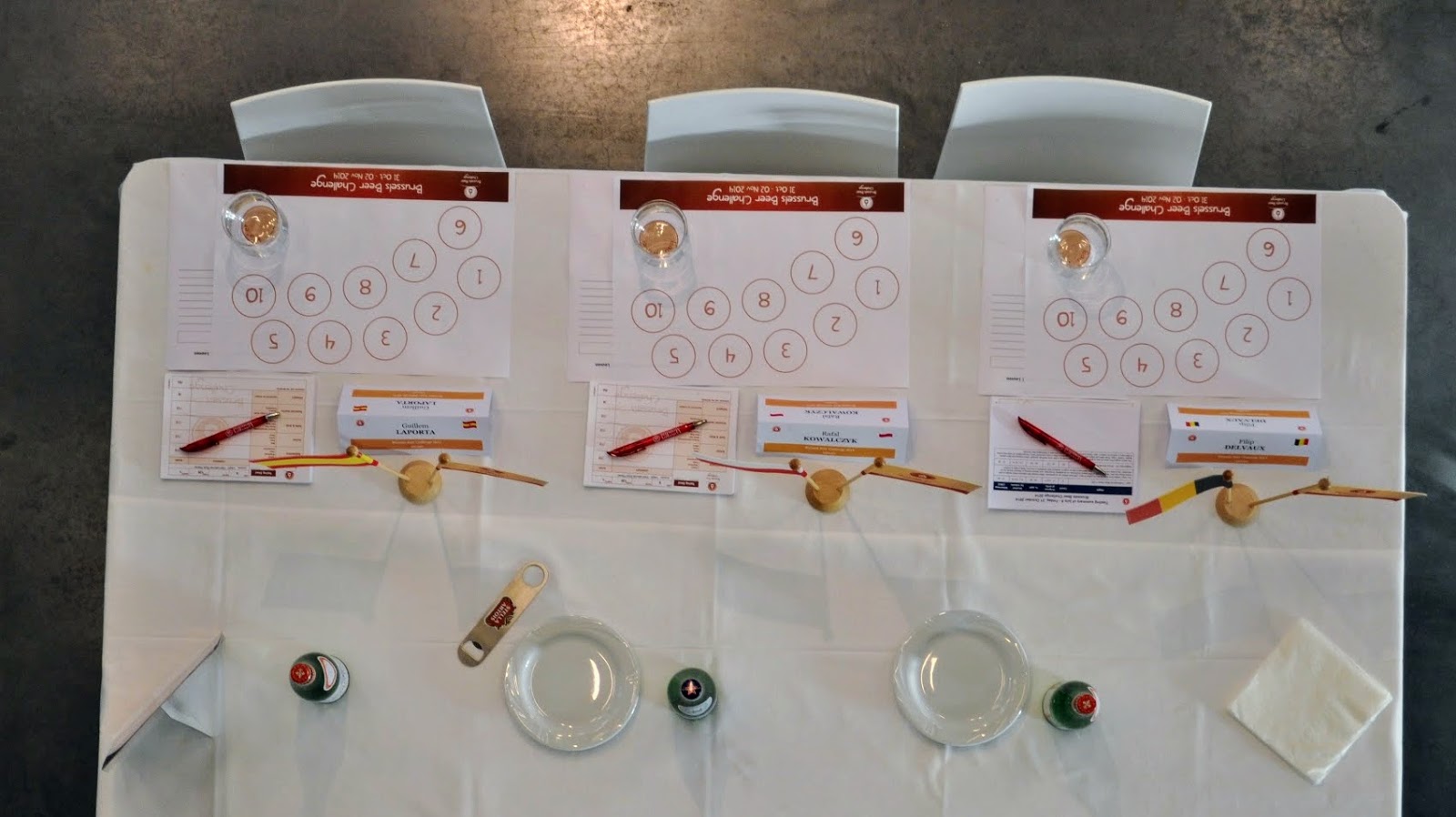
**Second pic of the Brussels Beer Challenge, which in my view (biased, as a frequent judge there) is a world-class competition.
***More disclosures: WBA paid me a small stipend for judging a few years ago and covered my train ticket to Hamburg this year. Brussels Beer Challenge usually pays for my hotel room but not travel expenses. Airfare is cheap so I rationalize it as research and education. But also it's fun to do.

Thursday, May 2, 2013

Highlight #9: Idealistic Beer, Idealistic Prices.

We were getting toward the end of a day bouncing around the Ardennes when we finally went in search of the mysterious Periple en la Demeure.

So we found it, and we drank, and we solved no great mysteries. Had a nice time though.

Periple en la Demeure--something like "Journey in the Abode"--is the home of Brasserie Oxymore, in a village called Limerlé. It's an easy drive from the Trois Fourquets, makers of Lupulus, or the Vielle Forge B&B, home of Inter-Pol. You could easily do all three in an afternoon, rolling into evening.

Oxymore is one of several tiny outfits that get a full listing in Good Beer Guide Belgium because it is officially a brewery, even if it doesn't brew on any sort of regular schedule. I'd never met anyone who had actually been there and tried the beer. So someone has to do it, right?

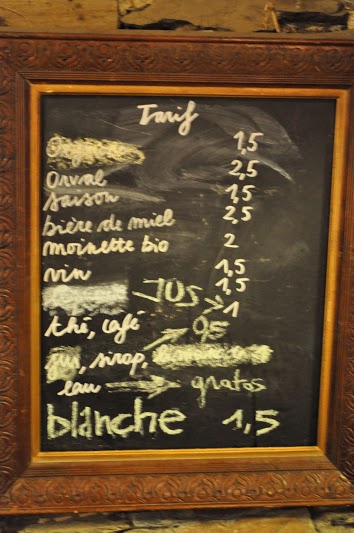
Let's get this out of the way: I still haven't had their beers. They were all out of Oxymore. You can see it scratched out in the photo of the chalkboard. It was said to be an odd blond ale around 5% strength.

They did, however, have Saison Dupont at €1.50 a glass. There are more direct routes to my heart, but only my wife and children know them.

You see, they are interested in many things at the Periple en la Demeure. Profit is not one. I am a huge fan of communitarian ideals when they arrive in the form of world-class beer, bought cheaply. It's not a business. It seems to be more of a project based on the arts and an ideal of agrarian sustainability. You can come to play music, screen films, bake bread, talk philosophy, plant veggies, or raise a cow. I'd like to be more specific, but I'm not sure I understand all of it. It's not that I don't speak French. It's just that it's been years since I was fluent in idealism.

For our purposes: Periple has a bar, with more reliable hours in summertime. Weekends only, I think. Atmosphere is honest, simple. There are a few tables in the lot, while the bar is cellar-like and cozy, with a lot of brick and artwork. It sells a few wonderful beers at cheap prices, and even makes its own from time to time. And the people there--at least the ones we met--are really tickled that travelers might pop in for a beer.

The one that Oxymore makes is no longer called Oxymore. It's a new recipe, called Hypallage. So they are continuing with a theme of literary devices. You can see the old-timey label here. Benoit Toussaint of the Periple told me that it's a red-amber ale of about 6% strength. The concept is "low mountain beer, brewed with pride."

This is my translation of his French, so apologies in advance, but he called it a "peasant beer, evolving, exploring the possibilities of brewing with a certain tendency toward building autonomy." In modern English we might say sustainability, using ingredients that are as local as possible. (I have no doubt that they would grow all their own if they could.) He said specifically that they want malt made from local barley, and that they would like to distribute to places that share their ideals. That includes searching for local solutions, and the belief in décroissance, or degrowth. Making a smaller footprint, and so forth.

"In other words, we reason and act for beer as for bread, since the products are cousins. The bread we bake ourselves, stone, wood-fired, and prepare with local grains. We grind in a watermill that we restored and returned to work. We plan to increase the production capacity of the brewery. In summary, this is not just a beer, it is also a process."

The cynical side of me finds most of that very naïve. But here is a really elegant way to shame cynics and get them to think seriously about your ideals: Sell them excellent beer at low prices.

I'd be willing to sweep aside all remaining skepticism if the beer turns out well. Let me know if you find out.

That's a highlight from a Belgian beer swing. Will I ever get to #1 at this rate? I have my doubts. Here's an explanation if you're wondering what I'm up to.

Monday, November 19, 2012

Familiar Faces in the Ardennes.

During the summer visit to Belgium I had a rental car for several days. The day I arrived in Luxembourg was not one of them. Starting that morning in Antwerp, I took trains to Gouvy. Then I hopped a bus to Houffalize, and from there lugged my wheeled suitcase down a bumpy path between pastures -- the cows were amused -- to the Vieille Forge.

The Vieille Forge is a B&B which is also home to the new-ish Inter-Pol nanobrewery, but I'll get back to that. This is in Mont, a village with a strategic location for beer travelers. From the lodge you can take a 15-minute walk through more pastures and down the hill to another village named Achouffe, which has basically been taken over by the eponymous brewery. Beer lovers can go to the Taverne there and enjoy Chouffe Houblon. Soup lovers who prefer copious coriander to hops can drink one of the other beers instead.

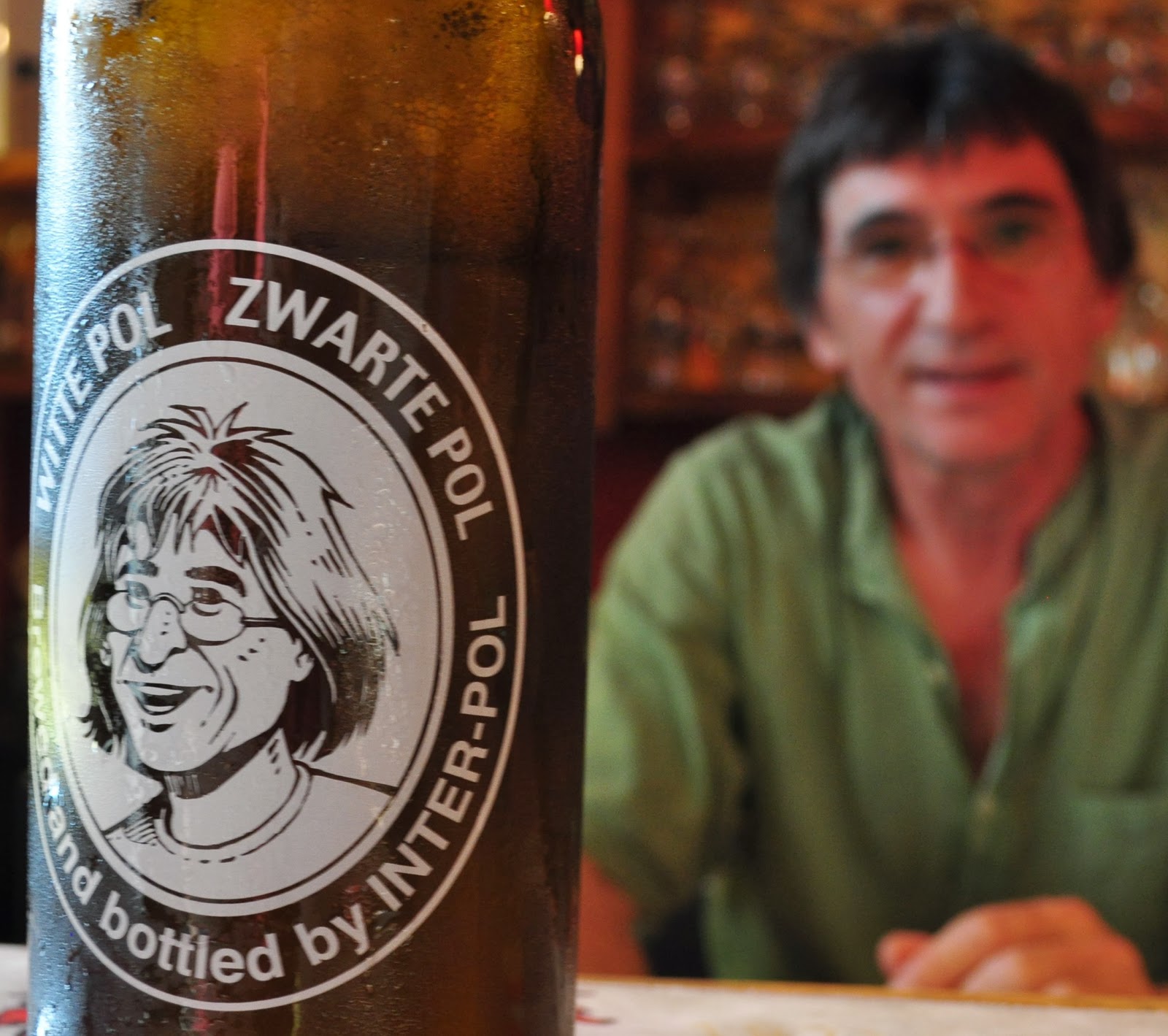
Here I wrote a rant about the travesty that La Chouffe has become. Then I deleted it. Much more interesting to talk about Pol's little brewery, as he puts it, the second largest one in the Achouffe valley.

Beer-traveler types were coming to Vieille Forge for years before there was a brewery here. Andy Neil, he of Bier-Mania tours, was the one who turned us on to it. Tine and Pol let us camp in the yard when the inn was full once, for the Grand Choufferie. (And what a piss-up that is, lots of folks drinking 8% Chouffe from kegs like it's lager, then attempting to climb stacks of beer crates. Highly recommended.) People came for proximity to Achouffe and Luxembourg's many natural charms, and for Tine's cooking, but they stayed to hear Pol talk about his brewery. He dreamt, then planned, then worked on that stone shed in the driveway -- the old forge itself. It opened in 2010.

The main two beers are the Witte Pol and the Zwarte Pol. The white is classic Belgian Witbier laced with citrus zest, refreshing, while the black one gets light sweetness from milk sugar and some bitterness from cacao. Both were intriguing and more than a bit mysterious, the types of beers you can sit and get to know over a couple of bottles. Neither was overdone in its spicing. Maybe Pol knows things that the brewery down the hill, where he leads tours from time to time, has forgotten.

Pol's beers (and those of the neighbor, and its parent company) are available at the Grand Café, the petit bar that takes up half the old forge. It opens Fridays and Saturdays at 5 p.m., very handy for guests who have been touring all day. It seems to have a few local regulars as well. Past and present brewers from down the hill have been known to appear.

It's worth noting that this makes a serviceable HQ for exploring the Ardennes, whether it's war monuments, trout fishing, or breweries you want. Or some combination thereof. Near enough are Trois Fourquets, Ferme au Chêne, Fantôme, Oxymore, and others.

Good thing my friends showed up the same night I did. With a car.

Friday, September 25, 2009

The 'S' on His Chest Stands for Saison.

One of my favorite places in town has revamped its beer list a bit. Nüetnigenough—hold on a second, do you need a pronouncer? I'm no authority on Brusseleer dialect (is anyone?), but I seem to get away with saying it like this, really fast: noot-neeg-enough. Practice.

Nüetnigenough's beer list shrunk from 28 to 25 but now contains no nonsense whatsoever. Light, bitter Taras Boulba and aromatic but sweet Lupulus are there now, plus a rotating beer of the month. In September it's the big and malty but nicely bitter Quintine Blonde from Ellezelloise.

There's also a new one from West Flanders called Papegaei, a blonde of 8% strength. It's said to be from a new brewery in Diksmuide called Verstraete, but in fact it appears to be made at Deca Services—nothing to be ashamed of. The same kit has hosted the brewers from De Ranke (now in Dottignies) and Struise (getting ready to move a few miles away into schoolhouse-turned-brewery).

Can't tell you what Papegaei tastes like. Not when there is Saison Dupont on draft, helping me tear through two large veal meatballs and carrot stoemp. I have no strength in the face of that beautiful kryptonite. Golden, quaffable, thirst-quenching, liquid kryptonite.

Wednesday, November 12, 2008

What's Your Best Train Beer? And an Argument for Cans.

I'm not talking about the tin-can, train-station swill to which we often resort when nothing else is available. I'm asking about your greatest coup... What's the best thing you've drunk on the train? A Westy, maybe? And did you have the proper glass for it?

It's an occurrence that borders on tradition... We take the train from Brussels to some beer fest or other event, out there in the hinterlands somewhere. We memorize the departure times of the last three trains back to Brussels, and we never ever catch the first two of these. Oh hell, we can spend these last 10 tokens if we wait 40 minutes and go for the last train out... Then, 50 minutes later: Time to book it! Grab something good for the train!

After the hop fest in Poperinge we went with the Petrus Blond, a bit sweet and pretty drab by Belgian standards. The Bavik café next to the station was happy to oblige, even if they had never heard of the brewery's aged beers. It got the job done.

Following last year's Brassigaume my friend Matt and I grabbed one (or was it two?) bottles of Saison Dupont and made use of our tasting glasses. Then the train packed up with post-holiday students on their way back to school, standing in the aisles and sitting in each other's laps. We felt it was only polite to share. By then I felt a bit ill from motion and claustrophobia and just possibly from too much beer. Unfortunately a pack of younglings had hemmed me in, preventing ay dash for the men's room. I managed to fight the bear and win, as we say in the Ozarks, but that was a long ride back from Marbehan.

Then last Friday was Hasselt's excellent Bierweekend. After more than three hours of festing Kjeld and I accidentally-on-purpose missed the last direct train to Brussels and opted for the change in Leuven. We grabbed two 75cLs for the ride – the hoppy blond Lupulus from 3 Fourquets and the quasi-mysterious Helkiase from Dupont. (I suspect that last to be the Vielle des Estinnes with another label, this one made for a medieval hospital museum in Lessines.)

Both were tasty but that saison-ish and refreshing Helkiase really won me over. Unfortunately it also hit the seats and the floor. I returned from a trip to the toilet to find a guilty-looking Kjeld and beer splashed everywhere. Apparently the train had lurched and he was unable to save my glass. Something seems to have dulled his reflexes. We were the only ones riding the train except a conductor, and he was less than impressed.

That's the problem with glassware on the train, isn't it? Once it spills, you've lost that beer. But a tin can... You might lose a few glugs before a dramatic and triumphant rescue.

That gets me thinking more about cans. I'd love to see a few Belgian craft breweries start using them, as some American ones do (see 21st Amendment or the mighty Oskar Blues). In terms of quality there is no reason not to do it. Yeah, there's a certain loss of aroma and prestige.

On the other hand, you look like a real asshole drinking from a tulip glass while fishing.

Monday, July 28, 2008

Speculatin' on a Hoppy Hypothesis.

I'm not a "hophead" per se. I'm not very interested in uber-double-imperial-IPAs or the latest hoppy monsters unleashed by extreme American breweries. But I did hone my palate on American craft beer. And I do pine for Belgian ales with more hop character--especially if they can also be refreshing.

Here's some welcome news then: Hoppy Belgian beers are on the rise. Anyway, they are according to all of my sloppy anecdotal evidence.

Witness the interest in products like Chouffe Houblon, made strictly for the U.S.A. but guzzled down like mad in Brussels whenever Delirium Café opens a keg. The locals also appeared to be loving the stuff on tap at the brewery's resto in the Ardennes. And it was popular enough that Moortgat rushed out its expensive and clumsy Duvel Tripel Hop to grocery stores before the holidays last year.

The small Senne brew firm exports its bitter and quaffable ales, but meanwhile its working overtime to meet growing demand in the local market. Estivale from La Rulles is also a popular choice. Géants recently hopped up its Saison Voison to nice effect.

And the last Zythos festival, a popular event to launch new products, offered a wave of hop-focused beers: Anker's Gouden Carolus Hopsinjoor, Alvinne Extra Restyled, Lupulus from Les 3 Fourqets (run by the Achouffe co-founders, incidentally), Slaapmutske Dry-Hopped Lager (made at Proef), and Cuvée De Ranke, a hoppy blonde blended with lambic. That's just off the top of my head. The next year will no doubt bring more.

Here's what I'd really like to know: Is this only because of the American export market, on which most of the small breweries depend? Or is it possible that Belgian drinkers also long for stuff that's not just sweet and strong and also isn't the same-old lager?

Guess it doesn't matter much. Long as it finds its way into our bellies. Meanwhile, feel free to blame Belgian brewers for their part in the global hops shortage.