Monday, December 17, 2018
What's Up with All Those Belgian Christmas Beers, Anyway?
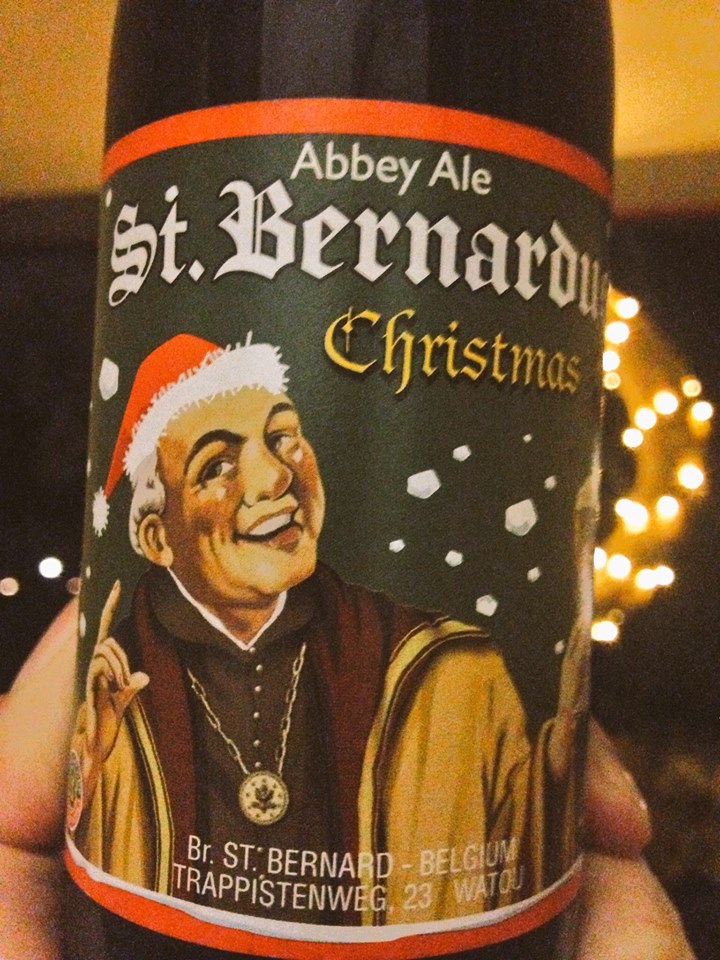
The Kerstbierfestival is in Essen, at Belgium's North Pole (near the Dutch border). The organizers go to great lengths to source every Belgian Christmas beer they can. Their first was in 1994, when they were able to find 38 of them. At that time there were about 110 breweries in the country.
What we can draw from this? For one, we can see that the number of special Christmas brews has expanded right alongside the number of small, independent breweries. That makes sense. It also makes sense (to me, anyway) that the existence of the festival in Essen has had something to do with it. Brewers know the event and want their beer to be a part of it.
So those are a couple of the possible answers to the question of why Christmas beers have become such a big thing in Belgium. Here are some other explanations I've heard or read at various times:
The faux-historical one: In the legendary old days the Belgian farmer-brewers would have had surplus grain after the harvest, so they would brew stronger ales to enjoy for the winter holidays. It's somewhat plausible and makes a nice story. I haven't found any evidence of it.
Palm started it: In 1947 it released Palm Dobbel, a somewhat stronger version of Palm delivered to clients as a thank you, and also to celebrate the brewery's bicentennial (based on a now dubious date shrouded in mist; in 1747 it would have been the De Hoorn farm brewery, which is older than that). Off the top of my head I can't think of any present-day Belgian holiday beers older than this one. That doesn't make it the first.
No, Artois started it: The story goes that Artois in Leuven introduced Stella as a Christmas beer named, sort of, for the Star of Bethlehem. However our friend Evan Rail has had a look at the brewing records. Trouble is, the brewery had fermentation problems with its earlier batches and didn't release the beer commercially until August 1927. From then on it was year-round. Thus I feel reasonably confident in declaring the Stella Christmas story to be nonsense. (Interestingly, the AB InBev site says it released Stella as "une bière de Noël, respectant en cela une coutume de l'époque," or "volgens de toenmalige traditie." That is, according to the custom of the time. So, maybe holiday beers really were a thing back then. Or, maybe we should be careful not to trust anything found on marketing websites, and this one in particular.)
Blame the British: Senne brewmaster Yvan De Baets -- whose Zinnebir Xmas is one of the best -- once told me his theory that the Belgians got the idea from the British, especially after World War I. This was a time when the Belgians were trying out pale ales and stouts too, so why not Christmas ales? (But as with other consumables, the Belgians have a special way of adding their own panache.) This is a rather plausible theory that also matches up somewhat with the timing of the Palm and Stella stories. If it was a "custom of the time," maybe this is why.
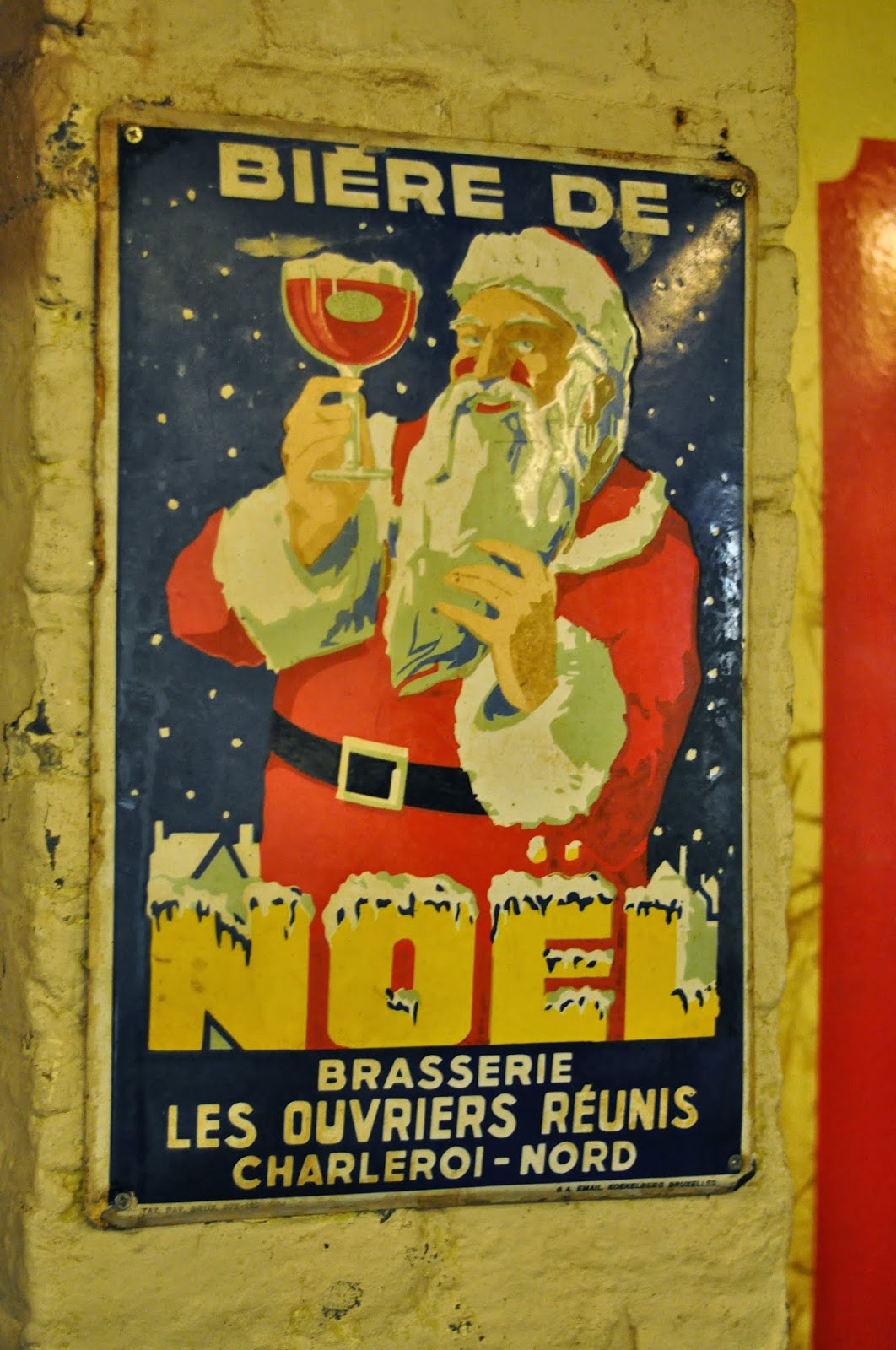
The capitalistic one: It's the money, stupid. You don't need to go to the Kerstbierfestival or fancy bottle shops to find Belgian Christmas beers. You can go to nearly any supermarket in Belgium and find endcap displays full of them. Or you can visit many corner cafés to find table tents and posters advertising brands like Palm Dobbel, Bush Noël, or Tongerlo Christmas, to name a few of the more common ones. They're nominally only available this one time of year, so many customers go for it. Not many brewers want to miss out on that.
More thoughts from De Baets: "As a brewer I can tell you what gets us moving, sometimes at least: We see clients, pubs, making an emphasis on Christmas beers at the end of the year and all the customers having their interest focused on them. So, what do we do? Well, we simply make one also. It maintains a interest in our products, it's as basic as that."
The truth may be some combination of all these things (er, minus the Stella bit): old traditions, good marketing sense, and a whole bunch of smaller breweries well versed in cranking out variety and oddities -- what's one more, to them? Why not join the fun?
Wednesday, October 10, 2012
Caution: Overlords at Work.
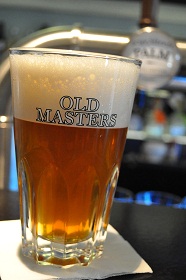
Old Masters! I'm unsure of which way to go on that. It has two distinct connotations for me: dead Renaissance artists, or scary science-fiction-fantasy overlords. Right. I'm going with the second one.
You'll heed the Old Masters and drink this if you know what's good for ye!
OK. That's a Palm Ongefilterd from the tap at Belga Queen in Brussels (please turn to p. 24 in your textbooks). The BQ is uppity Belgian cooking with impressive surroundings and magical toilets stalls, if you don't know. Beer list is Palm-Rodenbach-Boon-heavy. Mixed reviews on service but the food is usually good, they say. I can only vouch for the raw bar. You can do worse than a large, iced pile of various mollusks and a bottle of Mariage Parfait. (That was my birthday lunch one year. It was a good one.)
Back to the Old Masters. It is a label Palm has given to three its rare draft beers, which for years now have only been available to a small number of pubs. Among geeks the most coveted Old Master tick would be, I guess, the Rodenbach Foederbier, typically found only at the Zalm in Roeselaere (occasionally there are rumors of appearances elsewhere). The third member of the Old Masters is Boon lambic, three years of age. Besides Belga Queen and the Zalm, other cafés that get one or more of these beers include the Vosken in Gent, the brewery's own Brouwershuis in Steenhuffel, the Horta in Antwerp, and Engelbewaarder way up in Amsterdam. That's about it, as far as I know.
Actually Boon Oude Lambiek is available on draught in several places around Brussels and Payottenland, but only in those few pubs does it get the "Old Masters" treatment.
Are you ready for the strangeness?
The Palm website has a page devoted to the Old Masters. (Caution: Marketeers at work.) As the special glassware suggests, there is a CONCEPT at work here. So let's see what one of Belgium's largest breweries does with what are arguably its three most interesting (noting that interesting ≠ best) beers.
FLAT BEERS FROM THE PAST, NOW TRENDIER THAN EVER.oh boy.
Appearances are important too!Really? And did you know...
Flat beers are very digestible and moreover they spare you that bloated feeling in your stomach. However, a nice head looks good, which is why OLD MASTERS are served through a nozzle spraying fine jets of beer that absorb nitrogen from the air.
The consumption of carbonated drinks is dropping globally:Maybe I should say that I'm just poking fun and don't really have any great point to make. But promoting three beers of pedigree and mystique as "flat," and comparing them to water just before serving them via sparkler, is a head-scratching decision.
Flat water sells better than sparkling water
Lemonades are being replaced by fruit juices
This why the “Old Masters” are trendier than ever!
Or maybe it's best if we not question the overlords and just drink the stuff.
Thursday, August 16, 2012
I Take the Long Way to Veurne, and There Is a Party On.
Two things I always said I'd do in Belgium, and never did when I lived there: Take the coastal tram from end to end, and visit Veurne. Knocked both off the bucket list on the same day, two weeks ago.
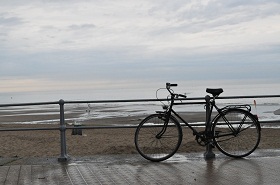
You can have a day pass on the Kusttram for a measly five euro-bucks. I start up in Knokke and ride down from there, popping off now and then to walk the seaside and look into certain cafés that need looking-into. I skip Oostende altogether to focus on the smaller towns along the way. If you can call them towns. At times the Belgian coast looks more like one long, skinny metroplex of high rises, blacklight mini-golf, cocktail bars, and trampolines. I'm there at the beginning of August, smack in the middle of high season. Tots are popping like corn on those trampolines while their guardians throng the beach bars and theoretically look on.
The whole area is ripe for specialist beer bars that know what they're doing. There are surprisingly few. Among those worth mentioning:
Toogoloog in Middelkerke is getting buzz among the geeks, and rightfully so. It keeps a smart list of 120 beers at last count. Recently being the only café in Belgium, as far as I know, to have Dupont Speciale Belge on draft gives you the idea. Naturally, the day I make my coastal swing is the one day a week that Toogoloog is shut. May you have better luck.
In Blankenberge, a block inward from the beach, next to the Casino, is the Royal and its wraparound corner terrace. You are watching crowds rather than waves, but it keeps 150 beers these days, including a couple of saisons and the odd curiosity, such as Seefbier. I make due with a St. Feuillien Saison, again noticing that the brewery has started listing Vitamin C as an ingredient. What's that about? Clever way to say "orange peel"?
In De Haan, a.k.a. the Cock-by-the-Sea, the great advantage of Torre is its location bang next to the tram stop. From my terrace table I can see the schedule of upcoming southward trams. Its card has 52 beers including Drie Fonteinen, hypothetically. My first couple of choices are out of stock so I enjoy an Oerbier and notice that Moinette is on draft.
Middelkerke has the ever-reliable Iceberg, with nearly 100 beers and seaside views. Like many in this region it is a Palm-Rodenbach-heavy list, but this one includes the stable from Gouden Carolus. I go with coffee. The day is long, and so is the Kusttram.
For now I'll leave out another handful of worthy cafés, because I said "specialist beer bars that know what they're doing." I'm not even sure that applies to all the ones I mention above.
The tram ends (and starts again) in De Panne. Now, many geeks will immediately think "Pannepot!" And they will hope that surely someone in De Panne is smart enough to stock it for the odd beery traveler. Well, they'd be... right, as it turns out. The Verloren Garnoare -- yes, the "Forlorn Shrimp" -- is where you drink while waiting for the train. It has Pannepot among its 50-plus beers, which also include Verhaeghe, St. Bernardus and Boon.
My train ride is a short one to Veurne, where a carnival is on in the Grote Markt. It seems I have just missed the town's procession of the penitents by a few days. (If there is anything the Flemish love more than beer, a friend once said to me, it is penance.) A sign says the party also marks an international kayak polo tournament. Initially I worry that I misread the Dutch, and that the reality is surely less weird than an international kayak polo tournament. I needn't have worried.
I check in at the Old House, which I can now recommend (classy and spotless former government building, converted to B&B, with a solid breakfast). It is now evening. Hunger pangs demand that I dispense with a scheme to rent or steal a bike and make for the Kunstemaecker. Instead I go with a local's recommendation: the Vette Os, a candlelit grillhouse attached to a shop specializing in unconventional world wines.
A well-marbled Irish ribeye and a not-so-unconventional bottle of Côtes du Rhône are my guilty pleasures on this night. It is easily the best steak I've eaten in Belgium, and I can recommend it as heartily as any coastal beer café. It's all a bit self-indulgent, but hell... I can celebrate penance and international water polo tournaments with the best of them.