Showing posts with label Dogfish Head. Show all posts

Thursday, September 29, 2011

Thirsty Pilgrim Roundup: Danish-American Elite Edition.

Question for those who have been to both the Great American Beer Festival in Denver and the Kerstbierfestival in Essen, Belgium: To which would you rather go?

GABF starts today. Long lines for beers and hundreds of people with whom I'd love to chat. Sounds like a lot of work to me. Thirsty, thirsty work.

Hey: It’s nearly time for you to take that long-dreamt-of trip to Denmark. By “nearly” I mean that your trip is approximately eight months away. May 11 and 12, 2012, to be exact. That’s when itinerant international-but-Danish brewer Mikkeller is organizing the first Copenhagen Beer Celebration. Says Mikkel Borg Bjergsø, "Our intention is to make a small, cozy festival where the main priority is quality." Laudable, I say even if it's tough to agree on what is quality. Interestingly (or not), the brewers lined up so far are mostly American. They include Jolly Pumpkin, Cigar City, Struise and Brewdog, among others. The announcement refers to them as the “absolute elite of the international beer scene” (again, according to whom? Ratebeer?). Anyway, “Mikkeller and Friends” would be a sitcom at least as interesting as that Dogfish Head show.

What we missed last weekend, along with the Beer Nut: The All-Ireland Craft Beerfest. (Is it weird that I'd rather be there than in Denver?) Among the participants: Eight Degrees, which I mention mainly because it will also be at that Mikkeller fest I just mentioned. An Irish craft brewery, run by an Aussie and a Kiwi. They appear to be pretty much brand new. Any reports?

Just south of DC, the old Shenandoah Brewing Co. -- where anyone could come and brew their own -- is gone (we made a couple of batches there ourselves there back in the day). Now the space will house a local edition of the Philadelphia-based Farmers Cabinet. Upscale comfort food and house-made beers. Brewmaster Terry Hawbakers says he’s into farmhouse styles, and that article mentions a funky, 3.8% abv grisette. “I think we want to focus on session beers,” he says. Promising.

From the Baltimore Sun, a visit to the Victoria Gastro Pub in Columbia, Md. Apparently the monthly beer tasting dinners there catching on (as they are in spots all over the country these days) and the chow is serious. Something to put on your Baltimore-Washington area to-do list. Let’s overlook the fact that the Sun writer referred to Lagunitas as “boutique” beer. That’s the sort of perfumey word that will send everyone running happily back to “craft.”

In Hoboken, N.J., a beer lover raves about the Gemütlichkeit at the new Pilsner Haus beer hall. Twenty-one taps with strength in Continental European beers and grub. Large mugs of lager. Everybody happy.

Thursday, July 28, 2011

Riffing on Beer Terroir, Scents of Place, and Belgian Upstarts.

This whole beer terroir chatter has the smell of a dog who's not going to leave my porch for a while. So I'm just going to keep feeding him. We'll see what he adds to the family.

Confluence, that's what's going on here. Lots of the people talking about the same thing and not even knowing it. It helps when you can give it a name or two and maybe even build a framework for thinking about it. A point of view. A set of questions to ask over bar chatter, or to employ when you browse the booze shop.

So: If you haven't already, go and read the Stan Hieronymous piece in the latest DRAFT, The Dirt on Terroir. Clicking on that link, by the way, does not excuse you from the good sense of plunking down a few duckets for the print magazine.

I'm not going to recap the whole article, but Stan's quote (circa 2006) from Sam Calagione of Dogfish Head is so juicy I've got to repeat it: "Je parl francais en peu, and I'm pretty sure the translated definition of terroir is 'dirt'. The wine world has wrapped this one word with mighty voodoo powers and created a cult of exclusivity around it. Breweries have terroir as well. But instead of revolving around a patch of land, ours are centered on a group of people."

Stan's kicker: "Don't call it terroir. Call it beer from a place."
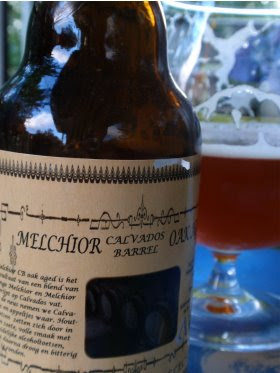
Now, remember that Washington Post article on "Belgium's upstart innovators"? Of course you do. It's the one with the likely-taken-out-of-context quote from Wendy Littlefield of importer Vanburg & DeWulf--the one about how brewers like Alvinne and Struise "really, arguably, are hurting the very culture that they claim to be arising out of."

Well, the Pour Curator recently had a long and interesting chat with Don Feinberg of V&D, which led to a long and interesting post. Feinberg has been deeply involved with Belgian beer for nearly 30 years, and his thoughts are enlightening. Here is part of the Curator's post, relevant to the aforementioned innovators:

When it comes to some of the new Belgian breweries, to Feinberg, the distinction is one of identity versus geography. Think of it this way: is a restaurant in Thailand necessarily a Thai restaurant? Well, maybe, in a grammatical sense, but if it serves burgers and fries, then not in the sense that most people might mean. Likewise, if a brewery in Flanders is making a great American style IPA, it may be making very good beer, but Feinberg and Littlefield would say it is not Belgian in any meaningful sense, other than strictly geographic.

"There are a couple brewers in Belgium who are making beer for Americans. We’re interested in Belgium, we’re interested in their traditions," Feinberg says. "There are certain flavors that are true to a type of culture, and if you don’t believe that, you’re one step away from making soda."
In my own email chat with Littlefield and Feinberg, which naturally followed that Washington Post article, Feinberg asked if I had read Jonathan Nossiter's Liquid Memory. I had not. So I bought it two days ago and have been devouring it since--mainly driven by all the obvious parallels (or near-parallels) with the craft beer world.

(In particular it brings to mind all the petty and more or less public squabbles among brewers, critics, lovers and sellers of Belgian beer. On some days, Belgian beer looks like a snake pit in which everyone talks hell behind each other's backs in a propaganda war to impose his or her view on the open-minded and undecided... Probably I've been guilty of that myself. And I'm not even sure I regret it. By comparison, North American craft beer looks like a church camp, complete with hand-holding and Kumbaya. For the most part, everyone in the North American beer world really does get along. The trade-off is a relative lack of really strong, critical viewpoints. Is it any coincidence that importers Don Feinberg and Daniel Shelton are two of the most outspoken people on the scene? But surely that's a post for another day.)

I have referred to brewers like Struise, Alvinne, Mikkeller and Brew Dog as not so much Belgian or Danish or Scottish but part of a postmodern, transnational craft beer scene--one for which globalizing forces (such as the Internet) can take some share of the credit or blame. I think it's a fair characterization. With that in mind, here is a snippet from the Nossiter book:
Terroir has never been fixed, in taste or in perception. It has always been an evolving expression of culture. What distinguishes our era is that instantaneousness and universality of change. Before, the sense of terroir would evolve over generations, hundreds of years, allowing for the slow accretion of knowledge and experience to build into sedimentary layers, like the geological underpinnings of a given terroir itself. Today layers are stripped away overnight, and a new layer is added nearly each vintage. "Why is this dangerous?" ask those genuinely eager for progress and modernity, as well as the conscious (or self-deluding) profiteers of this new world order. Because it risks wiping out historical memory, which is our only safeguard against the devastating lies of marketing and the cynical exploitation of global markets, culture and politics.
A lot to digest there. Thoughts?

I don't know whether this dog'll hunt, but at the least I'm taking him with me to the bottle shop next time. With all the options out there today, there are worse ways to narrow things down by sniffing out a sense of place.

Monday, June 20, 2011

Brewpubs, Drinking Local, Session Beer, and Tax Cuts.

In case you're still trying to work out where to take your summer vacation, the USA Today's travel section asks Andy Crouch to name 10 of the country's most interesting brewpubs. And it works in a plug for Andy's Great American Craft Beer book. So did I.

In a recent Beer Advocate column, Andy opines on craft brewers reducing their distribution rather than trying to compete in all 50 states. The Great Beer Retreat, he calls it. "We are entering a new era of craft beer, one in which selection around the country may shrink but where local beer will grow increasingly strong and entrenched roots."

Have a look at your own hometown. What do you see? In my hometown of Springfield, Mo., I see a brand spanking new brewhouse that sold 120 barrels to locals in its first two weeks. It has lots of room to expand. Now in Springfield there are people drinking craft beer who never gave it much thought before. It's easy to weigh that against a few hypothetical geeks ringing their hands over not being able to find some Dogfish Head special release. Very easy.

Three of my favorite things: St. Louis, D.C. and beer. So I was tickled to hear recently about the collaboration between Schlafly of St. Louis and three D.C.-area publicans of quality watering holes: Greg Engert of ChurchKey, Greg Jasgur of Pizza Paradiso and Sam Fitz of Meridian Pint. I was even more tickled to learn that the collaboration was a 4.2% abv dry-hopped pale ale called House in Session. The idea is to raise awareness about proposed cuts in excise taxes that would make life easier on smaller brewers. More info on that from the Brewers Association, if you're interested.

Yes, craft brewers lobby for handouts just like everyone else. At first glance it would appear to be a positive thing for drinkers as well, possibly leading to wider choice and (dare we hope?) lower prices. Here's more knowledge from the Washington City Paper.

Thursday, March 24, 2011

Sam Calagione Has a Dream.

I wouldn't normally interview fellow beer writers. I'd prefer to just drink with them. But when editors say "Jump!" I ask "How high?", do a couple armpit farts, and attempt a Triple Lindy.* So I'm writing an article about session beers, whatever those are, and my editor says I need to include the Session Beer Project. That would be the brainchild of beer writer Lew Bryson.

OK. Twist my arm.

So I was talking to Lew yesterday when he brought up this interview in the Atlantic with Sam Calagione. My first thought was, "Sam Calagione needs another piece in the Atlantic like he needs another nationally televised reality show." But I suppose the guy is as skilled an ambassador for craft beer as he is for his own brewery.

However, here are the question and quote that set Lew off:

What's a beer trend that you wish would go away?

See ice-cold beer! Above. Also, that session beers and extreme beers cannot peacefully coexist on the same shelf or within a brewer's portfolio...
Lew's response: "Who in the world thinks that? I don't think that."

The implication would appear to be that there is some groundswell of support for session beers out there, rather than just a handful of wishful writers and brewers, and that we want those extreme beers to get the hell out of our bars and our shops.

But that can't be right. It doesn't make sense. Every pro-session-beer type to whom I've spoken also loves strong beers, and beers of all sorts, and usually takes great pains to point that out. Instead, the rather obvious problem is that there are too few low-strength beers available, if any. Go ahead: Scan the strengths of your favorite brewery's range and see how many you find below 5%. Scan the draft list of your favorite taphouse. Practically speaking, besides a few wonderful exceptions, they just ain't there.

Sam Calagione is a smart guy. Therefore I assume he knows that very well. Therefore I choose to assume he is making a totally different implication. He is implying that taphouses and craft breweries should stop loading up their ranges with extreme beers, and start serving a few session beers to go along with them. So that they can finally coexist!**

In that case: Well put, Sam. Well put.

*"Is that hard?"
"It's impossible."

**Damn it, does this mean everyone's on the same side after all? Boring.

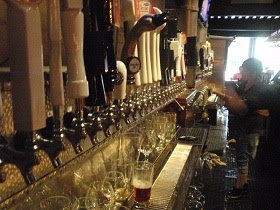
***Pictured: Behind the bar at ChurchKey. Just for fun, a scan of yesterday's draft list finds five beers below 5% abv: two German lagers, an English cask ale, and two English ciders. All coexisting peacefully with Bell's gorgeous Expedition Stout at 10.5%.

Friday, March 11, 2011

Flying Gnomes, Belgian Humor, and Aroma Hop Delivery Devices.

Thanks again to my friend and fellow Midwesterner Stefan Berggren, who just gives and gives and gets so little back in return. He's the one who spotted this Smisje label and sent it to me.

Remember the flying Chouffe video?

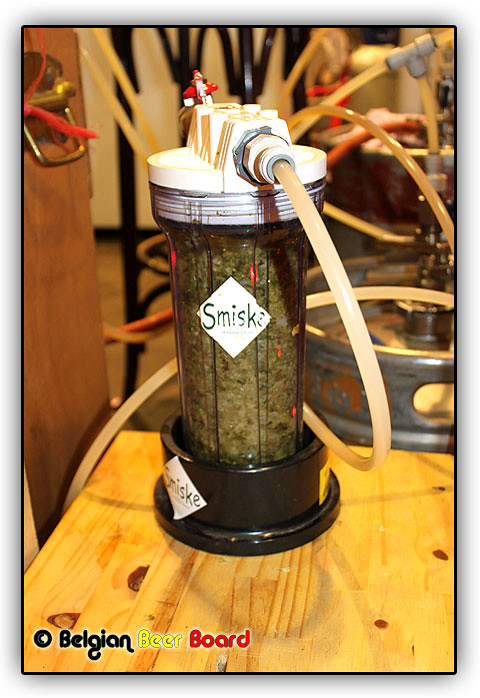
Speaking of Smisje: At last weekend's ZBF it made use of Dogfish Head's famous Randall the Enamel Animal. Have a look here, courtesy of Filip Geerts and his Belgian Beer Board. The strong pale Smiske ale got big smelly boosts from American Cascade and Palisade hops. So, any of you try it? How was it?

Back to the Midwest: Going to the Windy City anytime soon? Handy little article here from Time Out Chicago on spots to find small-batch beer, wine and booze. I note especially the Publican, which serves Becasse-inspired sweet lambic from earthenware jugs. In the future, all beer will be served from earthenware jugs. History is cyclical like that.

Speaking of the Midwest, again, this will be the 25th year for the Great Taste thereof. That's in Madison. That's where Stefan lives. My room is booked. He'll get what's coming to him. Meanwhile, good luck to anyone trying to peel me away from the real ale tent.

Tuesday, February 15, 2011

The First Chicha Post.

I'm researching the history of chicha. Corn beer. But first you get to hear my history with chicha.

Eight years ago (or so) I was in Peru, mainly in the Cuzco area to study Spanish and have a few adventures. One of them was to investigate those mysterious red bags that hung on long poles over the road. At some point I learned what the red sack meant: Chicha on sale here.

Now, we're not talking about the fruity, nonalcoholic, koolaid-like chicha sold in Peruvian restaurants. We are talking about the real stuff, fermented from the corn chewed up by village women. However, in the roadside shack I visited just outside Urubamba, the kindly abuela in charge didn't seem to have many teeth at all, let alone a whole set of chompers strong enough for chewing corn. Sadly my Spanish wasn't yet snappy to ask for an explanation, as she dipped my glass jar into a five-gallon bucket of what looked like dishwater.

If you count the skinny brown chicken darting around the inside of the shack, there were five of us in there. Besides the lady and I, a couple of grimy construction workers sat at the only table. They gave me big grins and made the hand gestures universally understood to mean, "Drink up, gringo!"

Funny: The drink that looked like dishwater also tasted like it. Soapy and a bit sour. Oh well. So maybe that old lady wasn't the Armand Debelder of chicha.

Have any of you tried Dogfish Head's chicha? Let us know what you thought. The video here includes Sam Calagione chewing and spitting, which will probably get my wife all hot.

Did chicha contribute to the downfall of the Incas and Aztecs? We'll find out very soon. Maybe even tomorrow. We'll even learn more about how to brew it at home. If you are so inclined.

Friday, July 23, 2010

When Does a Beer List Become Beer Porn?

I have a confession to make: I've been reading the draft list of Churchkey in DC almost daily for a few weeks now. I can't stop. It's just so... lurid.

And it doesn't even have any of those flowery, often inaccurate descriptors that plague the menus so many other haunts. There is only beer director Greg Engert's system of categorizing his offerings by broad yet useful profile: Crisp. Hop. Smoke. Cask. Malt. Roast. Fruit & Spice. Tart & Funky. Two pages, front and back, showing off a potent combination of quality, quantity and diversity distributed across 52 taps.

It's not the genres that turn me on, though. It's the actresses. Uerige Alt. Zinnebir. Bell's Cherry Stout on cask. Oliver's Bulldog Bitter, also on cask. Palo Santo Marron from a four-ounce snifter, which is frankly all you need. And these little starlets change every day.

What makes something pornography, anyway? To paraphrase an old Supreme Court ruling/joke, "I don't know, but I know it when I see it." Probably arousal is prerequisite then. I think this counts.

I haven't even told you about the food yet.

Wednesday, May 27, 2009

Brief Update on Setback at Drie Fonteinen.

Regarding questions left unanswered about the loss of 100,000 bottles of lambic at Drie Fonteinen... I can only help with a couple of them after speaking with Armand Debelder again on Monday.

First: Is the beer really ruined? Yes. There is no question about this in Debelder's mind. He told me that the temperature in the storage facility, after the thermostat broke, was higher than 50° C. If for some reason that doesn't satisfy you, chew on these words from the man himself: "There is one thing you can never buy at Drie Fonteinen, and that's a beer I can't get behind. Maybe I could sell some of these beers on the market, but is that what I'm working so hard for?"

Getting rid of the ruined beer is not as simple as pouring it down the drain. Debelder said it must be destroyed at a proper installation, and the nearest one is in Holland. "It would cost a fortune" to send it there, he said.

He is hopeful that the distillation project will work. An acquaintance once made a spirit from the Oude Gueuze and "it's excellent," Debelder said. "Probably it would be a very quality product."

Later, again regarding the spirit, he said, "This would help me survive."

Others (possibly including Dogfish Head brewer Sam Calagione?) have discussed taking up a collection to help the brewery. I mentioned this possibility, and a few times I asked Debelder what his loyal supporters out there could do to help. While he seemed touched, he changed the subject each time. Those who know him better may have more insight and decide to take the lead on such an effort.

(I would only state the obvious: Drie Fonteinen is not a charity, or even a nonprofit like the museum at Cantillon, but a very small business. That is NOT to say it can't be done, but it may need to be pretty clever. Again, I leave it to those who know better.)

As for whether he has insurance to cover the lost beer, I don't know. I honestly didn't think to ask and don't plan to bother him again about this for a while.

However, Armand Debelder is not down for the count by any stretch. He has some really interesting projects on the horizon. I hope to share them with you when he's ready to discuss them publicly.

Meanwhile, on the other side of Beersel, there is something concrete you can do to help out another traditional lambic maker. Gert Christaens and Oud Beersel could use some more votes in their effort to win the national Ultimate Makeover competition. At stake is €200,000 that would be used for a project to make the brewery more sustainable. Anyone with a valid e-mail address can vote once here (in French) or here (in Dutch).

And while we're at it, Cantillon, a.k.a. the Brussels Museum of Gueuze, is competing for the honor of best museum in town. You can offer your support here.

Monday, November 24, 2008

War, Beer, Beer, and Cassoulet.

Just a quick hello and a link for you. Short-and-sweet piece there on touring West Flanders. It starts with war but has a happy ending. De Dolle and the Poperinge Hop Fest get mentions. Mostly the piece reminds me of Ter Posterie, a great Ieper beer café and shop that sadly closed last year. To my knowledge nothing has yet moved into Ieper and filled that beery vacuum. Still a fascinating town and well worth visiting, especially for those with an interest in WWI.

Well, OK, one more link. Just to make sure you've seen the New Yorker piece on "extreme beers." Obviously there's a bit of a focus on Sam Calagione of Dogfish Head. Terrific piece of writing that does better than most to capture the innovative spirit of American craft beer these days. It's loooooonnnggg, but well worth your time.

On Wednesday we're off to Languedoc. This year it's cassoulet and red wine for Thanksgiving, kids. I might or might not get one more post in before going off the air until next week.