
Are you following my twitter thing yet? It's that thing over there, down on the left. I've been using it for stuff that I don't have time am too lazy to blog and yet might be useful. I resisted for a while. Now I'm not sure how I ever got along without DRUNK HULK.
 So... spring and summer travel plans. What are yours?
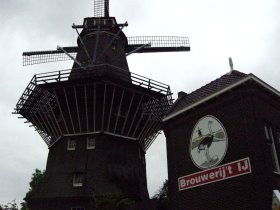
Maybe you'd like to go to Amsterdam. There's an 80 Beers guide for that, you know. Ron Pattinson still maintains his guide online, although you can also buy a dead-tree version. I own one, although I think it's an older edition. But I've used it. It works.
Finally, here's a free one: Mr. Chris Owen put this five-pager together for his own use. He has generously agreed to share it with you.
Then there's the Van Gogh museum. Saying you don't like Van Gogh is like saying you don't like the Beatles, it's either ignorant or a fucking lie.
Tomorrow (or else pretty soon): London. Or England. Or Britain, even. Whichever turns out to be larger.
Tuesday, March 27, 2012
Bloggy Quickness, Featuring Amsterdam.


Monday, March 26, 2012
Drie Fonteinen to Close Lambikodroom, Install New Brewery.
It appears to be sad news for those looking to visit lambic house Drie Fonteinen on their travels this spring and summer... but I'm not convinced the news is all that sad, in reality.
Brewer-blender Armand Debelder plans to shut his Lambikodroom tasting café in Beersel starting April 1, according to the café's website (in Dutch). The blendery will also cease all group tours until October 1, during the installation of the new brewing equipment.
To catch you up: Debelder ceased brewing operations for lack of funds after a thermostat disaster in 2009, although he never stopped blending lambics brewed elsewhere. His series of seasonal lambic blends launched last year, sold at a higher price which geeks have been happy to pay, has raised the money to re-start brewing.
Already I've seen messages from troubled beer travelers who had been looking forward to visiting Drie Fonteinen. They are fearful that it would be a waste of time. So let's put this news into context.
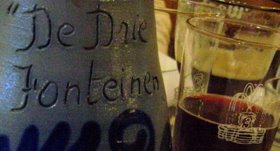 First of all, the Drie Fonteinen restaurant remains open and is one of the finest places around to enjoy traditional lambic with regional cuisine. Anyone who's ever been there for a bottle of vintage geuze with the Pajottenland salmon knows that it is never a waste of time. In fact, in my view, those who visited Lambikodroom but skipped the restaurant missed a key part of the Drie Fonteinen experience.
Secondly, the fact that Debelder and wife Lydie Hulpiau are re-installing a brewery ought to be welcome news to any Drie Fonteinen fan. The artisan will have full control over his product again, from fresh wort to blended and aged geuze (not to mention various experiments).
My advice: Swing by the brewery and see if anyone is there, perhaps say hello, and buy some bottles if the shop is open. The head directly around the corner and have a meal that ought to be on the bucket list of any lambic enthusiast.
I've asked Debelder and Hulpiau for more details and will share them right here if/when I hear back from them.
*Hat tip and hip-hop head nod to Jimbo Kowalczyk for sharing the news on BeerAdvocate.
Friday, March 23, 2012
Beer Festival Porn.
Festivals. Can't do them all, but thankfully the calendar starts to thick with them this time of year. I wonder if other geeks get as excited about their festivals as beer geeks do. Maybe. Anyway, for the beer geek who loves to travel, the festival calendar becomes a particular sort of pornography.
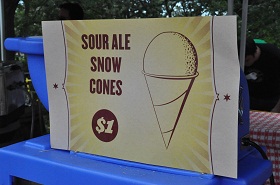 So, where to find your festivals? No doubt you have favorite sources already. There is the precisely named Beer Festival Calendar. Jeff Evans keeps a broad list at Inside Beer. For Belgians and belgophiles, Paul Briggs maintains his list (and I post it to the left). There are the Ratebeer and BeerAdvocate event calendars. And more.
Generally one can sort the fests and their locations into three categories: Wish I Could Go There, Maybe I Will Be There, and Hot Damn I Am Already There. Here are a few examples from my own perspective.
Wish I Could Go There: The most intriguing festival of 2012 is not in Copenhagen or Philadelphia or Moen. It's in Worcester, Mass., on June 24 and 25.
Co-organized by importers Shelton Brothers and 12%, here are two reasons why the event named simply The Festival is top-shelf: (1) the brewers themselves will be there, and (2) the sheer quality and breadth of those brewers (and the cider- and mead-makers too, let's not forget them). I can't think of another festival more likely to have so much excellence served by the people who actually, er, excel.
Pardon my cherry-picking, but among many more in attendance: Anchorage, Blaugies, Cantillon, Dochter van de Korenaar, de Molen, Drie Fonteinen, Haandbryggeriet, Hill Farmstead, Jandrain-Jandrenouille, Jester King, Jolly Pumpkin, Mikkeller, Pretty Things, Senne, Stillwater, Struise, Thiriez and Tilquin. Whew.
I was going to ask how they can afford to fly in all those brewers from around the world, but now we can guess: Tickets for a three-and-a-half-hour session are $100 $60 each. There are three sessions. A weekend pass to all three runs you $235 $160. Sadly not in my budget, but I understand why they are doing it how they are doing it. I intend to live vicariously through those who attend.*
UPDATED on May 4 to explain that my sloppy guess about flying in brewers was just that: sloppy. I'm told they are paying their own way. Also, the Shelton Brothers have dropped the ticket prices. Still pricey compared to typical beer festivals, but there is nothing typical about that one.
Maybe I Will Be There: We'll spend a chunk of our summer in the States this year, but our plans shift and flow like so much Mississippi mud. But one that's looking pretty fortuitous is the St. Louis Brewers Heritage Festival, tentatively set for June 1 or 2. But as Evan Benn reported yesterday, the website is dead and the date might change. So we'll see.
One quirk of this festival is that the brand names of the beers get left behind at the festival gate. Instead of promoting a specific product, the breweries get together and provide the widest possible range of beer styles and recipes. You might know which brewery made that walnut brown ale, but the point is not who made it or what it's called, but the fact that this is what one particular walnut brown ale tastes like.
In fact, the next festival I'm about to mention plans to do the same thing. But instead of 80 or so different styles, there might be 15. And some of them will come from homebrewers.
Hot Damn I Am Already There: You surely know the old Frank Zappa quote about how you can't be a real country until you have a beer. But there are real countries and then there are real beer countries, so here is a corollary: You can't be a real beer country until you have a beer festival.
Costa Rica is about to get its first one of any consequence. The first Festival de Cerveza Artesanal is set for April 21 at Avenida Escazú. I reckon 98% of you have no hope of attending (maybe next year), but for those of you who are already here or with the wherewithal, tickets are available for 15,000 colones (about US$30) at the Bodega de Chema in Los Yoses, TicoBirra in Pavas, or Costa Rica's Craft Brewing in Cartago.
I won't use this blog to bang on about the festival, but I might use Twitter to relay information from the organizers. I'll be there, but not as a journalist or an organizer. I'll just be a homebrewer on that day.
Thursday, March 8, 2012
The Pub at the End of the World.
The Black Sheep Pub is not a business. Owners Joe and Helena Wygal might call it a particularly expensive hobby. One friend described it as a museum. The word I'm going with is shrine--as in, a shrine to pubs everywhere and the beer that flows through their veins.
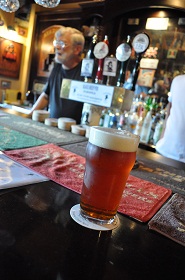 "I love the pub culture," Joe said over nonic pints. The beer was cool and not cold,* but the glasses sweat anyway in Guanacaste's jungle heat. "I had to start my own down here. It's not a replica. It's just a tribute."
The pub is its own small building but is essentially a part of the Wygals' private home. It is up in the hills near Nosara, popular for surfing and yoga and for being pretty far from anywhere else. Coming from San José, depending on traffic, you might be in for four hours of pavement and 45 minutes of gravel road.
We arrived at our hotel in Nosara and called the number, according to prior instructions. Gunter came to pick us up, and that's when the road got really bumpy. His stories distracted us from the fear that the potholes would rattle his doors off their hinges. And he came from the same city in Germany, Kiel, where my grandfather was born. Of course he did.
The journey adds much to the gladness of arrival, as does seeing four or five different beers on draft, which is almost totally unheard of in Costa Rica. On our visit Tim the barman (also the neighbor) was pulling pints from two Volcano beers, the Witch's Rock Pale Ale and Malo Gato brown, and three from Costa Rica's Craft Brewing: the red and hoppy Segua, the golden Libertas, and the sweetish and full-bodied seasonal IPA. It's got bottled imports too, complete with proper glassware. (The Duvel I had in mid-session was a pleasant strategic mistake, for which I paid the next day.)
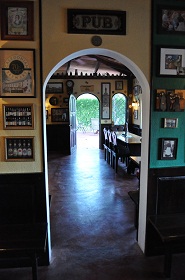
Utterly reasonable prices reinforce the fact that this is not a for-profit operation. In reality the prices are more like donations to keep the shrine going.
As a rule the Black Sheep is only open Saturday evenings, the occasional drinking holiday, and private parties. Prospective visitors should call 8928-5752 to inquire and ask how best to get there. Maybe Gunter will come pick you up.
*Update: Joe and Helena sent me a message, concerned that the everyday drinker would misinterpret this and think that the beer is un-cold. They prefer to describe it as "just cold enough." So there you go.
Friday, March 2, 2012
The Session: What Makes Local Beer Better?
The thing that makes local beer better is the same thing that makes my family's garden tomato better than the neighbors' garden tomato, even if it's not. Because it's fucking ours.
All things being equal, tie goes to the home team.
*More on the Session here.
Thursday, March 1, 2012
More Educational Hedonism in Belgium.
Where you might like to be this weekend, given your proverbial druthers: the Alvinne Craft Beer Festival, at Brouwerij Alvinne in Moen. For pleasure and for learning. Many of the selections on the list were carefully engineered not only to please the taste buds but also to raise eyebrows. And there is much to be said for that. On the other hand, you've also got a range of fairly reasonable cask ales coming down from the U.K. To rehydrate, or to reset the palate perhaps.
If you don't like the alphabet (and who does?), one way to organize these beers could be alcohol content. In that respect, Struise provides both bookends. At the high end, it brings along what was once a blonde ale before being concentrated by fractional freezing. Now, what is it? Barley wine? Liqueur? Who cares? It's 25 percent alcohol and called 5 Squared. If I were there, I might roll my eyes right before getting in line to taste it.
Then, on the other end of the spectrum, the Struise Single Black. That's "bob" stout of 2 percent strength, for designated drivers. In one place I saw this promoted as a "ridicule" stout. I'm not clear whether that was clunky English or a response from Struise toward those who would ask them for lower-strength beers. Either way, I'd be game to try it.
That reminds me: I posted an updated link to Paul Briggs' studious beer festival calendar a couple of weeks ago. Out of love. On Valentine's Day. You can find it here. Plan holidays accordingly.
Also, here's a bit of info from Chuck Cook on a newish and small brewery in Hoeselt, called Toetëlèr. Its flagship, of the same name of the brewery, is a Witbier flavored with elderflowers. They are doing other experiments.
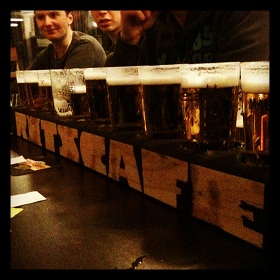 Last but not least: I've got a handful of excellent newish places in Brussels I've been meaning to tell you about. I'm going to ration them out like treats. So here is the Rits Café at Rue Antoine Dansaert 70, a five-minute walk from the Bourse. Local aficionado Steven Vermeylen has become something of a beer curator there. (He helps to organize the always fun Vilvordia Bierproeffestival, which is coming up on March 24.)
At Rits, there are a few commercial beers but featured breweries also include Cantillon, Senne and De Ryck. Vermeylen says that storage is an issue so the list is always changing, but soon he will add another list, the "master's choice, with a dozen rare Belgian and foreign beers." He calls it his "playground," and it promises further fun and education for the beverage-inclined.
*Photo by Lena Van Goethem.
Monday, February 20, 2012
Thursday, February 16, 2012
How a Couple of Really Interesting Beers Are Made.
L'Enfant Terrible and bottled Oude Faro from De Cam are the subjects of our discussion today. A couple of new, hard-to-find, sourish Belgian beers made in funny ways.
 The first one, from the still excellently named Dochter Van de Korenaar--I told you how fun that beer is. But I had no idea how it was made, besides the label's vague clue that it is a "gueuze-style ale brewed with wild yeast." Based on taste, my guess was an ale blended with Girardin or other lambic and allowed to mature. As usual, when it comes to me guessing about these things, I was wrong.
Here is the whole explanation, from Ronald Mengerik of the brewery in Baarle-Hertog:
L'Enfant Terrible is an odd beer. The basic beer is Bravoure, my smoked beer. After about two to three weeks fermentation as Bravoure the beer is transferred to oak wine barrels, where the beer is infected with lactic bacteria and Brettanomyces (both are local). Then, in four to six months the beer undergoes a lactic fermentation followed by a wild fermentation.About the smoky esters that go into a cocoon and emerge as beautiful butterfly fruity esters... pretty weird, right? I can vouch for it, as far as not noticing smoke. Oaky, yes. Smoky, not so much. But I've had the Bravoure a couple of times and, while fairly subtle, it is definitely smoky. So much of that smoke just disappeared in a puff of, er, fruit.
Smokey esters are changed into fruity esters by the Brettanomyces, which is a mystic and wonderful process. Then the beer is bottled by hand, and gets a refermentation of about two months.
Until now the production was very limited. I'm trying to upscale the
production. The demand is very much increased after winning a silver medal on the
'European Beer Star' this year.
I don't want to give you the wrong idea about L'Enfant Terrible. It had a rough edge and could use some refinement... The oak might have been a bit much, and there was some alcoholic heat. But it was a very tasty beer and damned interesting and I would buy another bottle given the chance.
Next: Bottled De Cam Oude Faro, about which there have been whispers, scant photographic evidence, and a small number of reviews.
I itched my scratchy head when I heard about this one. De Cam is a traditional little blendery. Bottled faro implies non-traditional corner-cutting nonsense. It implies pasteurization and/or artificial sweetening, basically. The background: Faro denotes aged lambic with candy sugar added. In hundreds of Brussels and Pajottenland cafés around the turn of the century (no, the other century), that often meant lambic from the cask and sugar from the little bowl at your table, stirred up with a spoon. But when you try to bottle that, the wild critters chomp on the sugars and churn out enough gas to make exploding bottle bombs. Hence the trickery.
I'll say it plainly: If the only faro you've had has been from bottles, then you still haven't had faro. For the real thing you'll need to book a trip to Brussels. And you should.
Digression over. I contacted De Cam blender Karel Goddeau. At first he was reluctant to let me write about it, as "we are only starting to experiment with it." I told him the cat's out of the bag and that it might be useful for lambic geeks to know that this one's a work in progress. So he relented.
Here's what Mr. Goddeau is up to: adding candy sugar to "very old lambic" and waiting to see what the wild critters do with it. In other words, they are fermenting the sugar and leaving behind a bit of extra flavor. He said the bottled beer should be nearly flat, "almost not foaming."
In his words: "I try to get it in the bottle the same as on draft on beer festivals, but I need to convince more then 99 other micro organisms to share my opinion."
Is there a common thread here? Maybe. Remember these two beers when someone says unthinkingly that Belgian brewers do not innovate. They do. But they do it at a different pace and within a different framework than anyone else. At times, it might as well be another dimension.
Thursday, February 9, 2012
Adventure as an Excuse for Beercation.
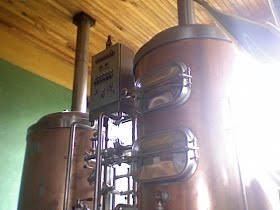
Sly folk looking to work crafty beer into their honeymoons or adventure travel would do well to mark it down. Two of the most popular destinations in Costa Rica are Volcán Arenal -- a proper, active cone rather than a big smoky hole in the ground -- and the laid-back beaches of Guanacaste, on the Pacific Coast. The smart way to get from one to the other is to rent a car and drive the northern route around Lake Arenal. Conveniently, that takes a thirsty gentleperson right by Volcano Brewing and the newly re-badged Lakeview Hotel.
No long ago it was called the Hotel Tilawa. We stayed there once, to meet the owner, J.P. Cazedessus, who was trying to get the brewpub started. The place was rough-and-ready; "in need of some TLC," was how we put it. In the off-season it felt like a private hostel. Now the hotel is under new management and a new name, while Cazedessus focuses on the brewery and eco-friendly housing projects. It remains a windsurfing destination, and there are options for hiking, fishing, boating, riding horses, whatever. Most importantly for our purposes, the beer is flowing.
Meanwhile: The flagship is called Witch's Rock, an American-style pale ale, and there are seasonals from time to time. The beer's name comes from a dramatic chunk of Planet Earth that juts out of the Pacific Ocean and enjoys a reputation for excellent surfing. Volcano Brewing is now connected to Witch's Rock Surf Camp in Tamarindo, where the pale ale ought to be on tap at Joe's place. So that could be your Guanacaste destination, if you're in need of one.
We stayed in Tamarindo not too long ago, and it was nothing if not versatile. You can get your high from wining, dining and massages, from surfing and sunsets, or from that friendly dude out on the sidewalk selling weed. Mix and match according to interest. Now, I reckon, we can add crafty beer to the list.
Tuesday, February 7, 2012
Brussels Grand Place to Welcome Hard Rock Café, Then Jump a Shark.
I was working on a long post breaking down this recent Bloomberg piece, which declares that "Brussels is for foodies." Which is true. It recommends 10 nice-looking and mostly expensive places to eat. I was going to show how few of them really give a damn about beer, which ought to be shameful in Belgium's capital. But there is no news in that.
Then I came across something really and truly shameful, and it put the other stuff into perspective. The news is that there will be a Hard Rock Café in Brussels -- and not just in Brussels, but on the Grand Place.
I checked the date. April Fools? No. But is it really a done deal? It would appear so.
We should not be surprised. The Grand Place -- one of Europe's most impressive city squares -- has been bogged down with tourist traps for years. They have indifferent service and overpriced, mediocre food. They hang old beer signs and give a superficial nod to the country's brewing tradition, and then stock nothing interesting beyond a couple of Trappists. Fine. At least they look the part. They are still brasseries and uniquely Belgian, even if we knew better places with better prices a few blocks away.
But the Hard Rock? Really? Has Brussels lost its mind? And now those of us --locals and foreigners alike -- who have labored to tell Brussels that it ought to have dignity, that it deserves some, are left to ask ourselves: Did it ever have a chance? Have we been wasting our time?
 "In addition to its food, Hard Rock offers unmatched specialty drinks from its award-winning bar menu, from Hurricanes and Margaritas, to its Alternative Rock non-alcoholic beverage menu featuring favorites like Wildberry Smoothies and Crushed Velvet 'martinis.'" Oh my.
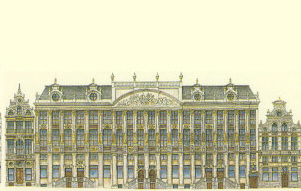
The address is Grand Place 12a, up in the southern corner. This building is also known as the Roi de Baviére (the "King of Bavaria"). Note that this is not the same building as Grand Place 12, which is two doors up from the Brewers House in the building known as the Maison du Mont Thabor. Number 12a is just across the mouth of Rue des Chapeliers, adjoining the Dukes of Brabant, next to 't Kelderke. You can see a map with addresses here. In the picture above, 12a is the lower building on the far right.
A nice place for some Hard Rock neon, right?
The Grand Place is a UNESCO World Heritage Site, and there are local protections that apply. The Hard Rock might have to leave the facade relatively intact, and may face restrictions on the aforementioned neon. According to news reports, a private investor owned the house and negotiated an 18-year lease with Hard Rock. If the company follows the same rules as everyone else on the Grand Place, it's hard to imagine how the authorities could or even should discriminate based on a history of tackiness. But you never know. The locals love a good protest, and maybe this will stir them up.
I'm sure there must be a class of tourist that would be happy about this, otherwise it would not be possible. Just don't blame the Americans: It's been 20 years since I met a fellow American who was excited about seeing a Hard Rock Café. And that person, I believe, had only recently hit puberty.
Meanwhile, Brussels says it plans to turn the Bourse into a national beer museum by 2014. I'd expect heavy support from A-B InBev, and all that such support would entail. The article says, "Unlike the Netherlands with their Heineken Experience, Belgium only has a number of small beer museums." As if that were a bad thing.
About the museum: The Flemish politician says something that says too much about much Flemish political thinking: "The fact that we have a special glass for every beer, with artisanal breweries tucked away all over the place is extremely charming for our Dutch visitors. Beer is a science in which we excel, and it could be perfectly showcased in a museum like this one. We feel the stock exchange is a prime location, even though 65% of all Belgian beer is brewed in Flanders."
See how he worked that last bit in? Absurd. Nevermind that Wallonia has only one-third of the country's population. But him singling out the Dutch tourist is interesting. Will the Dutch tourists who find the special beer glasses and little breweries "charming" think the same thing about a Jupiler museum?
And what will they think of the Hard Rock?
Finally, I have to note that Hard Rock's European operations VP, Calum MacPherson, said that the company hopes to make it an "essential gastronomic destination" in Brussels.
And there, ladies and gentlemen, is your perspective.

 Posts
Posts


