Monday, April 29, 2013

Mysterious Belgian Bar Snacks, Part III: Choesels.

It's been a quick five years or so since I posted a couple of entries in a hypothetical series called Mysterious Belgian Bar Snacks. Then this choesels thing came up. A long-delayed sequel, like the Color of Money and Wall Street II: Gecko's Revenge, or whatever that one was called.

A disclaimer, in the tradition of long-delayed sequels that are inconsistent with their predecessors: Choesels are not really a bar snack. I mean, they could be, but like many weird old peasant foods they're more easily found in upmarket restaurants that pay attention to local traditions. On the other hand, they would traditionally be accompanied by beer--lambic, most likely, because this is an ancient Brussels thing.

So, choesels! What are they?

I asked that very question some years ago at Restobières. And the waiter told me they were bull's balls. Well, how do you say no to that? Especially in the presence of friends and/or loved ones who (a) know you will eat pretty much anything and (b) heard the question and answer.

So, the other day: I'm scribbling something about Brussels food and come across choesels again. And I remember: bull's balls. Then my journalistic skepticism--a ponderous burden for anyone trying to make money by selling words--kicks in. And I think, really? Bull's balls? For real? Because journalistic skepticism sounds like that sometimes. So I spend more time than I should have googling around and learning that sometimes they could be pancreas or other bits and ends of the cow.

Not satisfied, I write to Chef Alain Fayt of Restobíères, known as one of the few chefs and restaurants still serving this local treat. And some days later I get a really fascinating answer, with historical context. Specific years and everything. He either knows the subject cold or spent some time researching; either way, I really appreciate it. Then I fix the spelling and typos just for you:

In fact, the choesels were the meal of poor people. It is an old custom. It was a mixture of different parts (breast of veal, oxtail, heifer sweetbreads, calf testes and pancreas) of beef. In fact, Gaston Clément (1879-1973) a famous Belgian chef ([royal] chef of the Belgian crown) published a recipe of the choesels in his book (1954) within included pancreas and testes. In 1899 and 1903, Jean de Gouy wrote in the 9th ed. of his book, La cuisine et la patisserie bourgeoise, that choesel is pancreas. Miss Lucas, a famous Brussels chef, has never used pancreas in the recipe of her Choesels. My opinion of this issue is that Choesels is a traditional meal and everybody can realize them with [their] personal touch. Personally, I do not put pancreas in my recipe, but [just] testes of veal.

I hope that it is now clearer for you.
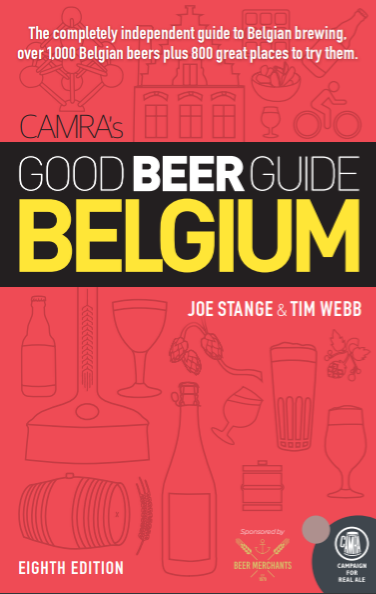
A recent frustration: I had lunch at Restobières last summer without taking a single photo that was worth a damn. So instead you get an image of his cookbook, La Cuisine à la Bière, which is hugely entertaining if your French is up to it. Choesels are in there. Rocky mountain oysters, Belgian style, and Fayt typically does it with lambic from De Cam. You can buy the cookbook at his restaurant.

Friday, April 19, 2013

More Fancied Beer, Less Fancied Prices.

Beerpulse posted a brief item yesterday, citing an Under My Host podcast, about Stillwater Artisanal Ales preparing to increase production nearly fourfold. I can flesh things out a bit.

The report mentions that he plans to lower prices but doesn't get specific. Strumke told me in late March he expects a retail price of $11 for a four-pack of Cellar Door, his best-selling beer. "That's re-inventing my company," he said, by going with bigger volume. Lowering prices, "that's been my goal from Day One, just takes time."

I also asked him about how often he is going to Two Roads, his new contract brewery. "As much as I have to be," he said. "Brewing at that level is very automated. I've been up there re-designing it, because it doesn't scale up. Once it's dialed in, it's more efficient, it's better. But you can't just multiply things. It doesn't work like that. You have to re-create the beer."

He added that his goal, of course, is keep the product exactly the same as before.

Currently Stillwater beers are available in 35 states. He said that now they'll go to "pretty much every state" and also more countries.

He is clearly excited about the idea of making "regular beer" but of a very high quality. "I want to re-invent the way that people look at beer," he said. For example, with his Classique--which will be canned--"it’s our grandfathers new beer. What is it? It’s not a saison. It’s not a lager. It’s a fucking beer."

I tasted the Classique on draft. It's an austere thing, bone-dry and pale, with nowhere for its spicy-resin bitterness to hide--fine with me, as I didn't find it abrasive. At 4.5% strength it can be drunk in volume, not just made that way. Like his Premium, it's got corn and rice, a nod to American lager tradition.

If he makes enough of this stuff, with the Brewers Association still think him "traditional"?

"Why can’t you make a good beer with corn and rice? That’s bullshit."

Now just for fun, here is something I wrote for DRAFT in 2010, appearing in the March 2011 issue:

His Stillwater Artisanal Ales are generally found in 750mL bottles that sell for about $12 in a shop. Not everyday beers, then, but ones to carry to a dinner party. I have no problem with that. My worry is that, in shop after shop, bottles like these are crowding out more affordable options for those of us who want great beer anytime, not just for special occasions.

With mutual friends, I met Strumke in Baltimore at The Brewer’s Art. We lounged on sofas and sipped strong Belgian-style ales beneath a really impressive chandelier. With my tact eroded by alcohol, I whined about the price of his beer and he offered a sensible response. Damned if I could remember what it was. So I contacted him again and just asked.

“First off, I don’t see my beer as being overly expensive,” Strumke said. Yet making beer in small batches means there are no bulk deals for materials, and, “with that said, I have set out to make uncompromising beers with the best ingredients I can obtain. Price is not a deterrent as the goal is extreme quality.”

Basically, Strumke is making a small amount of beer for a group of people who can’t get enough of the stuff. “Craft brewing is, like it or not, part of the epicurean and artisan movement,” he said. “In my case, I make beer for the connoisseur, those who understand what I am trying to do and appreciate my efforts.”

I like Brian’s beer and respect his view. He takes real pride in his product, and after that, sales are the only metric that matters.

Yet his argument worries me a bit. Epicures and connoisseurs tend to have larger beer budgets than typical drinkers. I don’t like a line of thinking that leaves ordinary drinkers with lesser beers. We know from experience that great beer doesn’t have to cost much. There are a lot of price points out there, and room for all of them. But I want to see more of them on the lower end. Somehow, I doubt I’m alone. ...
Apologies for that photo, which is poor even by my standards. Late night, lots of events, yada yada. I even had a real camera on me and apparently chose not to use it.

Tuesday, April 16, 2013

'All-Day' Beers and Usefulness as a Useful Standard.

Yesterday I spoke for a while with Mike Stevens, CEO of Founders Brewing, for an upcoming article in Draft.  While I had him on the horn, there was something else I wanted to know about: the All-Day IPA.

When I first met this beer in 2011 at the Great Taste of the Midwest, there was an iffy, experimental air about it.  It was a brewers' beer, one they had been tweaking and enjoying for a few years, and I don't think they knew if it would really take off with a public making noise for Kentucky Breakfast Stouts and the like.  On this blog I've banged the session-beer drum, mainly for selfish reasons (i.e., I want to see more of them).  But aside from a few cranky writers there has not been much evidence of any wider session beer trend.  Most of the buzz and attention has gone, and still goes, to stronger, more extreme beers or those with weird stuff in them.

Session beers are not sexy.  But maybe that's the point.

My argument has been that there appears to be money in lower-alcohol beers, if anyone cares to make it.  The country's best-selling beers are light lagers that hover around 4.2%.  Granted, they're devoid of character, but they do say something about what people find useful.  More to the point of flavorful beer--as session beers ought to be--is the popularity of wheat beers in North America.  Boulevard Wheat (4.4%) and Widmer Hefeweizen (4.7%) have paid a lot of bills.  Is it because they're made with wheat?  Or maybe it's the lemon!

Or maybe people are just, I don't know, fucking thirsty.

Now we're seeing more session-strength hoppy ales.  Founders All-Day IPA is one of the more visible ones. So, two years later, how is it doing?

"It's killing it," Steven said. "It honestly is. ... We knew we had something great there, we knew we'd have positive results, but we didn't expect the results we're seeing."

Partly by design, Founders goes for variety and lacks an obvious flagship.  Meanwhile All-Day IPA is on its way to becoming the brewery's top seller.

Not bad for a "seasonal." For now the beer is only available from March to September. It was the brewery's second-biggest seller in the year's first quarter... and it was only available in March.

"We can't make enough of it right now. It's crazy," Stevens said.  Canned 12-packs of it will arrive in July.

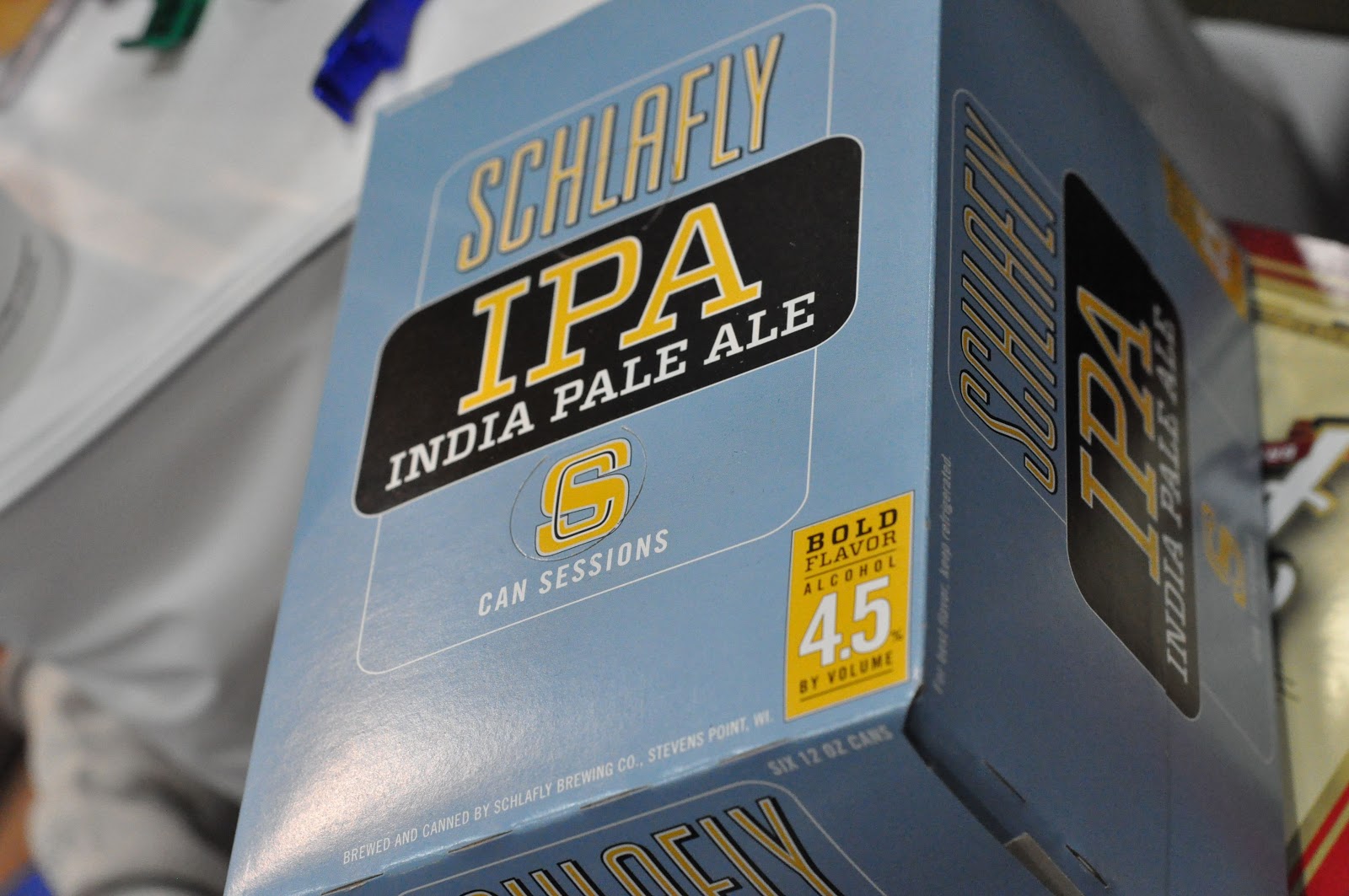
(And let's watch what happens with Schlafly's new IPA, available in cans and clocking in at 4.5%.  I bet it sells very well. Without lemons.)

All this happens while Founders is in the midst of a $25 million brewery expansion.  It sold 70,000 U.S. beer barrels last year and estimates 130,000 this year, as the brewery expands its distribution footprint.  A session beer is part of that success.

Funny how that seems to happen when brewers sell beers that they particularly like to drink.  People who work with beer tend to--shocking, I know--drink it often.  There is utility in reasonable strength.

"It gets more and more difficult to do these all-day promos, so a session beer was sounding really good," Stevens said.

My crazy-insane theory: a beer that is useful for a brewer tends to be useful to other working people too...  and those may be the drinkers who, aside from a few cranky writers, make the least noise.

Tuesday, March 19, 2013

Highlight #10: Le Resto des Saisons

The name of the place is La Ruchette, and it's in a village north of Charleroi called Viesville. That's about four kilometers from the optimistically named Brussels South airport.

I knew nothing about the Ruchette a few days prior.  It was not on any of my maps or to-do lists.  But a brewer recommended it, and that can lead to surprises.  So we went to check it out.

Near as we could tell, the "Hive" is the main attraction in Viesville.  It's on a square called Place des Combattants, complete with requisite war statue.  Its wide terrace on this quiet square allows outdoor eating and drinking in fine weather.  It was, and we did.

As it turns out, Viesville's village pub stocked 120 well-chosen beers, heavy on Hainaut regionals, saisons, hoppy things, and 75cl bottles.  Not bad for a little surprise.  In the refrigerator by the bar we spotted other bottles not on the beer card, a sign that the owner is always looking for new things.  He said as much to us later, and recently told me by email that he's updated the list again.  So the number may be bigger now.

It's a meat-heavy menu; we went for the daily "lunch rapide" special: house steak-frites.  The frites were not dumped on the plate but nicely presented in one of those dainty cone stands, like this one.  We were pleased.

Oh, and we drank.

The list features Dupont, Ellezelloise, Géants, Rulles, Senne, plus some lambics, all the Trappists.... We knew right away we wanted something saison-ish in a 75cl bottle to share, but which?  In the fridge we spotted a bottle from the would-be Brasserie Deseveaux, a buckwheat saison called Sarazen.  But you already knew that, because you peeked at the photo.  Turned out to be a fine food beer.  Just barely off-dry with a touch of caramel, but its most endearing trait was an honest sort of graininess throughout.

Incidentally, I recently contacted brewer Sébastien Deseveaux, who makes the beer at Proef, as well as a newer one with oats called Saison Avena.  He aims to have his own 15 hl kit installed this summer.  We'll keep an eye on it.

Anyway: one or two more there for you Saison Road-trippers to add to the list.
So for me, that's a highlight. More to come. Here's an explanation if you're wondering what I'm up to.

Wednesday, February 13, 2013

Highlight #11: The House of (Beer and) Cheese.

These are in no particular order, did I mention that? OK. Why, then, am I going in reverse numerical order, as if to make a big fat deal out of #1 if I ever actually get there? I don't know. Shoulda coulda woulda.

Oh, hey... do you like beer? Cheese too? I gather it's a big thing these days, pairing beer and cheese. No, scratch that, it's been a big thing for at least a decade now. Hey, you know who else loves beer and cheese? The Belgians. And they are pretty good at both of them. Don't get upset that most Belgians would prefer to drink wine with their meals, including their cheese. That's a global affliction, and Belgium is very close to France. But the beer-and-cheese thing, that's catching on there too.

OK, let's talk about meccas. Not the Mecca but small-m meccas, the kind that all travelers have. They're like bucket lists except you don't scratch them off the list and you don't worry about kicking the bucket. Instead you just feel a pull to visit there one day, or again, or repeatedly. In the Belgian beer world, the Kulminator is a mecca for people who like old Belgian ales. Moeder Lambic Fontainas is a mecca for those who like hops and lambic on draft. Westvleteren is a mecca for those who like the holy and hard-to-get. And so on.

So, how about a new mecca for the beer-and-cheese heads?

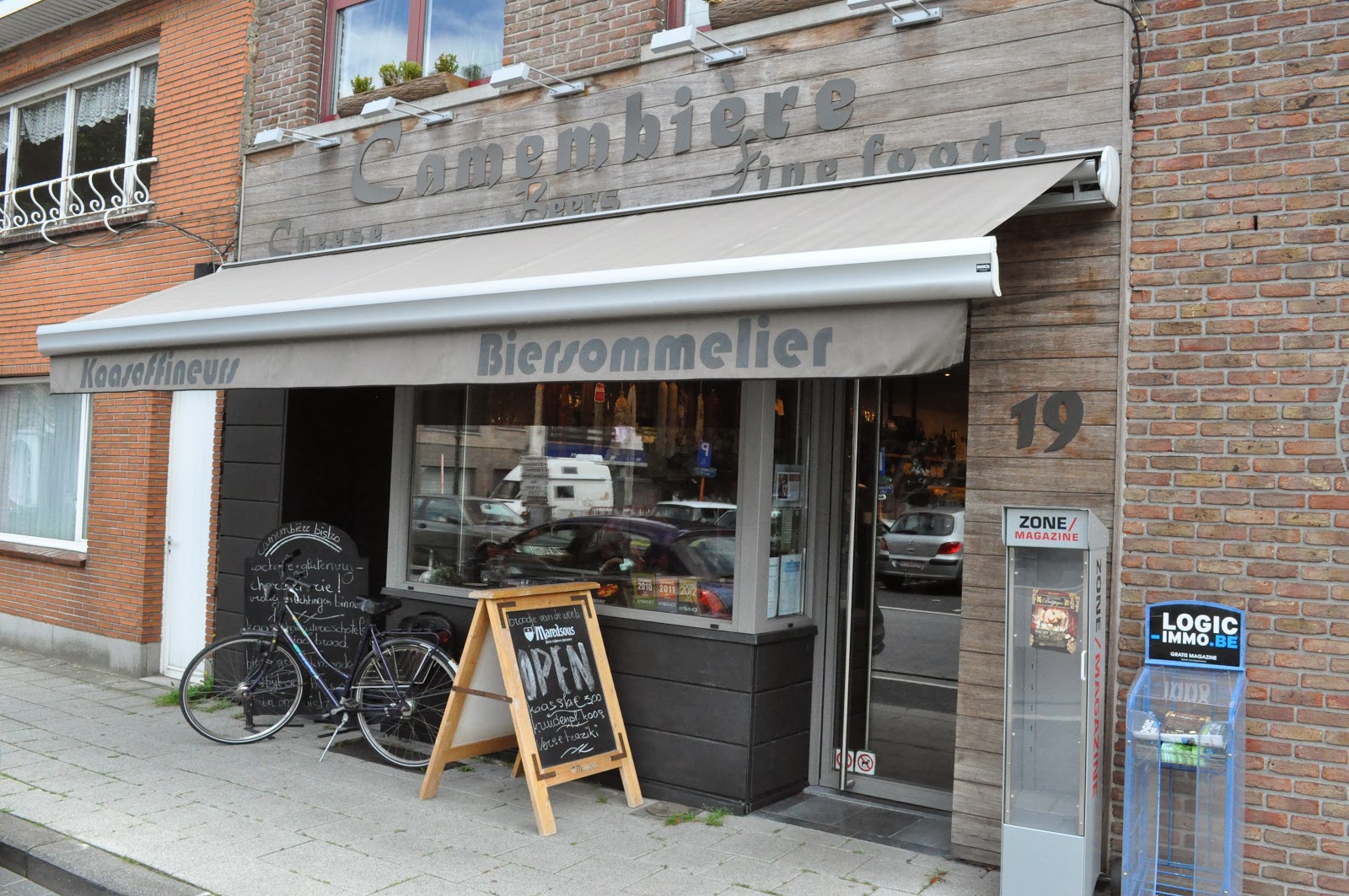
I might have been there. In the sprawl that shoots south of Antwerp, there is a town along the A12 road called Aartselaar (which in the competition for Belgian-town alphabetical supremacy is up there with, I don't know, Aalst I guess). In this town is a groovy little shop called Camembière. It's a good name, a name that signals exactly where this is going. Out front the canopy even says, "Kaasaffineurs, Biersommelier." This is a place of expertise.

Philippe Wagman and Mieke Foubert are the proprietors. Philippe is a former construction engineer who followed a childhood dream to be a cheese monger. "I let everything fall down for this, and it's much nicer. ... I wanted to do this since I was 13, but I think my parents didn't take me seriously. And I never got it out of my head. ... I found cheeses amazing. How do you start with cow's milk and end up with so many different kinds of cheese?"

The beer part came later, "about 10 years ago," he said. "I was frustrated when I ate good cheeses and a bottle of wine. I like wine, I have nothing against wine, but I found it frustrating. ... The wine didn't match with most of the cheese I was eating. So I thought, 'Why don't I try it with beer?' And I found some really nice combinations. Everybody speaks about beer and cheese combinations now. Ten years ago it was, 'What are you doing?'"

In Limburg there is a vocational school for professionals called SYNTRA, and it's one of the programs in Belgium offering a "beer sommelier" or zytholog certification these days. Philippe got one to put alongside his long-held interest in cheese affinage.

The question of what to pair with what is the subject of ongoing experimentation, but Philippe and Mieke have no shortage of ready suggestions. Some useful results came out of a judged tasting that put 12 of the country's more interesting beers against a varying selection of three cheeses per beer. The judges then ranked the strongest pairings. The top four pairings, for your reference:
Rodenbach Grand Cru with Grevenbroecker
Westmalle Tripel with Old Brussels
Oud Beersel Oude Geuze with fenugreek Geitenkass
Saison Dupont with Pas de Rouge
I took some Grevenbroecker and Pas de Rouge with me to munch with the chosen beers that evening. Not an organized tasting but I had a hell of a time. And one of these days I ought to scribble something on Belgian craft cheese and its parallels with Belgian craft beer. But not today.

Camembière stocks about 90 beers at last check, with plenty of good taste and an eye toward what pairs well. Also a wide variety of cheeses, plus charcuterie and other nibbles. There is a small table or two for sitting down for a snack, but large groups will need to make other plans. There is a De Lijn bus stop nearby for the ambitious, but those with cars will find it easier. It's pretty close to Steenhuffel, if you want to check out Palm's Brouwershuis tap. Bring some stinky cheese in there with you, while you're at it.
So for me, that's a highlight. More to come. Here's an explanation if you're wondering what I'm up to.

Tuesday, February 5, 2013

Highlight #12: Best of the Browns.

Q: What's better than a shiny, modern, specialist beer café with hundreds of great bottles and taps from which to choose?

A: An utterly brown one, with a small handful of great beers.

I'd like you to meet the Brumaire. This is a real neighborhood brown café in Saint-Gilles, a corner bar that looks like so many others, with Stella Artois signage and smoky regulars sitting out front, holding court. Once inside you have the requisite gaming machine and little bags of potato chips or sausage bites. Inexplicably for such a small place, there are stage lights and a disco ball.

I counted 37 beers on the wall-mounted list, made from those slats and little plastic letters like you used to see in hospitals and elementary schools. To my shame, I took no photo of this. But among the usuals were Jambe de Bois, Witkap Stimulo, Hommelbier, and a few Trappists than included Orval, Rochefort 10, Westmalle Tripel, and Chimays blue and white, the latter being on draft.

Plus Saison Dupont.

Translations are imperfect, but maybe this is like an American hole-in-the-wall dive that happens to have Sierra Nevada on draft, or a British "community pub" that happens to have well-kept Taylor's Landlord. A jewel.

So there I was in the middle of a long foot-trek from central Brussels to Moeder Lambic St-Gilles -- which is just a couple of blocks away -- drinking a Saison Dupont in one of the brownest cafés in Brussels, which automatically puts it in the running for brownest worldwide. Nibbling on those awful, wonderful little sausage bites. Trying to figure out where they boogie when the disco ball goes into effect.

So for me, that's a highlight. More to come. Here's an explanation if you're wondering what I'm up to.

Highlights of a Belgian Swing.

So my current project is a big fat book full of Belgian stuff. Tell you more soon. What I want to say just this moment is that I got to 156 beery cafés across that country on a three-week swing last summer. That includes several that were shut, and it also includes 15 breweries. I mean "café" in the broadest sense here, encompassing restaurants and brewery taps and night spots and museums with bars (in Belgium, a museum without a bar is a paltry thing).

The number is nothing to boast about. Many were unremarkable, and I drank a lot of water and coffee between scenic country drives and city tram rides. I could think of better things to do, and often I did. But as work goes, you know, it was all right. OK, better than all right. My point is this: There were highlights.

So I have some pretty swell suggestions for you.

I've come up with a list of a dozen favorite places from my summer swing. I hope they'll help other folks plan their own. Bear in mind, I'm not calling these the 12 best cafés in Belgium (although a few would certainly be on that hypothetical list). These are just my 12 highlights, the spots and moments that pleased me most. Best I can remember. In no particular order.

I'm going to ration them out, partly because I hate really long posts. Also because each of them deserves a post of its own.

Stay tuned for the first:

11. House of (Beer and) Cheese: about Camembière.
12. Best of the Browns: about the Brumaire.

Monday, December 10, 2012

Parallel-o-gram.

Sometimes beer writers seem to constantly compare their subject to the wine world. Other times we go to great lengths to avoid it.

Here's the thing: Sometimes it's apples-oranges. Other times it's apples-apples.

If you are geeky about beer and read about wine at all -- or vice versa -- how many times have you read about one drink and slapped yourself, realizing the same truth basically applies to the other? As economic commodities and cultural artifacts, fermented drinks of moderate alcohol have lots in common. Lots and lots.

That was an aside. Which is a poor way to start. Hey, have you heard about how Asians are buying everything that is cool? It's an exaggeration, mostly. But it's a narrative that's going to stick around for a while. For example: Some savvy Asian businessfolks just bought Wine Advocate. Eric Asimov of the New York Times writes that "the move recognizes a new reality, that the center of orbit for critics like Mr. Parker is now in Asia rather than North America."

You don't think similar things are happening with beer? Have you noticed where Belgian Beer Cafés (tm) are opening lately? For more on that, you may owe it to yourself to get a really large stocking, one large enough to fit the superb new World Atlas of Beer.

But that wasn't what caused my self-slapping. It was this bit, which touches on one of my pet topics:

In one sense, Mr. Parker and other like-minded critics planted the seeds of their own obsolescence. The 100-point scale and the vocabulary of tasting notes — those brief wine descriptions that break down what’s in the glass to a series of aromas and flavors — are meaningful only until people start to develop a sense of their own taste. Wine-lovers discovered that these were merely intermediate tools, and that with confidence and ease comes a curiosity that goes beyond what’s in the glass.
Sub in Ratebeer and Beer Advocate for Parker et al, and let me know what you think.

Full disclosure: I was recently asked to be an admin on Ratebeer. I declined, so that I wouldn't feel obligated to write things like, "Full disclosure, I was recently asked to be an admin on Ratebeer..."

Monday, November 19, 2012

Familiar Faces in the Ardennes.

During the summer visit to Belgium I had a rental car for several days. The day I arrived in Luxembourg was not one of them. Starting that morning in Antwerp, I took trains to Gouvy. Then I hopped a bus to Houffalize, and from there lugged my wheeled suitcase down a bumpy path between pastures -- the cows were amused -- to the Vieille Forge.

The Vieille Forge is a B&B which is also home to the new-ish Inter-Pol nanobrewery, but I'll get back to that. This is in Mont, a village with a strategic location for beer travelers. From the lodge you can take a 15-minute walk through more pastures and down the hill to another village named Achouffe, which has basically been taken over by the eponymous brewery. Beer lovers can go to the Taverne there and enjoy Chouffe Houblon. Soup lovers who prefer copious coriander to hops can drink one of the other beers instead.

Here I wrote a rant about the travesty that La Chouffe has become. Then I deleted it. Much more interesting to talk about Pol's little brewery, as he puts it, the second largest one in the Achouffe valley.

Beer-traveler types were coming to Vieille Forge for years before there was a brewery here. Andy Neil, he of Bier-Mania tours, was the one who turned us on to it. Tine and Pol let us camp in the yard when the inn was full once, for the Grand Choufferie. (And what a piss-up that is, lots of folks drinking 8% Chouffe from kegs like it's lager, then attempting to climb stacks of beer crates. Highly recommended.) People came for proximity to Achouffe and Luxembourg's many natural charms, and for Tine's cooking, but they stayed to hear Pol talk about his brewery. He dreamt, then planned, then worked on that stone shed in the driveway -- the old forge itself. It opened in 2010.

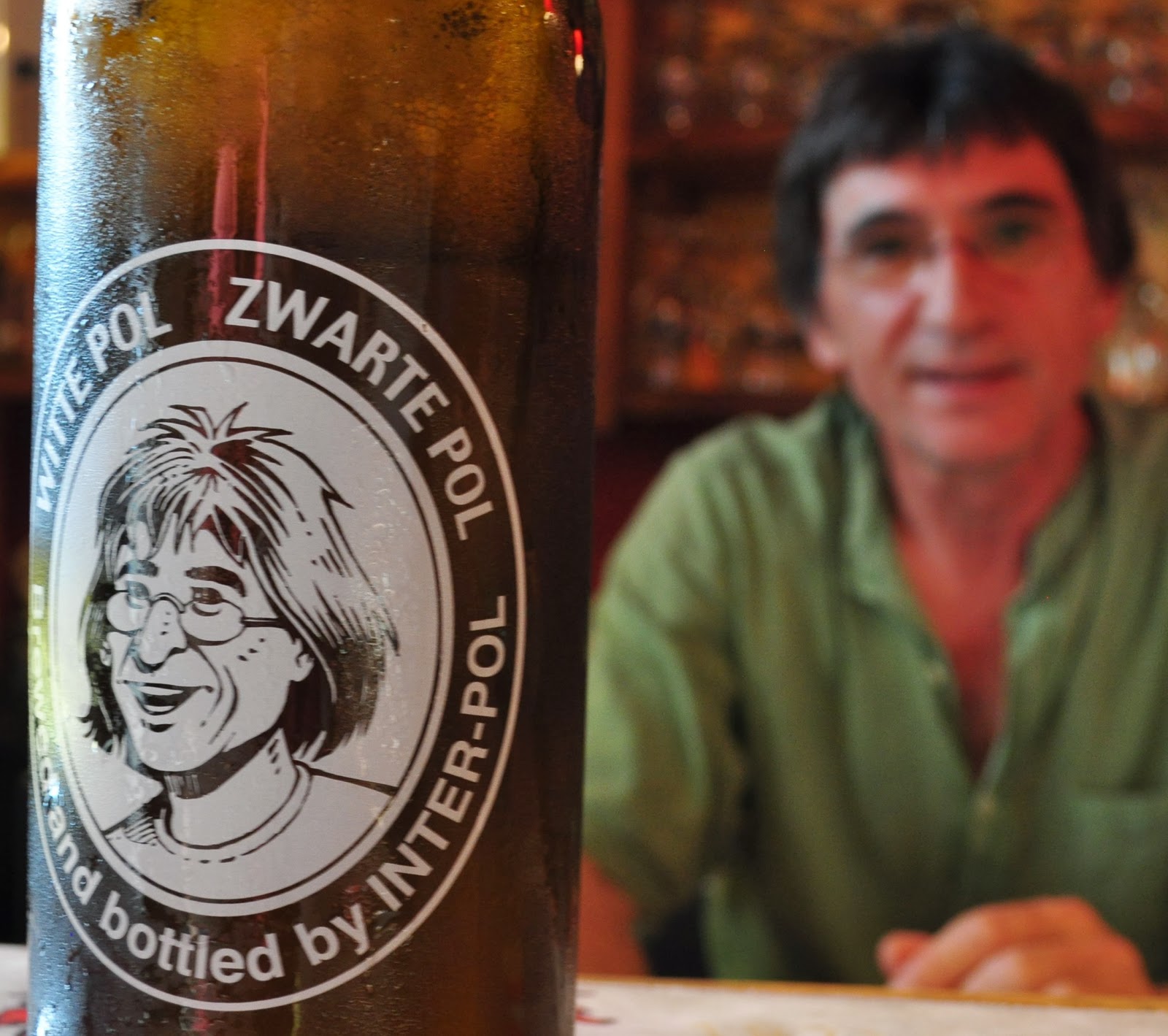
The main two beers are the Witte Pol and the Zwarte Pol. The white is classic Belgian Witbier laced with citrus zest, refreshing, while the black one gets light sweetness from milk sugar and some bitterness from cacao. Both were intriguing and more than a bit mysterious, the types of beers you can sit and get to know over a couple of bottles. Neither was overdone in its spicing. Maybe Pol knows things that the brewery down the hill, where he leads tours from time to time, has forgotten.

Pol's beers (and those of the neighbor, and its parent company) are available at the Grand Café, the petit bar that takes up half the old forge. It opens Fridays and Saturdays at 5 p.m., very handy for guests who have been touring all day. It seems to have a few local regulars as well. Past and present brewers from down the hill have been known to appear.

It's worth noting that this makes a serviceable HQ for exploring the Ardennes, whether it's war monuments, trout fishing, or breweries you want. Or some combination thereof. Near enough are Trois Fourquets, Ferme au Chêne, Fantôme, Oxymore, and others.

Good thing my friends showed up the same night I did. With a car.

Thursday, November 1, 2012

Like "Happy Ending," Get It?

Back at Costa Rica's first craft beer fest in April, folks were buzzing about, well, a lot of things. In fact there were many buzzes going around. And there was much interest in the big-flavored beers of Treintaycinco.

Pictured are the beers that comprise the familia completa. Attractive, eye-catching labels. Note the strengths on those suckers: Two are at 8% and two others are at 9.8%. Then there is the Japi Endin, a lighter "tropical lager" made with local tapa de dulce sugar and checking in under 5%. I've tasted a few of them a different times and here are my early impressions: They have been very good at times, based on solid and interesting recipes. Consistency isn't quite there yet. But when these babies go legal, they will immediately be among the most interesting beers available in Costa Rica.

Co-founder Ignacio Castro Cortiñas says that the permit process is far along, and that "very soon" the nanobrewery will have news on where to find the beers. I'll try to keep you posted but a safer bet is their Facebook page.

Also, here's more info from a post that David Ackley did on his Local Beer Blog in June.