Monday, December 10, 2012

Parallel-o-gram.

Sometimes beer writers seem to constantly compare their subject to the wine world. Other times we go to great lengths to avoid it.

Here's the thing: Sometimes it's apples-oranges. Other times it's apples-apples.

If you are geeky about beer and read about wine at all -- or vice versa -- how many times have you read about one drink and slapped yourself, realizing the same truth basically applies to the other? As economic commodities and cultural artifacts, fermented drinks of moderate alcohol have lots in common. Lots and lots.

That was an aside. Which is a poor way to start. Hey, have you heard about how Asians are buying everything that is cool? It's an exaggeration, mostly. But it's a narrative that's going to stick around for a while. For example: Some savvy Asian businessfolks just bought Wine Advocate. Eric Asimov of the New York Times writes that "the move recognizes a new reality, that the center of orbit for critics like Mr. Parker is now in Asia rather than North America."

You don't think similar things are happening with beer? Have you noticed where Belgian Beer Cafés (tm) are opening lately? For more on that, you may owe it to yourself to get a really large stocking, one large enough to fit the superb new World Atlas of Beer.

But that wasn't what caused my self-slapping. It was this bit, which touches on one of my pet topics:

In one sense, Mr. Parker and other like-minded critics planted the seeds of their own obsolescence. The 100-point scale and the vocabulary of tasting notes — those brief wine descriptions that break down what’s in the glass to a series of aromas and flavors — are meaningful only until people start to develop a sense of their own taste. Wine-lovers discovered that these were merely intermediate tools, and that with confidence and ease comes a curiosity that goes beyond what’s in the glass.
Sub in Ratebeer and Beer Advocate for Parker et al, and let me know what you think.

Full disclosure: I was recently asked to be an admin on Ratebeer. I declined, so that I wouldn't feel obligated to write things like, "Full disclosure, I was recently asked to be an admin on Ratebeer..."

Monday, November 19, 2012

Familiar Faces in the Ardennes.

During the summer visit to Belgium I had a rental car for several days. The day I arrived in Luxembourg was not one of them. Starting that morning in Antwerp, I took trains to Gouvy. Then I hopped a bus to Houffalize, and from there lugged my wheeled suitcase down a bumpy path between pastures -- the cows were amused -- to the Vieille Forge.

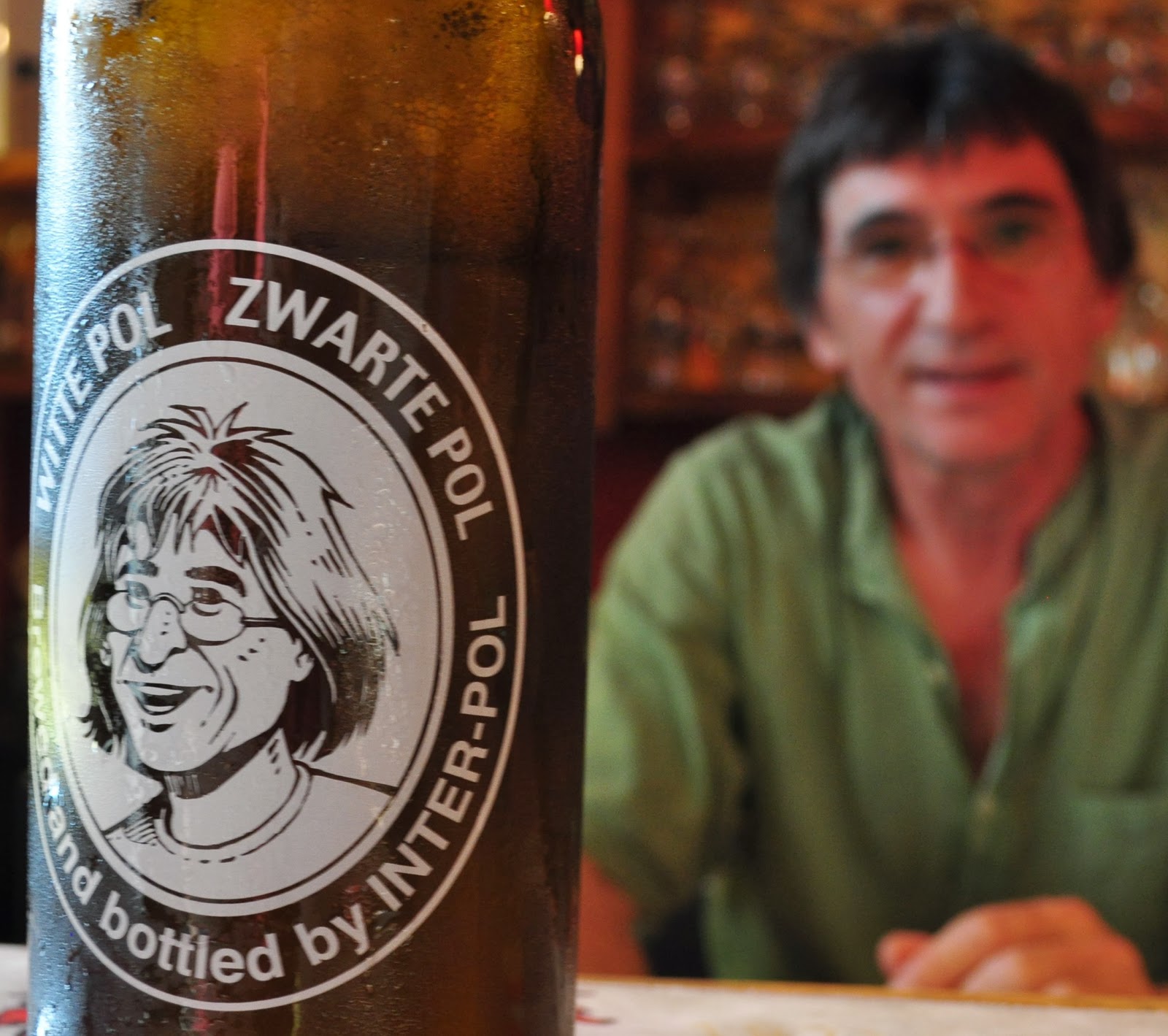
The Vieille Forge is a B&B which is also home to the new-ish Inter-Pol nanobrewery, but I'll get back to that. This is in Mont, a village with a strategic location for beer travelers. From the lodge you can take a 15-minute walk through more pastures and down the hill to another village named Achouffe, which has basically been taken over by the eponymous brewery. Beer lovers can go to the Taverne there and enjoy Chouffe Houblon. Soup lovers who prefer copious coriander to hops can drink one of the other beers instead.

Here I wrote a rant about the travesty that La Chouffe has become. Then I deleted it. Much more interesting to talk about Pol's little brewery, as he puts it, the second largest one in the Achouffe valley.

Beer-traveler types were coming to Vieille Forge for years before there was a brewery here. Andy Neil, he of Bier-Mania tours, was the one who turned us on to it. Tine and Pol let us camp in the yard when the inn was full once, for the Grand Choufferie. (And what a piss-up that is, lots of folks drinking 8% Chouffe from kegs like it's lager, then attempting to climb stacks of beer crates. Highly recommended.) People came for proximity to Achouffe and Luxembourg's many natural charms, and for Tine's cooking, but they stayed to hear Pol talk about his brewery. He dreamt, then planned, then worked on that stone shed in the driveway -- the old forge itself. It opened in 2010.

The main two beers are the Witte Pol and the Zwarte Pol. The white is classic Belgian Witbier laced with citrus zest, refreshing, while the black one gets light sweetness from milk sugar and some bitterness from cacao. Both were intriguing and more than a bit mysterious, the types of beers you can sit and get to know over a couple of bottles. Neither was overdone in its spicing. Maybe Pol knows things that the brewery down the hill, where he leads tours from time to time, has forgotten.

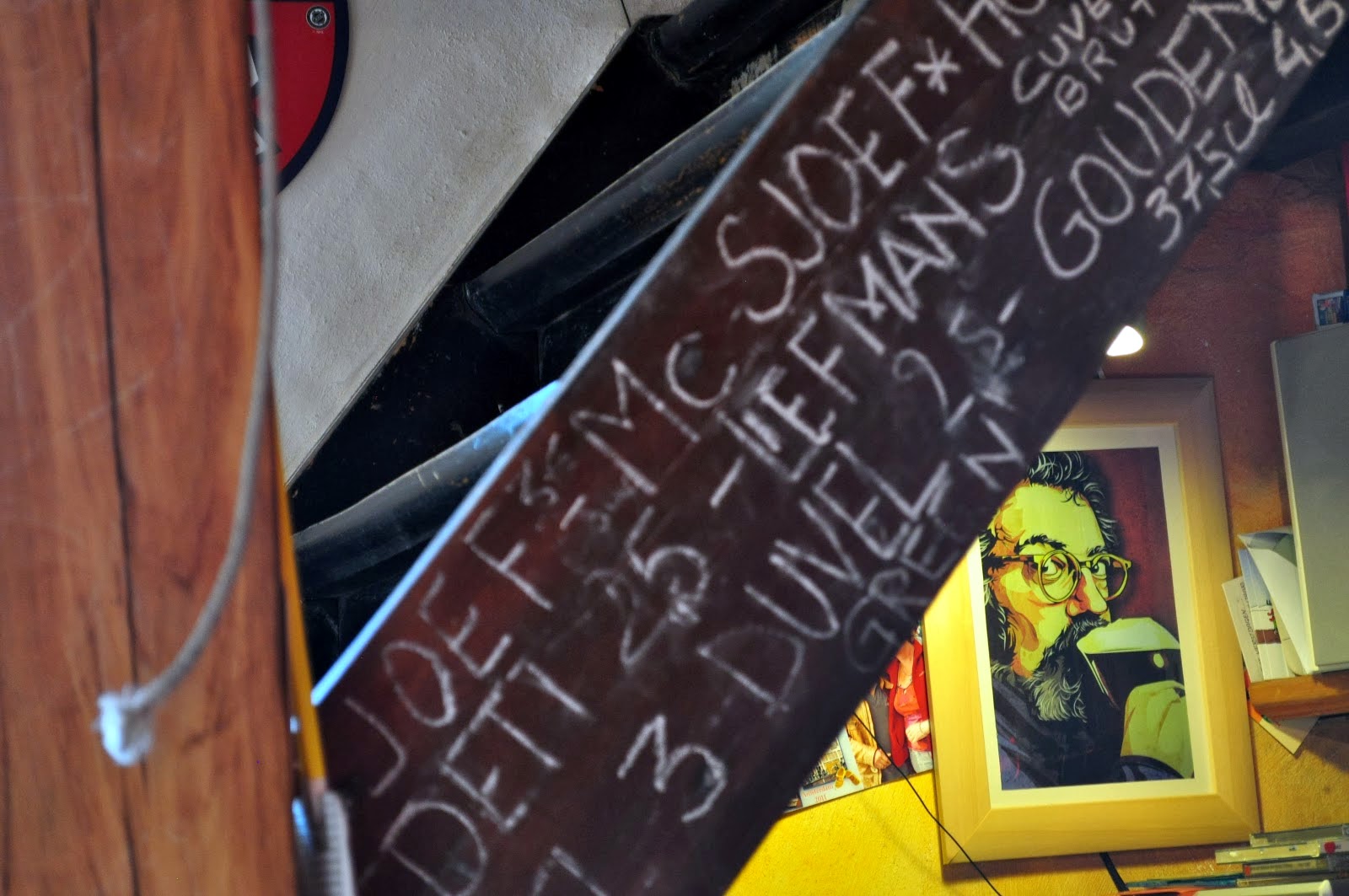
Pol's beers (and those of the neighbor, and its parent company) are available at the Grand Café, the petit bar that takes up half the old forge. It opens Fridays and Saturdays at 5 p.m., very handy for guests who have been touring all day. It seems to have a few local regulars as well. Past and present brewers from down the hill have been known to appear.

It's worth noting that this makes a serviceable HQ for exploring the Ardennes, whether it's war monuments, trout fishing, or breweries you want. Or some combination thereof. Near enough are Trois Fourquets, Ferme au Chêne, Fantôme, Oxymore, and others.

Good thing my friends showed up the same night I did. With a car.

Thursday, November 1, 2012

Like "Happy Ending," Get It?

Back at Costa Rica's first craft beer fest in April, folks were buzzing about, well, a lot of things. In fact there were many buzzes going around. And there was much interest in the big-flavored beers of Treintaycinco.

Pictured are the beers that comprise the familia completa. Attractive, eye-catching labels. Note the strengths on those suckers: Two are at 8% and two others are at 9.8%. Then there is the Japi Endin, a lighter "tropical lager" made with local tapa de dulce sugar and checking in under 5%. I've tasted a few of them a different times and here are my early impressions: They have been very good at times, based on solid and interesting recipes. Consistency isn't quite there yet. But when these babies go legal, they will immediately be among the most interesting beers available in Costa Rica.

Co-founder Ignacio Castro Cortiñas says that the permit process is far along, and that "very soon" the nanobrewery will have news on where to find the beers. I'll try to keep you posted but a safer bet is their Facebook page.

Also, here's more info from a post that David Ackley did on his Local Beer Blog in June.

Wednesday, October 31, 2012

I Refuse to Name This Post "Reflections on" Something or Other.

Love that tiled mirror ceiling. Excellent for peeping into glasses and shirts and taking not-so-clever photos.
Some of you U.K. folks will see the face on the right and know right away where I am in this photo. For the rest of you: That's Tom Cadden, manager and geek extraordinaire at the Craft Beer Company in Clerkenwell, London. It's an ideal visit for any tourist who wants to see what the evolving British version of the craft beer movement is all about, while still having the option of well-kept cask-conditioned ales.

There were 21 keg taps and 16 cask pumps, by my count. Tom told me that about 40 percent of what he sells is cask, versus 30 percent in keg. The fridges were full of real lambics and other fun bottles; those are another 20 percent of sales. The other 10 percent would be wine and spirits, i.e. "I don't think I like beer but my friends brought me." (Occasionally, they're the ones dragging their friends along next time.)

I drank Moor Top, a 3.6%-strength, aromatic deep-gold ale from Buxton. It is among that new-ish wave of citrus-hopped, session-strength ale that has become one of mankind's greater cultural achievements, the culmination of millenia of just messing around. It seemed to be in many places when I was there in August. Suited me well.

I asked Tom (and lots of other people) what "craft beer" means in Britain. He said it's an unanswerable question and then proceeded to answer it pretty well. More to come, including better but still not-so-clever photos, in an upcoming issue of Draft.

Wednesday, October 10, 2012

Caution: Overlords at Work.

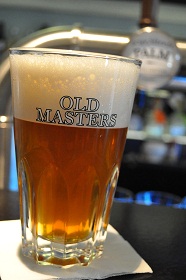
Old Masters! I'm unsure of which way to go on that. It has two distinct connotations for me: dead Renaissance artists, or scary science-fiction-fantasy overlords. Right. I'm going with the second one.

You'll heed the Old Masters and drink this if you know what's good for ye! 

OK. That's a Palm Ongefilterd from the tap at Belga Queen in Brussels (please turn to p. 24 in your textbooks). The BQ is uppity Belgian cooking with impressive surroundings and magical toilets stalls, if you don't know. Beer list is Palm-Rodenbach-Boon-heavy. Mixed reviews on service but the food is usually good, they say. I can only vouch for the raw bar. You can do worse than a large, iced pile of various mollusks and a bottle of Mariage Parfait. (That was my birthday lunch one year. It was a good one.)

Back to the Old Masters. It is a label Palm has given to three its rare draft beers, which for years now have only been available to a small number of pubs. Among geeks the most coveted Old Master tick would be, I guess, the Rodenbach Foederbier, typically found only at the Zalm in Roeselaere (occasionally there are rumors of appearances elsewhere). The third member of the Old Masters is Boon lambic, three years of age. Besides Belga Queen and the Zalm, other cafés that get one or more of these beers include the Vosken in Gent, the brewery's own Brouwershuis in Steenhuffel, the Horta in Antwerp, and Engelbewaarder way up in Amsterdam. That's about it, as far as I know.

Actually Boon Oude Lambiek is available on draught in several places around Brussels and Payottenland, but only in those few pubs does it get the "Old Masters" treatment.

Are you ready for the strangeness?

The Palm website has a page devoted to the Old Masters. (Caution: Marketeers at work.) As the special glassware suggests, there is a CONCEPT at work here. So let's see what one of Belgium's largest breweries does with what are arguably its three most interesting (noting that interesting ≠ best) beers.

FLAT BEERS FROM THE PAST, NOW TRENDIER THAN EVER.
oh boy.
Appearances are important too!

Flat beers are very digestible and moreover they spare you that bloated feeling in your stomach. However, a nice head looks good, which is why OLD MASTERS are served through a nozzle spraying fine jets of beer that absorb nitrogen from the air.
Really? And did you know... 
The consumption of carbonated drinks is dropping globally:
Flat water sells better than sparkling water
Lemonades are being replaced by fruit juices
This why the “Old Masters” are trendier than ever!
Maybe I should say that I'm just poking fun and don't really have any great point to make. But promoting three beers of pedigree and mystique as "flat," and comparing them to water just before serving them via sparkler, is a head-scratching decision.

Or maybe it's best if we not question the overlords and just drink the stuff.

Wednesday, September 12, 2012

C-A-S-K in the U.S.A.

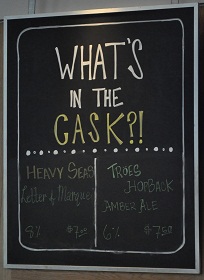
Cask ale in America. Tricky topic, if you're used to understanding cask ale as something like the "real ale" defined by CAMRA. Good luck with that in the States, outside of certain festivals and a very few pubs where casks actually manage to turn over quickly because people are drinking them quickly. That's why God invented cask ale, after all. So people could drink it quickly.

I'm still working it out -- I have this feeling that the answers are all up there in my brain, but the parts are still disassembled -- but in the meantime I share three ideas. Directions of thought. Conversation starters. Theories. Things. Meanwhile I'd like to thank Tom Cizauskas for educating me in July when I was in the D.C. area (Fireworks Pizza and Galaxy Hut that evening, if you're curious). My lack of clarity on this topic is no fault of his.

1. American cask ale is not new. We can see it as trendy, if we want, since beer-specialist bars have been adding more of them lately, or so it seems. But let's call it a comeback. Cask has been part of the American micro/craft beer movement for a good long while. Got that, whippersnappers? Let's keep this in perspective. In Maryland alone: Bertha's Mussels, not what anyone would call a beer bar, has had cask ale since the 1980s. The Wharf Rat, also on Fell's Point, has had a beer engine since the mid-1990s, Cizauskas said. Maryland had Steve Parkes' British Brewing Company starting in 1988, later re-named Oxford. According to Cizauskas, British was Maryland's first micro since Prohibition, and its first beer was the cask-conditioned Oxford Class Amber. Let me re-state that: Maryland's first modern craft beer 24 years ago was a cask ale. I suspect we'd find similar stories elsewhere, especially on the East Coast.

2. Without breathers, there would be much less American cask ale. CAMRA wouldn't approve, so let's call it a practical American compromise. Cask breathers allow a small amount of Co2 to enter the cask, extending its life. Most American beer bars simply can't turn over a cask in a few days, not if they want to keep them around at all times. One example on my summer jaunt: Old Speckled Hen at the Farmers Gastropub in my hometown, Springfield, Missouri. Not my favorite beer, but I love the idea that I can have a pint of cask ale there. Without a breather it wouldn't be possible -- except on those special nights when Mother's brings in a firkin. Folks drink it the same night, naturally, as they do for special cask events at brewpubs and beer bars across the country these days. Special cask events are nice. Reliable, ever-present casks are even nicer.

3. Choices for what to put in those casks is often interesting, often poor. In Missouri and again in the D.C. area, most of the cask options I saw this summer were 6% or stronger. Often they were IPAs or otherwise high in bitterness, missing the extra bubbles that are frankly needed to scrape the resin off the tongue and help make them drinkable. The thinking, if there is any, might be, "Casks are special, the beer in them ought to be special, and special beer ought to be strong and hoppy!" Meanwhile brewers and bars are missing a chance to showcase the beauty and complexity of lighter ales, where cask has its real advantage over keg. Another way to think about it: Cask conditioning can help not-so-special beers taste very special indeed.

Like I say, I'm still working it out. I'd love to hear more thoughts and arguments on American cask ale from absolutely anyone. More than anything, I think, I'm unclear on what all those beer bars out there are actually doing with their casks -- breathers? turning it over faster than I think? key kegs? -- so it would be interesting to hear some examples.

Top photo is from Pratt Street Ale House, home of Olivers Ales, Max's Taphouse in Baltimore. Lower one is from Fireworks Pizza in Arlington, Virginia. Text CORRECTED to say that Wharf Rat has had cask since mid-1990s, not 1980s.

Friday, September 7, 2012

Atlanta Airport to Get First Belgian Beer Café™

It's been a year or so since I ranted about the news that the InBev-run Belgian Beer Café chain wanted to open locations in the United States. Specifically, I targeted a beer list "weighted with saccharine and fakery." It was a gut reaction fueled by the realization that many people would get their first taste of Belgian beer from a global behemoth that profits from efficiency and mediocrity and efficient mediocrity rather than beer of much character.

Sorry, Leffe. Sorry, Hoegaarden and Stella. You have your fans but you are what you are.

A necessary clarification: A-B InBev cannot legally own their own cafés to sell their own beer in the United States. So the firm that works with InBev to design the cafés, Creneau International (and give them credit, many are stunning), has the rights in the United States. It sounds like sleight of hand but I reckon the lawyers have their ducks lined neatly in a row.

I haven't changed my mind about that sample beer list. It is patently weak next to the better-curated Belgian beer lists around the world, in bars or restaurants where people know what they are doing. I see a few reliable gems greatly outnumbered by dull cack of sugar and spice. I grant that a beer list can be like a Rorschach test and we will not all see the same picture. But when I apply my perspective, as far as it goes, that is what gets spat out. I stand by it.

On the other hand...

Well, I'm a practical man. I travel a lot. And just as I'm more inclined to drink a Hoegaarden in Costa Rica than in Belgium, due to complex algorithms of relative quality and availability, well...

Airports. Against all odds they remain beer wastelands, generally speaking. Yet they are those places in the middle of those sorts of days when we most often think, "Fuck, man. I need a beer."

And they are where the first U.S. Belgian Beer Cafés are going.

The very first one will be in Atlanta, scheduled to open in two weeks. The second will open in Newark.

I fly through Atlanta sometimes. Like most airports, it is shit for beer. Best you can find there, last I checked, is a Sweetwater IPA in one of those closed-up bars where they quarantine the smokers. Not an entirely pleasant experience.

But the announcement says this: The beer list in that Atlanta bar will include, among some other stuff, Chimay Blue on draft and Saison Dupont in bottles.

Well, like I say, I'm a practical man. I know where I'm headed next time I'm passing through ATL. I'll probably be plucking down $14 or some absurd price for a certain farmhouse ale archetype.

After the airports, there are plans to open locations in New York City and Philadelphia. And just a wild guess but I'm guessing they won't be right next door to Gramercy Tavern or the Monk's Café.

And a final thought: I am not anti-corporate. I am anti-mediocrity.

Thursday, September 6, 2012

In Heaven There Is No Football, Either.

I was just writing something up on the Kunstemaecker in Steenkerke, West Flanders. That beer café's slogan is "In de Hemel is geen bier." In Heaven there is no beer, just like that old polka song. (That's why we drink it here.) That got me to wondering about the song itself.

There is a version of that song in the language of most if not all major beer countries, plus a few more. Maybe you knew that. I didn't.

Here is something else I didn't know, and since I'm currently about as wound up as I could be for the start of (American) football season, I'll share it: The song, like so many other pleasant and beery things, is deeply embedded in the traditions of American college sports.

Thank you, Wikipedia, which as always we do not take as gospel but use relentlessly anyway:

Students at the University of North Dakota sing the song after every Fighting Sioux goal during hockey games at the Ralph Engelstad Arena.

The song is frequently played by the Yale Precision Marching Band with the added verse: "At Harvard there is no ale (No ale?!) / That's why we go to Yale / And when our livers fail / We'll still be glad we went to Yale"

The University of Nebraska Cornhusker Marching Band sings this song after being dismissed at the end of every home game.

The song is played frequently at home hockey games at the University of Minnesota-Duluth (UMD), University of Minnesota, and University of Wisconsin by the schools' bands.

This song has been adopted by the University of Iowa as their victory song, to be played by the band after Iowa Hawkeyes wins. Some know it as the Hawkeye Victory Polka.

It is an unofficial school song of Michigan Technological University, as played by the Huskies Pep Band. Along with the original lyrics, the students sing 4 original verses whenever the song is played.

The song is a performed at all home games at the University of Wyoming[1], where it is known as the 'beer song'. The fans chant for the song to be played, until the band leader relents. This cycle may happen multiple times during a sporting event.

The song In Heaven There Is No Beer is played at every football and basketball game at Fort Hays State University, Kansas.

The song is also performed after every NDSU Bison football and basketball victory by the North Dakota State University Gold Star Marching Band and Bison Pep Band.

In Heaven There is No Beer is played after every football and basketball game at Sam Houston State University in Huntsville, Texas.

The University of Idaho's Vandal Marching Band performs this song after every sporting event they play at, regardless of whether the Vandals win or lose. The band's Sousaphone Section also performs it at various tailgate partys before home football games.

The Ohio Northern University Marching Band during the fourth quarter of every home football game, while the pep band often plays it at the end of men's and women's basketball games.

The song is performed monophonically at football games and various homecoming events by the pep band of Wartburg College in Waverly, IA.

The song is often played at home UNH Hockey games by the Beast of the East Band.

The song is often played by the West Virginia University Tuba Corps.


Thursday, August 30, 2012

As Seen On TV.

We noticed a lot of ink in K.C. Just one of many things that reminded us that we (a) are old and (b) have been away from America for a while. Lots of tatts. Oh, they've been around forever but they're definitely more mainstream than they used to be. Especially in the hospitality industry. For whatever reason.

Or maybe it's just the places we like to hang out.

Vader and Boba. Any dude who doesn't know who they are, she can immediately strike off the list.

The tattoos were on legs which were on a server who was working at Grinders, a Kansas City dive that is among one of the few actual dives to be featured on that show with that guy who is supposed to go to these types of places. She was nice enough to let me snap a photo.

I drank a Deschutes Twilight Ale, an easy-going golden-pale with plenty of hop flavor and aroma and so a bit like Mirror Pond and that was A-OK with me. Possibly inspired by the previously mentioned artwork, I went to the Dark Side afterward with a Green Flash Double Stout. A naughty thing, that one, thick and sweetish and smooth with plenty of chocolate flavor and stealthy alcohol. For the inner child. Appropriate, given what I ate with it.

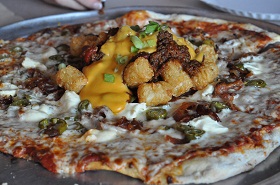
That pizza: Bacon, cream cheese and jalapeño with a pile of tater tots, chili, cheese and green onions in the middle of it. The tot thing is a Grinders option and no doubt part of what attracted that guy on that show. It is an eyebrow-raiser. It is something you order because you know that you will remember it, and if it turns out great, well, that's just a bonus.

The pizza was what I ate in college. The tot pile was what I ate in elementary school. And then a strong, almost dessert-like black beer. If that isn't comfort food, I don't know what is.

Places like this existed 15 years ago. Never doubt it, teenagers. But the beer options would have been fewer. Now, 10 or 20 taps of real beer and loads of bottles... shoot, that's mainstream.

Or maybe it's just the places we like to hang out.

Thursday, August 23, 2012

Snapshots of the Postmodern: Craig Allan.

That fourth bottle going from left to right, with the colorful swirly label and 37.5cl bottle, is the Cuvée d'Oscar from brewer Craig Allan. As I wrote in my recent article for Draft, Allan is a Scot living in France who brews at Proef in Belgium. So there is another slice of the transnational craft beer movement for you.

Those bottles were displayed on the mantle behind the bar at the Kerelshof in Cassel last December, something like the "beers o' da month" shelf. Hence the Christmas beers. The Oscar isn't a seasonal but rather one of Allan's regulars, alongside his American-citrus-hopped Agent Provocateur. The Oscar, meanwhile, might be an ideal route for anyone wanting to get to know Nelson Sauvin -- grapes and berries? -- a bit better. Allan is big on hop flavor and aroma, with plenty of late- and dry-hopping. Meanwhile the bitterness is kept in check. I found each beer to be a joy.

While there we heard some gossip that Allan, who lives in Picardy -- about halfway between Lille and Paris, if that helps -- wanted to open a brewhouse of his own in Cassel. A couple of days ago I finally remembered to ask him about it. It turns out the place he was looking at hadn't been used in about 10 years, needed a lot of repairs, and the owner was asking for too much money for all that. "So unfortunately c'est tombé a l'eau as they say in France," Allan said in an email, "a shame because as you know Cassel would be perfect for a brewery..."

And more, in case you're curious:
I am currently based in Picardy where my French wife is from and am back to looking at an installation in this region. My wife has started a new job here so we will probably stay around here now. ... At the moment I have around 40 professional clients in Paris, about an hour's drive away, including some very good restaurants (my wife studied wine in Burgundy and used to sell to some of the best Parisian restaurants so had some good contacts) and I think there is enormous potential in Paris so perhaps Picardy isn't too bad after all! I am looking into brewing in a brewery in the north of France to supplement the beers produced at de Proef but the ultimate aim is still to have my own brewery.
Like a lot of people, Craig Allan is making some fine beers at someone else's brewery. Like a lot of people, in fact, he is doing so in Lochristi, Belgium, at Proef. Yet I find myself hoping that he gets his own brewhouse going and settles down. Why? Will the beer be better, or have more character? No guarantees there. I'm a hedonist and I shouldn't care. But I do.

I like it when a brewer faces more risk and challenge to achieve a vision for what ends up in my glass. Maybe it's because I'm a writer and adversity makes a better story. Or maybe I'm just a sadist. Anyway, I find it reassuring that he says he wants his own place. There seem to be many other brewers these days content to do otherwise.