
There aren't really that many beery guidebooks out there, although if you read this blog much you might think otherwise. I forgive you for thinking it. I'm more or less determined to spread the word about any of them I can find. Because I like beer and I like travel, as you might have gathered. And somehow I sense that you like those things too. So, thanks to a tip from Sylvain Dupuis, I'll now call your attention to La Route des Grands Crus de la Biére, by Martin Thibault and David Lévesque Gendron. I can't vouch for it. But I can tell you about it.
As you might have deduced, the book is in French. That doesn't bother me, because I know very well that some of you speak and read French. Hell, I know that some of you, mes amis, are French. But even those of you who can't read a word will find that things like beautiful photographs, addresses and contact information are more or less universal.
The guide focuses on the craft breweries and beer cafés of Quebec and New England. Really handy if you already live there. And what is it about a beery guidebook that gets you to thinking about new vacation possibilities? For example, now I know I can visit Latvia as well as Quebec. I will not go thirsty, and I will have a sense of purpose.
Want to go to the official book launch? It'll be at 4 p.m., November 13, at the Benelux in Montreal. Quebecois ale on cask. See you there. I wish.
Friday, October 29, 2010
Plan a Beery Trip to Quebec From Your Armchair.


Thursday, October 28, 2010
Of Gypsies and Race Car Drivers and Auteurs.
Last week I wrote a bit about the phenomenon of brewers without breweries... a.k.a. gypsies or nomads or itinerants or whatever you want to call them. Now I'm really going to pile it on, so in the interest of civility I need to re-iterate that many of them are great people making great beer. If they weren't, I wouldn't even care about this issue. I just can't help wanting bigger and better things for them. To summarize my argument: Some of the nomads are making great beer, but they have it somewhat easier than brewers who are risking it all to start their own house and make it work. That latter group deserves more fame and honor and, maybe, more of our money. So there is one point. And I would note that it's a point unrelated to the quality of the beer.
So what about quality, then? Is a brewer with his own kit and greater control over it going to make better beer? As hedonists we might say that as long as they are making great beer for us to drink, we don't care where they make it. Persuasive.
However, that is a hedonism of immediate gratification. I'd propose a more thoughtful, long-term hedonism that allows us and our children's children to enjoy those great beers for years to come. Anyway, the troubles of starting and owning a brewery might lead to better beer--even in the short term. Right?
Stan Hieronymous weighed in Monday and got some more chatter going. He suggested that those running their own place are more likely to have a relationship with the maltsters and hopsters--and thus more likely to get exactly the raw ingredients they want for better control over their work. Another point.
More compelling: Stan suggested that every brewery has a rhythm, and if a brewer is only visiting then he is not part of that rhythm. I would elaborate a little more. Brewing is a fairly complicated process. Lots of pesky steps and big machines. Every place has its quirks, and usually there are lots of lots of them. Someone intimately familiar with her own system is going to know those quirks cold, how to minimize some of them, and how to use others as a strength.
It's not a perfect analogy, but try to imagine a race car driver who rents his wheels every weekend. He would probably be at a disadvantage.
We haven't even touched on the issue of product consistency. If it's important to us as drinkers, then surely we've got to favor the brewer-owners, not just the brewers.
But that's business talk. One of the supposed strengths of nomadic brewing is greater creative control over recipes. This suggests an image of artists who don't want to fuss with bookkeeping or employees. No doubt there is something to it--not everyone is cut out for business. Me, for example. But it leads me to another sloppy analogy, this time from film criticism: the auteur. There are directors and producers and writers and actors. Then there are directors who have the freedom and tools to implement their total artistic vision.
Likewise, there are brewers and there are owners. But maybe to really control your artistic vision, if that's what interests you, you also need to control your brewery.
Finally, for a more philosophical perspective, I've got to quote a comment on Stan's blog from "ollllo," whom I suspect is David Schollmeyer from the Phoenix-based Beer PHXation. Obviously he's a fellow thirsty pilgrim: "I don’t want to live in a world where beer (even great beer) magically appears from somewhere. I want to know where it comes from and I want to go where it lives. ... Beer is one of the last great reasons to travel."
Unless you are a brewer. In that case it is one of the last great reasons to stay put.
Pictured: Pieces of brewing kit at the Brasserie de la Senne in March. Their quirks are yet to be revealed. Yvan de Baets and Bernard Leboucq have been making great beer on the road for a few years now. Once they get things running--probably in the next few weeks--I think we can expect it to improve.
Wednesday, October 27, 2010
Westvleteren to Go On Sale in... the Supermarket?
If there is any justice in this world, this news will destroy the ridiculous secondary market for the stuff. But I doubt it. According to Dutch-language newspaper Het Nieuwsblad this morning, the brothers at Westvleteren have been in talks with the Colruyt supermarket chain to sell their coveted beers. The goal is simply to raise additional money. A monk told the newspaper via telephone that the monastery's needs were greater than previously thought.
If my translation is correct, the article notes that nothing has been finalized. It's not clear how the beer would be sold, but one option is said to be a box with Westvleteren's three different beers and a glass.
It's not clear if this will really happen--it's hard to believe after all these years--but if so it will be big news in the world of craft beer. Most of us know, deep down, that there is no such thing as "best beer in the world." However if you shut a bunch of geeks in a room and forced them to a consensus at gunpoint, getting past all that "uh, whatever beer is in front of me" garbage, "Westvleteren 12" would be the most likely answer--as it has been on Ratebeer and Beer Advocate for several years now.
For my part, I wish we could fast-forward ahead many centuries to the part where the monks are kegging the Blond and shipping it straight to our local shops so we can take it home and plug it into our kegerators.
In the mean time, take a gander at my old spiel on how to get Westvleteren the honest way. (Damn, was that more than two years ago?) It remains accurate, for now, and one of Thirsty Pilgrim's most visited posts.
Tuesday, October 26, 2010
Montezuma's Repose.
 When you walk into a postcard, I think, you really ought to sit down and have lunch in it.
We rented a house further down the peninsula and came to Montezuma to check out the town and the waterfalls. Just across from the waterfall access is the Hotel Amor de Mar. Late morning-ish, we came there looking for food and coffee. We passed through the open-air hallway and entered the postcard. Green grass, blue skies, big waves, palm trees and the whole bit. Lots of places to sit out there. We drank strong java and frescos and munched on thick sandwiches made from homemade bread. The tykes napped in hammocks. The surf crashed into the rocks. It was all right. We can't vouch for the rooms or houses at Amor de Mar yet, but we hope to try them out one day. At least we can vouch for the view. The rates run from $40 in low season, sharing a bathroom, to $200 for a beach house in high season. So you can hunt for your price point. Montezuma town is a five-minute walk.
Never did find a decent beer in Montezuma, or anywhere on the peninsula for that matter. But we did pay a visit to the brewers of Perra Hermosa in the surfer town Malpaís. Recently returned from a spell in Boston, the Ackermans are working away on a 15-gallon system and preparing to upgrade it. More on them very soon.
Saturday, October 23, 2010
Using 'Session' as Adjective and Verb and Game Plan.
I made a session beer, and today I will session it. It's dark and roasty but highly drinkable at 3% strength. Call it a mild if you want. That's what I call it, because it's one easy syllable and I can't be bothered with more. Less talk, more quaff.
Usually I wouldn't bore you with my own haphazard homebrew adventures. But it's Saturday, and so few of you read blogs on Saturdays. We all know that blogs are best read and written within cubicles on weekdays when there are more important things to do.
This mild is an experiment gone a-right -- maybe the first time I've ever been able to say that -- made from the second runnings of a strong stout. The alcohol was around 2.5% and tasted watery after primary fermentation, so I added some tapa de dulce -- raw cane sugar. So there's a nice local touch and it sounds much better than "invert" or "sucrose." Probably tastes better too. And adds color. Anyway: success.
I never thought I'd be a big adjunct guy, but there are so many around here to play with. That strong stout -- first runnings, remember? -- also took some tapa de dulce and next will get some organic cocoa nibs sanitized/extracted in guaro -- a local hooch that's a cousin of white rum. Shooting for around 8% and a bruiser that will stand alone or embrace some nog come Yuletide.
Meanwhile, back to sessioning a session with the sessionable session beer: Today is gameday, even if lived vicariously from afar. We'll fire up the grill for a desperate tailgate, but instead of the Columns we have a sweeping view of Costa Rica's Valle Central. Gorgeous day. I'd be surprised if the mild lasts the next 24 hours.
Come on over.
Friday, October 22, 2010
This Weekend's Random Place Where I Would Like to Be: Cabool, Missouri.
 Just outside of Cabool is a shed next to a modest house surrounded by cow pastures. That shed is the home of Little Yeoman, an absolutely-no-frills three-barrel brewery throwing an Oktoberfest party tomorrow, October 23. In this era of multi-course beer-pairing dinners and rare boutique bottles, I'd nominate Chad Fredrick's hard-working operation as the Least Pretentious Brewery in the World.*
Bring your lawn chairs and your tents and be prepared to drink, eat and camp. According to a message I received from FOB (Friend of the Brewery) Kenneth Donnalley, the Cream Ale, Porter and American Pale Ale -- believe me when I say that all are robust and well-hopped -- will be going for $1.50 a draw. Munching options will include brats, barbecue, homemade potato chips and "the best baked beans in the world." Six bucks, all you can eat.
There is no website but Donnalley runs a fans' group on Facebook. The brewery's address is 12581 Dallas Lane. Look for the mailbox shaped like a keg and follow the gravel road.
*Have other nominees for this prestigious award? I'd love to hear about them. Send a photo too.
**Pictured: official glassware. So much for drinking with your eyes. Flavor is all that matters in the House of Yeoman. Wish I'd bought one for the collection. Next time for sure.
Thursday, October 21, 2010
The Oxen Are Thirsty in Atlanta and There's Beer in Texarkana.
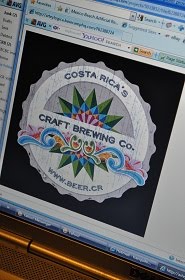 Here's a peek at the just-finalized logo for Costa Rica's Craft Brewing Company. I considered asking for the original image file, but the over-the-shoulder screen shot is so much more journalistic. Or is it voyeuristic? Eh, what's the difference?
Note the homage to the carreta, the finely painted ox cart that is one of Costa Rica's national symbols. That's going to look mighty fine on bottle caps one of these days. Or on pint glasses. Or T-shirts. Or -- dare I say it? -- on a carreta.
Imagine hauling some beer to local ferias in a specially painted ox cart with a real live ox. Gentlemen, put that one in your suggestion box.
Wednesday, October 20, 2010
Honor Thy Brewers (Especially the Ones with Digs of Their Own).
It's one thing to brew. It's not always easy, and some are (much) better at it than others. But it can be learned. It's another thing entirely to run a successful brewery -- small or large -- keep it clean, keep it running, keep the books, and make the business last. Brewers and families with the guts and fortitude to raise the capital and pull that off deserve some extra honor and attention for it.
Some families have been doing it for generations, but it's those initial risk-takers who really impress me. I'm thinking, for example, of the guys at Struise, whose flavorful beers became popular in geekdom before they bit the bullet and opened their own place in Oostvleteren, West Flanders, last year. I'm thinking of my friends Yvan and Bernard of Brasserie de la Senne, who have gone through hell to open their dream brewery in Brussels next month. And lately I'm thinking about these guys trying to make and sell craft beer in Costa Rica of all places. We owe them all congratulations and crossed fingers. Buying their beer wouldn't hurt, either. Clay Risen's interesting "gypsy brewers" piece today on the Atlantic website is what brought this all to mind.
Basically, all the reasons I think brewers with breweries deserve more applause are the flip side of what's so attractive about itinerant brewing. It takes a lot less money, and therefore less risk. Someone else can maintain the machines. Someone else can pay the rent. So we are enjoying the work of a greater number of creative types who otherwise might not be brewing at all -- or at least, not be making exactly the recipes they want to make. Which occasionally are exactly the recipes we want to drink.
I met Brian "Stillwater" Strumke in Baltimore one night in July. I asked him a bit about his brewing situation. I bugged him about what I thought were high prices on expensively packaged small-batch beers. And then I paid up anyway, of course, and thoroughly enjoyed his Staateside Saison on a few occasions in the D.C. area.
So the hedonist in me wins out. As usual. But with a caveat.
The nomadic brewers making a good product deserve our duckets and pats on the backs too. But maybe they also deserve to be bothered repeatedly with a simple question, if for no other reason than to nudge them toward further greatness:
"So, um, since your beer's so good... when are you going to start your own brewery?"
Tuesday, October 19, 2010
How to Make and What to Do with Pineapple Salsa.
 Slice a pineapple, a jalapeño, and some red bell peppers. Drizzle them all with a bit of oil. Grill them over fire. Chop them up and toss with fresh cilantro, the juice of half a lime, and a few drops of your favorite hot sauce. Serve it on top of a char-grilled steak.
Wash it down with a Guinness Foreign Extra Stout.
The end.
'
Damn. I'll never fill a cookbook that way. I'd have to tart it up with stuff like, "Be sure to wear gloves while handling hot peppers, especially if you wear contact lenses," and "The roasted espresso notes in the stout complement the sweet pineapple, while finding harmony with the char on the steak." And so on.
Sunday, October 17, 2010
Of Gashed Tires and Sour Fruit Saison.
We were almost totally lost for the third time in two days when it happened. I was driving our truck down a hill from Cartago, looking out over a valley of what appeared to be tugurios, a.k.a. favelas, a.k.a. slums, when I turned and ran over a concrete embankment. It jutted out into the road and was impossible to see from the driver's side. The concrete was not the problem. It was the hidden steel rebar that warped the running board and gashed the tire. The air didn't hiss out so much as whoosh.
So my friend Ryan and I we were late for our meeting on Friday with the guys from the soon-to-be-launched Costa Rica's Craft Brewing Company. Oh, first we put on a show for the locals. Ho hum, just a couple of rich gringos getting dirty, changing a tire on a busy road, don't mind us. I gave two kids a few coins for standing around and trying to look helpful. And we were on our way.
"Here in Costa Rica it's always something, man," brewery co-owner Brandon Nappy said. Naturally I thought of my tire. But he was talking about all the red tape and expense of starting a legitimate business in this country, where bureaucracy and stamps and ribbons are a fine art. "You have to be thick-skinned and level-headed and just go with it."
Nappy ought to know. The 29-year-old previously had a charter fishing business out of Quepos on the Pacific Coast. That lasted about four months. Then the boat sank. Literally.
Much of what we talked about while lingering at the brewery for a few hours, in no hurry to get back on the road during a downpour, was the challenge of doing it all right. On the up and up. Having all the permits. Hiring a lawyer to help cross t's and dot i's. Being ready for inspections, should they come. Getting your trademarks straight. So if the Craft Brewing Company fails as a business, it ought to be for business reasons -- not legal ones.
Then there is the whole problem of, you know, actually selling beer. Finding all the expats, tourists and ticos who would buy more flavorful beer in a heartbeat. Starting to educate the others. And publicizing in an environment where the Imperial logo is practically the national flag.
For example: Draft beer is not that common in Costa Rica. The locals call it cerveza cruda and either treat it as something special or, more often, shun it and drink from the bottle. However, the Craft Brewing Company is dedicated to establishing its beers on draft before selling bottles in the future.
"We have to get them away from the idea that draft beer is raw beer," brewer C.S. Derrick said. Then there is teaching bars about the importance of glassware, and how to keep it sanitary. "One of the biggest focuses starting off here is education." My thoughts: Some of the best education and publicity will come from other customers. I'm not just talking about word of mouth. When you see someone else with a glass of that crisp, golden ale and its fluffy, persistent head -- and that froth is something no lager in Costa Rica can match -- you just want one for yourself. Meanwhile the pale ale -- named Segua for the Cartago folk legend about a she-monster who punishes drunken, unfaithful men -- has the sort of hopping and bitterness that American craft beer drinkers have come to expect as a matter of course. If all goes according to plan, both these beers will be available in November. Stay tuned to find out where.
Then, later, for those willing to pay more for something special, there may be a few surprises. Such as an experimental saison we tasted that had been aged on sour cas. It confirmed my previous suspicion that this acidic fruit begs to be used as a brewing ingredient. Derrick's cas saison was tart, dry and sparkling, with the lime-like aroma and taste of the cas providing an unmistakable lambic-like quality. Really encouraging stuff.
On the way back, despite clear directions from Nappy and Derrick, we missed a turn and got lost in San José. Rough neighborhoods. Again. At night. Another opportunity for Costa Rica to show off its near total lack of street signs. Please understand that when I say we had to use a compass to find our way out, it is not a figure of speech.
By the way, beer enthusiasts and homebrewers in Costa Rica are welcome out at the brewery. Say hello and make friends. Maybe even pitch in and help out. The "address" is 800 meters west of Riteve, in Tejar El Guarco, just outside of Cartago. I recommend you use a GPS. And watch for embankments.


 Posts
Posts


